Log Splitter Won't Start or the Ram Won't Return: Fixes
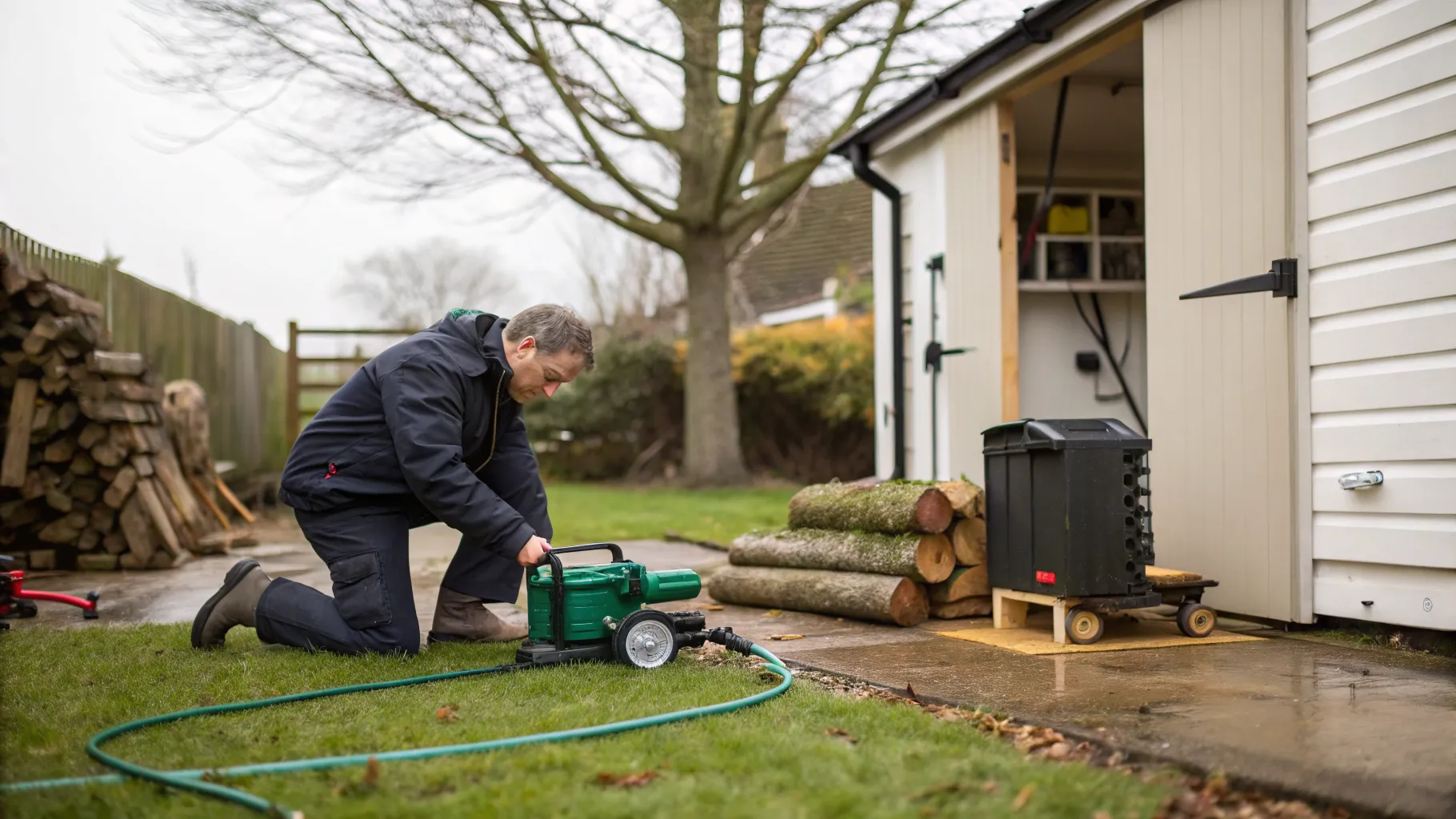
Most of these faults are not a broken machine. On a domestic electric log splitter, the same handful of causes come up again and again: a bleed screw left tight, oil that is low or cold, a thermal cutout that needs to cool, or an extension lead robbing the motor of voltage. Nearly all are free to fix and take ten minutes.
Before you touch the wedge, the carriage, the oil filler or anything inside the machine, pull the plug out of the mains. The two-hand controls are a safety guard, not an off switch. The ram can still move if the machine is live and a control gets knocked.
Find your symptom below and work down the list in order. Where a step is specific to a brand, we have said so.
The splitter won’t start, no power
Likely causes: blown plug fuse, a tripped RCD, a thermal cutout that has shut the motor off, or an extension lead dropping the voltage.
- Check the 13A plug fuse first. Pull the plug, open the fuse holder, and replace a blown fuse with a fresh 13A. A slow-blow 13A is best because the motor pulls a surge on start-up. Forest Master recommend exactly this.
- Check your consumer unit. Has the RCD or a breaker tripped? Reset it. These motors draw roughly 1.5 to 2.3kW, so they want a sound 13A circuit of their own. Do not run the splitter on the same socket as another heavy load.
- Suspect the extension lead. This is the quiet killer. Forest Master’s own rule: any extension cable must be a thicker gauge than the splitter’s own power lead, kept short, and fully uncoiled. A long thin lead, or one left wound on the reel, drops the voltage so the motor cannot reach speed. It hums, strains and trips. If the machine starts fine plugged straight into a wall socket, your lead is the problem.
- Let it cool if it has been working hard. See the thermal cutout section below. A motor that has just tripped on overload will not restart until it has cooled.
- Press the motor button first, then pull the lever. Let the motor spin up and get some momentum before you load it. Pulling the hydraulic lever against a cold, stationary motor is a common way to make it hum and blow the fuse.
If it still does nothing with a good fuse, a fresh circuit and no extension lead, the motor or switch is the fault and it is a repair or warranty job.
The ram won’t return or retract
This is the most searched fault, and on a cheap electric machine the cause is almost always hydraulic, not mechanical. These units have no powered retract; the pump only pushes the ram out, and a return spring pulls it back. Anything that stops oil moving freely will stop the spring doing its job.
- Check the bleed screw is open. This is the single most common cause and a ten-second fix. The bleed (or air-release) screw sits on the oil filler cap or dipstick. It must be loosened before use so air can move in and out of the tank as the ram cycles. Forest Master and Titan Pro say loosen it three to four turns; Hyundai’s manual for the HYLS7000HE says 1.5 turns. Check your own manual for the exact figure. If it is left tight, the tank cannot breathe and the ram goes sluggish, stalls, or will not fully come back.
- Check the oil level, and try the tilt test. Low oil is the classic cause. Quick field test: lift or prop the motor end up so the front end points slightly down, on level ground or a gentle uphill slope, then run it. If the ram returns normally like that, you are low on oil. Forest Master reckon wrong tilt or low oil is the issue around nine times out of ten.
- Warm the oil on a cold day. Cold, thick hydraulic oil moves slowly and the ram drags until it warms. Run a few cycles with no log in and it usually frees up.
- Bleed out an air lock. Trapped air stops a smooth return. With no log in, loosen the bleed valve and cycle the ram its full travel about 20 times. If it still hangs, leave the bleed valve open and stand the machine with the valve end uppermost for 24 hours so the air can rise out. This is Titan Pro’s procedure.
- Rule out mechanical binding. If the hydraulics are fine, check for something jamming the carriage. Pull the plug, then look underneath the pusher and down both sides of the carriage for wood splinters and packed sap. Check the small plastic spacers under the blade have not been dislodged. Clear sap off the bed and rub on a thin layer of workshop grease. Forest Master are clear: use grease, not WD-40. WD-40 thins out and attracts grit.
The ram won’t push, no splitting force
Likely causes: a control not fully released, a loose lever knob, low oil, or someone has wound the pressure relief valve.
- Fully release one control between strokes. Holding both controls down without letting one come back can stop the machine re-stroking. Let one go, then re-engage.
- Check the lever linkage. Forest Master’s checklist: the plastic knob on the lever should be fully screwed on (loose, and the lever cannot travel its full stroke), the valve stem should stay in contact with the lever face and pop back out when you release it, and the lever face should be bent a full 90 degrees.
- Check the oil level. Low oil means weak or no force as well as a poor return.
- Do not touch the pressure relief valve. It is factory-set. If force has dropped and someone has wound it, that is the cause, but resetting it is a job for the manufacturer. Adjusting it yourself is unsafe and voids the warranty.
It loses power or won’t split hardwood
First, a reality check. Most of these machines are 4 to 7 tonne. A 4 tonne Titan TTB762LSP from Screwfix or a 5 tonne Handy is not a 20 tonne petrol splitter. Big, knotty or green hardwood will beat it, and that is the machine’s limit, not a fault.
If it used to split fine and now struggles, work through these:
- Respect the rated log size. A log too long or too thick for the bed jams the cycle and trips the thermal cutout. Stay under the rated maximum length and diameter for your model.
- Turn knotty or green logs end for end. Knots split easier from one side. Some blades, like Forest Master’s DuoCut, are designed to split from either end.
- Check the oil. Low oil, old degraded oil or the wrong grade all sap force. See the oil table below.
- Look at the wedge. A dull or notched wedge bites poorly and stalls on tough rounds.
It’s leaking hydraulic oil
- Is it a brand-new machine leaking in transit? That is almost certainly the bleed screw left open in the box. It is not a fault. Tighten it and wipe up the oil. The screw must always be closed before the machine is moved or transported, or oil weeps out and air and moisture get drawn in as it cools.
- Check you have not overfilled it. Oil expands when hot. An over-full tank pushes oil out of the breather and seals. Fill to the dipstick mark, never to the brim.
- Worn ram or piston seals are a genuine fault and a repair, covered by warranty on a new machine.
- Never permanently seal the breather or vent. The oil has to expand when hot and contract when cold. Blocking the vent completely can stress and crack the tank.
It cuts out partway through a session
This is the thermal overload cutout, and it is doing its job. If the motor is worked too hard or overheats, a thermal protector cuts the power.
To reset it: switch off, unplug, and let the motor cool right down. Give it a good 15 to 30 minutes; the reset will not take while the motor is still hot. Cutting your session into shorter runs stops it tripping in the first place.
If it keeps tripping, do not just keep resetting it. Repeated trips usually mean one of these:
- Low oil straining the motor. Check the level.
- An over-long or over-thick log stalling the cycle. Cut your rounds shorter.
- A voltage-drop extension lead. Plug straight into the wall, or use a thicker, shorter, uncoiled lead.
Fix the cause and the trips stop.
Hydraulic oil quick reference
Grade and quantity genuinely differ between models, so always check your own manual and treat this as examples, not gospel. Using one universal figure is how people overfill or under-spec their machine.
| Model | Oil grade | Approx. quantity |
|---|---|---|
| Forest Master FM10 (7 ton) | ISO 46 | ~3.5 litres |
| Hyundai HYLS7000HE (7 tonne) | ISO 32 or 46 | 3.5 litres |
| Titan Pro TPLS7T (7 ton) | ISO 32 | per manual |
| The Handy THLS-C (5 ton) | per manual | ~2.9 litres |
The Handy recommend an oil change every 150 hours on the THLS-C, and most of these machines come pre-filled and want their first change somewhere in the 150 to 200 hour range. Check your own manual for the figure. Spare bleed valves are sold as a part if you have stripped or lost yours.
When to stop and contact the manufacturer
Work through the symptom list first; most faults clear there. Stop and call the manufacturer or a repairer if:
- The motor does nothing with a known-good 13A fuse, a clear circuit and no extension lead.
- Oil leaks from the ram or a seal, not from an open bleed screw or an overfilled tank.
- Splitting force has dropped and you suspect the pressure relief valve has been moved.
- You hear grinding, smell burning from the motor, or see damaged hydraulic hoses.
A machine still under warranty should go back to the seller rather than be opened up. For choosing the right size machine in the first place, see what tonnage log splitter you need. For more on the whole category, start at the log splitters hub, and if you are weighing up a replacement, the best electric log splitter UK guide covers the models named here.
As ever, any buy prompts on this site use our affiliate links.
Frequently asked questions
Why won’t my log splitter ram return to the start?
Nine times out of ten it is a closed bleed screw or low oil. Loosen the bleed screw a couple of turns first. Then prop the motor end up so the front points slightly down and try again; if it returns like that, you are low on oil. Cold, thick oil and an air lock are the next things to check.
What does the bleed screw do, and how many turns do I loosen it?
It lets air move in and out of the oil tank as the ram cycles. Leave it tight and the tank cannot breathe, so the ram goes sluggish or will not fully return. Loosen it before use: Forest Master and Titan Pro say three to four turns, Hyundai’s HYLS7000HE says 1.5 turns. Check your manual. Close it again before you move the machine.
How do I reset the thermal overload, and how long does it take to cool?
Switch off, unplug, and leave the motor to cool right down, a good 15 to 30 minutes. The reset will not work while it is still hot. If it keeps cutting out, the real cause is usually low oil, logs that are too big, or an extension lead dropping the voltage.
Can I use an extension lead with an electric log splitter?
Yes, but it must be thicker than the splitter’s own power lead, as short as you can manage, and fully uncoiled. A long thin lead, or one left wound on the reel, drops the voltage so the motor cannot reach speed. It will hum, strain and trip. If the machine runs fine straight off a wall socket, the lead is your fault.
Why is my new log splitter leaking oil straight out of the box?
The bleed screw was almost certainly left open for transit. Tighten it and wipe up the oil. It is not a fault. Just remember to loosen it again before you use the machine, and close it before you move it.
Why does my log splitter just hum and not move?
The motor is straining and cannot turn the pump. Usual causes are low oil, an under-voltage extension lead, or pulling the lever before the motor has spun up. Press the motor button first and let it get going, plug straight into the wall, and check the oil. A persistent hum will blow the plug fuse, so do not keep at it.
Why won’t my splitter split hardwood like it used to?
If it never could, that is the machine’s limit; a 4 to 7 tonne electric unit is not a petrol 20 tonner and big, knotty or green hardwood will beat it. If it used to manage and now struggles, check the oil level and grade, look for a dull wedge, keep logs within the rated size, and try turning knotty rounds end for end.
Do I really have to use both hands to operate it?
Yes. Two-hand control is built into log splitters sold in the UK to meet CE/UKCA safety conformity and the log splitter safety standard (BS EN 609-1). One hand holds the motor button, the other works the hydraulic lever, and the ram only moves when both are engaged. A machine that “won’t move” is very often just one control not being held. Never try to defeat or bypass it; it is the safety guard.
Want the seasoning calendar and our log-price watch in your inbox?
Join the Kindling List