Best Electric Log Splitter UK: Tested Picks for Every Job
Most UK homeowners splitting their own firewood do not need a petrol monster. A mains electric log splitter runs off a normal 13A plug, makes far less noise, and handles seasoned softwood and reasonably straight hardwood without breaking your back. The trick is matching the machine to the wood you actually burn, because a 4-tonne kindling splitter and a 7-tonne long-throat machine are different tools for different jobs.
This guide segments our picks by the job, not by a flat ranked list, so you can jump to the one that fits your wood and your garden.
When you buy through links on this page we may earn a commission. It never changes what we recommend or what you pay. See our affiliate disclosure.
How we chose
We started from the wood UK homeowners actually feed a stove: seasoned softwood, mixed hardwood, and the occasional awkward green round. We weighted three specs that decide whether a machine frustrates you: rated tonnage (treated as a manufacturer self-rating, not a measured figure), maximum log length (the “throat”, which is where most buyers get caught out), and maximum diameter. We only name models that are genuinely on sale in the UK with verified specs, and we say plainly where electric power runs out and you need petrol or kinetic instead. Every machine here runs off a standard domestic socket. None needs a special supply.
Best overall: Forest Master FM8T-TC
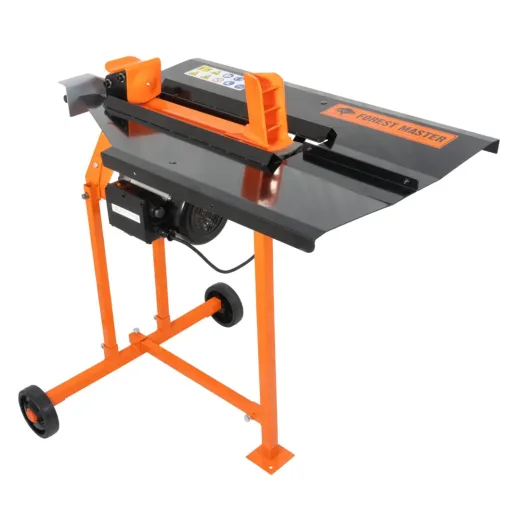
For most people heating one room with seasoned mixed wood, the Forest Master FM8T-TC is the machine to beat. It is a 5-tonne rated horizontal splitter with a 2.2kW motor, takes logs up to 370mm long and 300mm in diameter, and comes on a bench so you are not stooping. The FM8TW version adds a trolley stand if you want to wheel it about.
It is the popular everyday Forest Master for a reason: light enough to move, fast enough that you are not standing around between cycles, and the 370mm throat swallows standard UK stove lengths. Seasoned ash, beech and straight-grained oak within the diameter limit go through fine.
Limitations: 5 tonnes is mainstream, not heavy. Big, knotty or twisted-grain rounds at the top of the diameter range will slow it down or jam it, and very wet green hardwood is hard work. For that you want more tonnage or a different fuel type entirely.
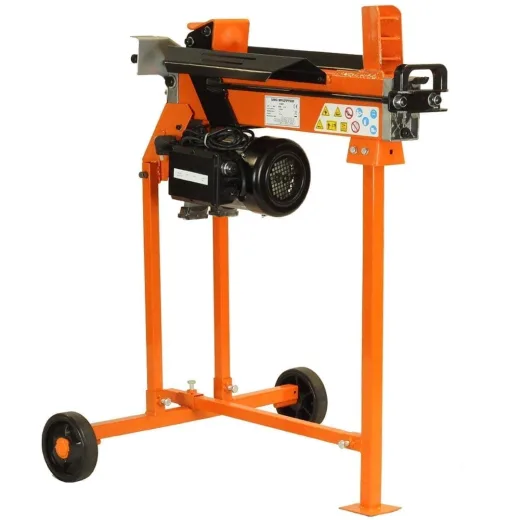
Best budget / entry-level: Titan TTB762LSP
The Titan TTB762LSP from Screwfix is the cheapest sensible route in. It is a 4-tonne rated horizontal machine with a 1.5kW induction motor, a 25 by 37cm log capacity, and it weighs around 50kg. For small dry softwood, offcuts and making kindling from already-split pieces, it does the job at an entry-level price.
Be clear-eyed about it. Four tonnes and a short throat mean this is not a hardwood machine. It is for people who burn mostly softwood, split modest volumes, and want to stop swinging an axe in the cold. The Draper 81203 (also sold as LS001) sits in the same bracket: 4 tonnes, 1.5kW, up to 370mm length and 50 to 250mm diameter, around 43kg, with the same basic build and the same caveats.
One naming note: Screwfix’s “Titan” range is a different company from “Titan Pro”. Do not confuse the two when you are shopping.
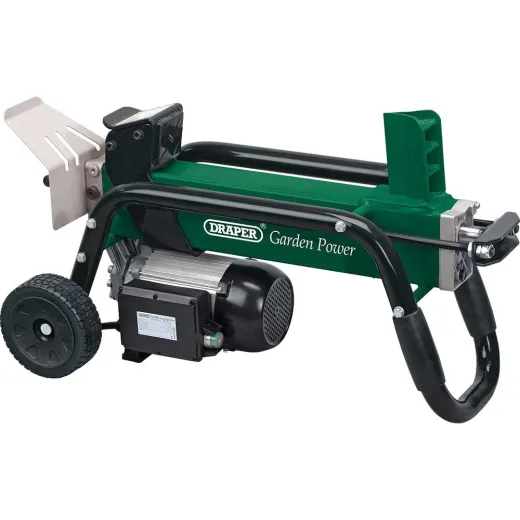
Best for hardwood and bigger logs: Hyundai HYLS7000HE
If you burn a lot of seasoned hardwood, step up to 7 tonnes and a long throat. The Hyundai HYLS7000HE is rated at 7 tonnes with a 2.3kW motor, takes logs up to 520mm long and 250mm in diameter, weighs around 60kg, and runs on 145mm wheels so you can move it. Cycle times are about 12 seconds forward and 7 seconds to retract. Hyundai markets it for oak, ash and beech, and it comes with a three-year home warranty, which is unusually good in this category.
The combination that matters here is 7 tonnes plus the 520mm throat plus the warranty. The long throat means you are not cutting your logs short to fit, and the extra tonnage gives you margin on denser, straighter hardwood rounds.
For an alternative with a clever blade, the Forest Master FM10T-7-TC is a 7-tonne Duocut: 2.2kW, up to 450mm length and 400mm diameter, around 67kg with bench, roughly a 15-second cycle, stand included. The Duocut wedge splits from both ends, so it punches above its tonnage on wide rounds. The Titan Pro 7t (from titan-pro.co.uk, not Screwfix) is a third option: 7 tonnes, 2.3kW, 520mm length, 50 to 250mm diameter, around 64kg, waist-height stand included.
Honest ceiling: even at 7 tonnes, big knotty or wet green hardwood is slow going. If you are processing large green oak rounds in volume, an electric machine is the wrong tool and you want petrol, PTO or kinetic.
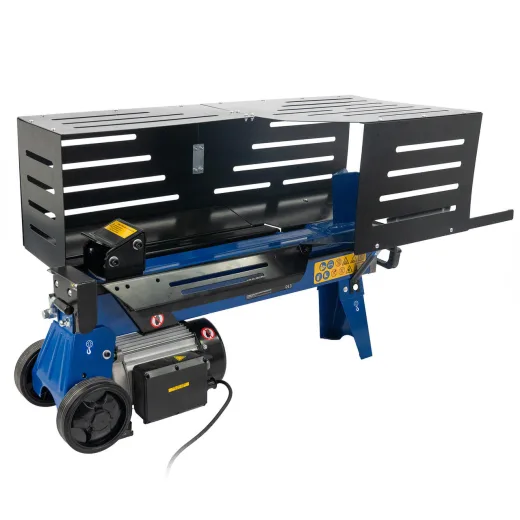
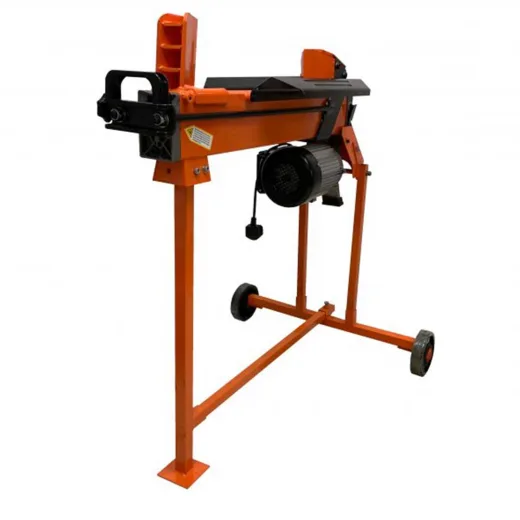
Best compact for small gardens: Forest Master FM5T-TC
When storage and weight matter more than outright capacity, the Forest Master FM5T-TC is the easy pick. It is rated at 5 tonnes with a 2.2kW motor, splits logs up to 300mm long, weighs around 32kg on its own (47kg with the bench), and runs a quick 9-second cycle. It arrives on a stand and is genuinely portable, so it tucks into a shed corner and lifts into a car boot without two people.
The trade-off is the 300mm throat. That is shorter than most stove logs, so you may end up cutting your rounds a touch shorter before splitting. If your wood is already cut short and your garden is tight, that is a fair swap for how light and fast this machine is.
Best manual alternative for light use
If you only split a few baskets of kindling a season, or you have no convenient outdoor socket, a manual splitter is worth a look before you buy any electric machine. Hydraulic hand splitters and slide-hammer “Smart Splitter” style tools cost a fraction of a powered machine, never trip an RCD, and store flat against a wall.
They are slow and they are physical, so this is genuinely for light use: kindling, small dry softwood, the odd round. For anything past a few hours of splitting at a time, the electric machines above pay for themselves in spared effort. We have not named a specific manual model here because the category turns over quickly; buy a well-reviewed current model from a UK retailer rather than the cheapest listing.
Quick comparison
| Model | Rated tonnage | Max log length | Type | Best for |
|---|---|---|---|---|
| Forest Master FM8T-TC | 5t | 370mm | Horizontal | Everyday seasoned mixed wood |
| Titan TTB762LSP | 4t | 370mm | Horizontal | Budget, dry softwood and kindling |
| Hyundai HYLS7000HE | 7t | 520mm | Horizontal | Seasoned hardwood, stove lengths |
| Forest Master FM5T-TC | 5t | 300mm | Horizontal | Small gardens, easy to store |
| Forest Master FM8VE | 8t | 550mm | Vertical | Big awkward rounds, no lifting |
| Manual splitter | n/a | varies | Manual | Occasional kindling, no socket |
For a fuller rundown of the category and the maths behind the numbers, see our log splitters hub and our guide to what tonnage log splitter you need.
How to choose
Tonnage by wood type. UK domestic electric splitters cluster at 4 to 8 tonnes rated force. Four tonnes suits dry softwood and kindling. Five tonnes is the mainstream all-rounder for seasoned mixed wood. Six to seven tonnes is the step-up for seasoned hardwood within the size limits. Eight tonnes (vertical) is the top of the consumer electric tree. Remember that tonnage is self-rated and not standardised between brands, so a 7-tonne electric and a 7-tonne petrol are not equivalent in real life. Treat the number as a guide, not a guarantee.
Log length (the throat) is the spec people forget. Short-throat machines take roughly 300 to 370mm logs (FM5 300mm, FM8 and Titan and Draper 370mm). The 520mm-class machines (Hyundai 5t and 7t, Titan Pro 7t, Sealey LS520H, Handy THLS-6G) suit standard UK stove lengths without you having to cut your rounds shorter. Forest Master’s Duocut models quote up to 450mm because the blade splits from both ends. Match the throat to the length you actually cut your logs.
Diameter. Most machines top out at 250 to 300mm diameter. The Forest Master Duocut claims up to 400mm thanks to its two-ended blade. In the real world, large knotty or twisted-grain rounds at the top of any machine’s range are slow or jam, whatever the headline figure says.
Duty cycle and real-world speed. Cycle times run from about 9 seconds (FM5) to 18 seconds (FM8VE). Manufacturers’ “up to 100 to 220 logs an hour” figures assume small, straight, easy logs. Your real hardwood rate will be a fraction of that, so do not buy on the logs-per-hour headline.
Horizontal versus vertical. Horizontal is standard for consumer electric and fine for logs you can lift onto a bench. Vertical machines (FM8VE, Sealey LS550V) let you split heavy rounds on the floor without lifting them, which saves your back on big timber, but they are heavier (the FM8VE is around 110kg) and need floor space.
Power and safety. All of these run off a standard 13A, 230V socket, so no special supply is needed. Use an RCD outdoors and avoid long thin extension leads, which drop voltage and can stall the motor. Always operate two-handed, keep the guard fitted, and never reach in to reposition a part-split log while the ram is moving. No loose gloves or clothing near the wedge. If a log jams, reverse the ram rather than trying any “trick” to free it.
If your machine plays up, our guide to a splitter that won’t start or whose ram won’t return covers the common causes.
Frequently asked questions
Are electric log splitters any good? Yes, for the right job. For seasoned softwood and reasonably straight-grained hardwood within the size limits, a good electric machine saves a lot of effort and runs off a normal socket. They struggle with big, knotty or green wet hardwood, which is where you would want petrol or kinetic instead.
How many tonnes do I need to split hardwood? For seasoned, straight-grained hardwood within the diameter limit, 5 to 7 tonnes of rated electric force is usually enough. For large green or knotty hardwood in volume, no domestic electric machine is the right answer; buying guides point to 20 tonnes and up, which means petrol or PTO.
Can an electric log splitter split green or wet wood? It can, but it is much harder than splitting seasoned wood, and it will be slow on anything dense. Either go up in tonnage or, better, season the wood first. Dry, straight-grained logs split far more easily.
What is the difference between a 5-tonne and a 7-tonne splitter? More force and usually a longer throat. A 5-tonne machine is the mainstream choice for seasoned mixed wood. A 7-tonne machine gives you margin on denser, wider hardwood rounds and the 7-tonne models here also tend to take longer 520mm logs.
Will a 5-tonne electric splitter split logs up to 10 inches across? Ten inches is around 250mm, which is within the diameter range of most 5-tonne machines on paper. In practice, a round that wide and dense, especially if it is knotty or wet, will be slow and may jam. Straight-grained seasoned wood at that size is fine; awkward grain is not.
Do electric log splitters need a special power supply? No. They run on a standard 13A UK three-pin plug at 230V from a normal domestic socket. Use an RCD outdoors and avoid long thin extension leads, because voltage drop can stall the motor.
Horizontal or vertical, which is better? Horizontal is fine if you can lift your rounds onto a bench, and it covers most domestic firewood. Vertical is better for heavy rounds you would rather not lift, because you split them on the floor. Vertical machines are heavier and need more floor space.
Why won’t my electric splitter split knotty or twisted logs? Because the grain is fighting you. Electric machines push a wedge in a straight line, and twisted or knotty grain does not split cleanly along that line. Owners describe awkward hardwood as soul-destroyingly slow on electric. Split easier wood on the machine and save the gnarly rounds for a maul or a more powerful splitter.
Is the Screwfix Titan log splitter any good? The current Titan TTB762LSP is a fair budget machine for small dry softwood and kindling at 4 tonnes. It is not a hardwood machine and the throat is short. If your wood is mostly hardwood or your logs are long, spend more on a 5 to 7-tonne long-throat model.
What does the Forest Master Duocut blade do? It splits the log from both ends at once rather than driving a single wedge through from one side. That lets the FM10D and FM10T-7 handle wider rounds (up to a claimed 400mm) than their tonnage alone would suggest, which is why they are a strong pick for larger seasoned rounds in their price band.
Want the seasoning calendar and our log-price watch in your inbox?
Join the Kindling List