Best Long Reach Lighter for Wood Burner: Butane Dies at 0C
Choosing the best long reach lighter for a wood burner is usually presented as a straight choice between a refillable gas lighter and a rechargeable electric arc. It is not quite that, because the two fail in completely different ways and the deciding factor is something almost no roundup mentions: how cold the room is when you light the stove, and what you are actually trying to set fire to.
Butane stops working near freezing. An electric arc never stops working but produces no flame, which changes what it can and cannot ignite. Get those two facts straight and the decision makes itself.
The temperature problem, which decides most of this
A gas lighter holds its fuel as a liquid under pressure. It works because that liquid boils back into a gas at room temperature and feeds the burner. The moment the ambient temperature falls towards the fuel’s boiling point, the vapour pressure in the tank collapses and the lighter stops feeding properly, first giving a weak yellow flame and then nothing.
The numbers are the point. Normal butane boils at about −0.5°C. Isobutane, which is blended into better refill gases, boils at about −11.7°C. Propane, which is blended in smaller quantities because it is much higher pressure, boils at about −42°C.
Now think about where a wood burner actually gets lit. A room that has been unheated since yesterday morning in January is often 8 to 12°C. A lighter left on the hearth of a cold room overnight is at that temperature. A lighter kept in an unheated porch, a garage or beside the log store can easily be at 2 or 3°C. A pure butane lighter at 3°C will feel sluggish and unreliable, and one that has been outside on a frosty morning will simply click and do nothing.
Three practical consequences:
- Do not store a gas lighter where you store the logs. Keep it indoors, ideally in a warm room, not on the hearth of a cold one.
- A cold gas lighter can be warmed in a pocket for two minutes and it will work again. This is the single most useful thing to know if yours “has broken” in December.
- Buy refill gas that names isobutane or a butane blend, not the cheapest pure butane, if the lighter lives anywhere cool.
An electric arc lighter has no fuel and no boiling point. Cold does reduce lithium cell capacity, so a very cold arc lighter gives fewer lights per charge, but it does not stop working. That is a genuine and often decisive advantage in an unheated cottage or a holiday let.
The flame problem, which decides the rest
An arc lighter does not produce a flame. It produces a plasma arc between two or four electrodes, a few millimetres across, and the arc is hot but has almost no thermal mass. It transfers heat to a very small area.
That matters enormously depending on what you present to it:
Paper and natural wool firelighters: an arc lights them instantly. A wood wool firelighter dipped in wax is essentially designed for a point ignition source and takes an arc without complaint.
Thin kindling directly: an arc will struggle. You can hold it on a splint and get a glow, but a flame takes time and often does not establish. A gas flame wraps around the wood and heats a whole face of it.
A compressed briquette or a heat log: an arc is close to useless on its own. These need a sustained flame from a firelighter, which we cover in how to light a wood burner with briquettes.
So the honest rule is: if you always light with a firelighter, an arc lighter is fine and arguably better. If you light with paper and kindling alone, or you like to nudge a reluctant fire back to life with a bit of direct flame, you want gas. Our guides to the best firelighters and the best kindling cover what you are actually igniting.
There is a related point about top-down lighting. If you build the fire with the firelighter and kindling on top of the logs, which produces a much cleaner light-up, the ignition point is at the top of the load and easy to reach. If you light from the bottom, you are reaching past a stack of logs into the back of a firebox, and reach becomes the whole issue.
How much reach do you actually need?
Enough to get the flame to the ignition point without your knuckles entering the firebox, and enough to keep your hand outside the door opening while the neck is inside.
Most domestic stove fireboxes are between 250mm and 400mm deep. A standard 100mm disposable lighter puts your fingers inside that space. A neck of 200mm or more keeps them out. The extra-long versions at around 300mm or more are genuinely useful for a deep or wide firebox, an inglenook, or a stove with a small door where you are working at an angle.
Flexibility matters more than raw length on a stove with a narrow door, because you need to angle the flame downwards or sideways once the neck is through the opening. A rigid neck of the right length is fine for a straight-on firebox and awkward for anything else.
Refillable gas: what to look for
Refillable, not disposable. A disposable long lighter is a false economy and adds a plastic body to the bin every few months. A refillable metal one lasts years, and refilling takes ten seconds.
Windproof or a jet flame. Not for wind exactly, but because the draught up a stove flue is real and a soft flame will be pulled sideways off your target. A dual flame or jet burner holds its shape.
An adjustable flame dial. You want a big flame for a firelighter and a small one for a candle.
A child resistant mechanism, which is a legal requirement. Under the retained EU Decision 2006/502/EC, lighters placed on the market must be child resistant, and the definition of a lighter covers utility lighters used for igniting materials such as “paper, wicks, candles and lanterns”, not just cigarettes. Novelty lighters that resemble toys, cartoon characters, animals, food or that play sounds or flash are banned outright. Lighters meeting BS EN 13869:2002 are presumed to comply, and the general safety standard is BS EN ISO 9994. There is an exemption for genuine luxury refillable lighters, but it is narrow: it requires a written guarantee of at least two years, a design intended for at least five years of safe use with replaceable non-consumable parts and an after-sales service. The Decision itself is on legislation.gov.uk if you want to read the definition.
The two long-reach gas lighters we would actually put on a hearth are Zippo’s, because they are metal, refillable, adjustable and carry a child safety button rather than relying on the luxury exemption.
Zippo Flex Neck Utility Lighter (black). A refillable butane lighter with a bendable neck, a rubberised body, a wind resistant flame and an adjustable flame dial. The flexible neck is the feature that matters on a stove with a small door, because you can set the angle once and leave it. It is sold unfilled, so buy butane at the same time; note that lighter fuel cannot be posted, so that part is a shop purchase or comes from a seller shipping it as dangerous goods.
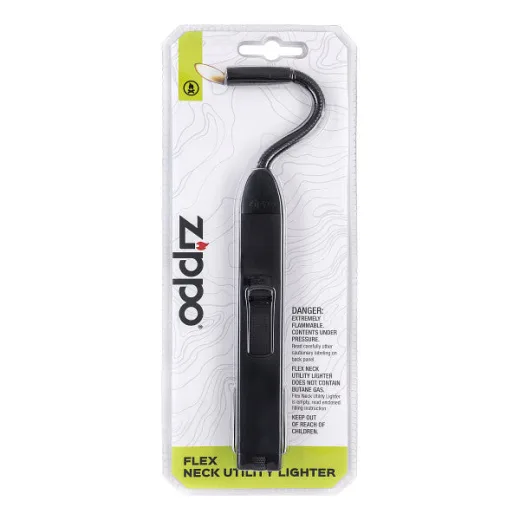
Zippo Flex Neck XL Utility Lighter. The same idea with a much longer bendable neck, around 13 inches. This is the one for a deep firebox, an inglenook or a multi-fuel stove where you are lighting at the back of a grate. It is longer than most people need for a small stove and exactly right for a large one.
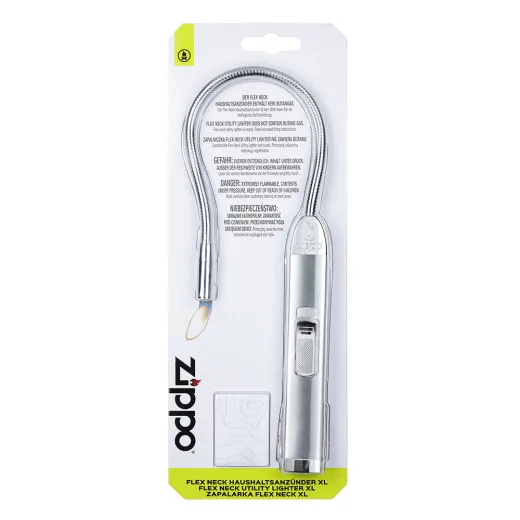
Both are refillable rather than disposable, which is the point. Neither will work well at 3°C straight out of a cold porch, for the reasons above.
Electric arc: what to look for
A flexible neck and a real reach. Cheap arc lighters put the arc 60mm from your hand, which defeats the purpose.
A battery indicator. An arc lighter with no charge display fails silently, and you find out with a laid fire and no ignition.
A safety lock. Arc lighters are not covered by the same child-resistance presumption in the same way as a flame lighter mechanism, and a physical lock switch is worth having.
USB-C rather than micro USB. A trivial point that becomes annoying in year three.
Realistic expectations on cycle life. Manufacturers quote a few hundred lights per charge. In practice you are pressing the button for two or three seconds per light on a firelighter, and a charge lasts most people several weeks.
The RONXS USB-C rechargeable arc lighter is the one that keeps coming up in this category, with a 360 degree flexible neck, a battery display and a safety lock. We have not tested it against the Zippos on a stove, so treat that as a specification comparison rather than a verdict, and we will not put a buy button on something we have not verified properly.
The honest third option: long matches
Extra long safety matches, the 100mm to 280mm kind sold for fireplaces, light first time, cost almost nothing, work at any temperature, need no fuel or charge and go in the recycling. They are worse in a draught, they are consumed, and they give you one shot per match.
For a household that lights a stove once a day with a firelighter, a box of long matches genuinely competes with a lighter, and a lot of people who buy an arc lighter go back to them. The case for a lighter is repeat use without consumables and the ability to hold a flame on a stubborn spot for five seconds.
Which to buy
- Warm room, firelighter every time: an arc lighter is the cleanest answer, no fuel, no consumables.
- Cold cottage, unheated room, holiday let: an arc lighter, for the temperature reason, and store it inside.
- You light with paper and kindling, no firelighter: gas, and a flexible neck.
- Deep firebox or inglenook: the extra-long flexible neck gas lighter.
- You want to spend nothing and think about it no further: long matches.
Whatever you pick, the ignition source is the least important part of lighting a stove well. Dry wood under 20 per cent moisture matters more, which is what a moisture meter is for, and how you stack the fire matters more still. If your stove is hard to light, the lighter is rarely the reason.
Frequently asked questions
What is the best long reach lighter for a wood burner? For most people, a refillable metal gas lighter with a flexible neck and an adjustable flame, because it produces a real flame that will light kindling as well as a firelighter. If your stove is in a cold room, or you always light with a firelighter, a USB rechargeable arc lighter is the better choice because it is unaffected by temperature.
Why does my gas lighter stop working in winter? Butane boils at about −0.5°C, so as the lighter gets cold the pressure in the tank falls and it cannot feed the burner. A lighter stored in a cold porch or next to the log store will be sluggish or dead on a frosty morning. Warm it in a pocket for two minutes and it will work again, and keep it indoors between uses.
Can an arc lighter light kindling? Not easily. An arc lighter transfers heat to a few square millimetres and has no flame to wrap around the wood. It lights paper and wood wool firelighters instantly, struggles with bare kindling and is close to useless on a briquette. If you never use firelighters, buy gas.
Are long reach lighters legal to buy in the UK? Yes, and they must be child resistant. The retained Decision 2006/502/EC requires lighters placed on the market to be child resistant and bans novelty lighters that resemble toys, animals, food or that flash or play music. The definition covers utility lighters used for lighting paper, wicks, candles and lanterns, not only cigarette lighters.
Can lighters and lighter fuel be sent by post in the UK? Lighters containing flammable liquid or gas, and lighter refills, are on Royal Mail’s prohibited list. New unused empty lighters are acceptable. In practice that means a refillable lighter often arrives unfilled and the gas has to be bought locally or shipped by a seller set up to send dangerous goods.
How long a neck do I need for a wood burner? Long enough to keep your hand outside the door opening. Most stove fireboxes are 250mm to 400mm deep, so a neck of around 200mm covers the majority of stoves, and an extra long neck of 300mm or more is worth it for a deep firebox, an inglenook or a stove you light from the bottom.
Sources
Want the seasoning calendar and our log-price watch in your inbox?
Join the Kindling List