Best Log Splitting Axes UK 2026: Fiskars and Beyond
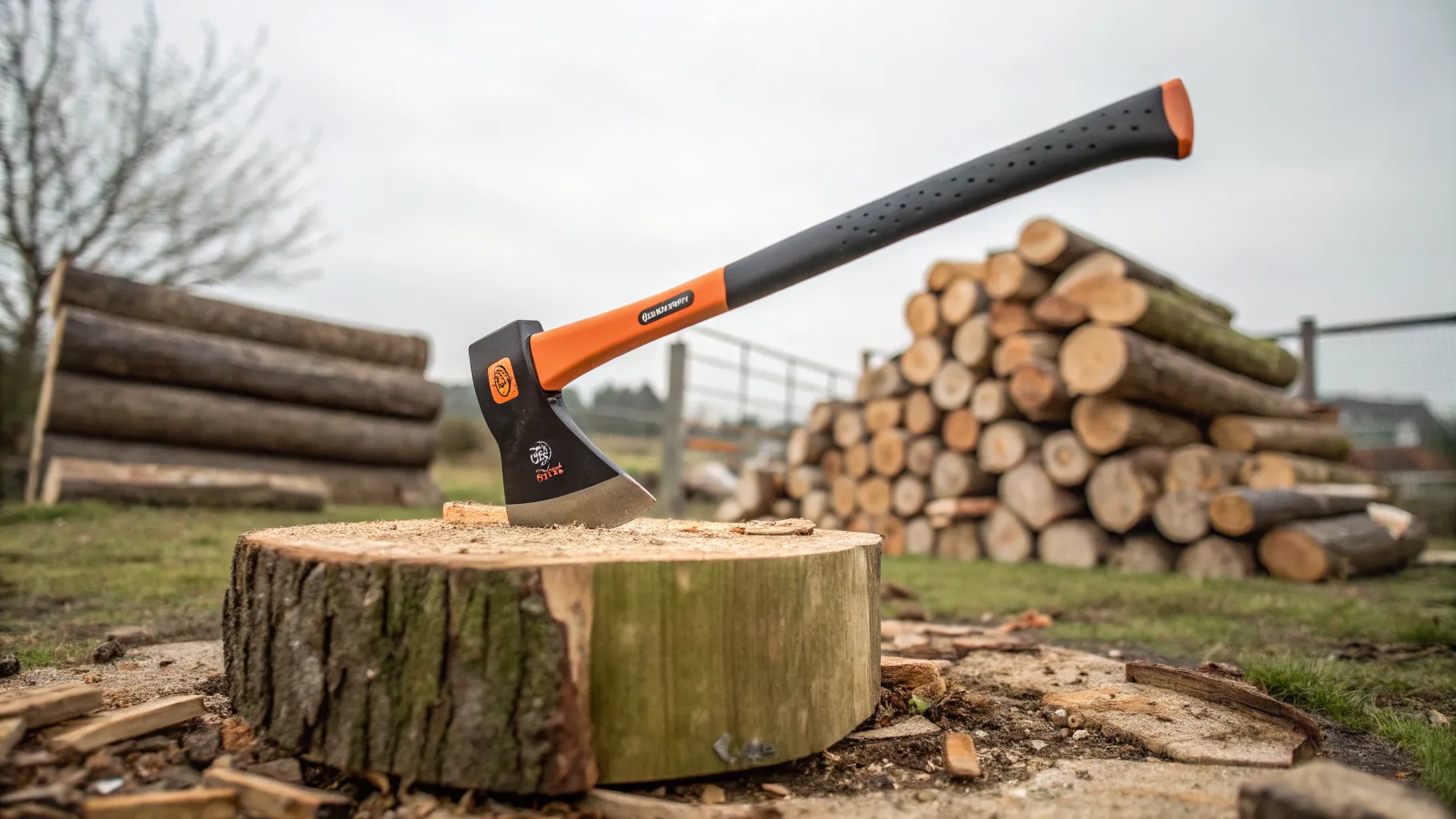
A good splitting axe turns a chore into ten quiet minutes before the kettle boils. The wrong one bounces off seasoned oak, jars your wrists, and lives in the shed unused. This guide covers the splitting axes worth buying in the UK for 2026, with one fact most other lists miss: Fiskars is mid-way through renaming its best-selling splitters, so the axe you read about as the “X25” is now sold as the “X32”. Buy the wrong listing and you will not be wrong, but you should know why both are on the shelf.
If you have a lot of wood and a bad back, a powered machine may suit you better. We cover those separately in our log splitter guides, and you can size a hydraulic machine with what tonnage log splitter do I need. This page is about the hand tool.
The Fiskars rename: X25 is now X32, X27 is now X36
Fiskars has moved its splitting axes to a fifth-generation X-series, and the model names have changed. The two that matter most to UK buyers:
- The X25 (77cm) is being replaced by the X32.
- The X27 (91.5cm) is being replaced by the X36.
The new heads are roughly 15% wider and 10% taller with a bigger wedge, an upgraded FiberComp handle, and a longer SoftGrip section. The geometry is genuinely improved for getting through stubborn rounds.
Here is what no one tells you at checkout: as of mid-2026 both the old and new versions are on sale in the UK at the same time. The old X25 and X27 are not faulty or discontinued stock; they are simply being run down. So you have a choice. The outgoing X25/X27 are proven, widely reviewed, and often cheaper. The new X32/X36 have the better head. We have confirmed UK retailers stocking the new X32, but at the time of writing we have not verified a stable Amazon UK listing for it, so the buy boxes below point at the current X25/X27, which remain excellent. If you find the X32/X36 at a price you like, buy with confidence; the axe is better, not worse.
Splitting axe or splitting maul?
Most “best axe” lists quietly mix in mauls, which muddies the advice. They are different tools.
A splitting axe has a head of roughly 1.3kg to 3kg with a thin, sharp, convex-tapered wedge. The cheeks flare out behind the edge so the blade levers the grain apart instead of burying itself. It is fast, light, and accurate, and it shines on straight-grained seasoned or kiln-dried logs, which is most of what a wood-burner owner splits.
A splitting maul has a heavier head, roughly 2.7kg to 3.6kg, with a blunter convex face that works by sheer mass and wedge angle rather than a keen edge. It is slower and more tiring but better on big, knotty, stringy rounds such as green oak or elm. A maul face must be slightly convex; it cannot be hollow-ground, or it jams.
The practical line: if you are splitting seasoned or kiln-dried logs up to about 25cm to 30cm across, a good splitting axe is the right call. Keep a maul or a steel wedge in reserve for the occasional gnarly round. We keep mauls on their own page in the splitters, axes and kindling section so this guide stays focused.
One more thing a splitting axe will not do well: kindling. It is too powerful and too long to safely tap down a small baton. For that you want a dedicated kindling splitter, which is a much safer tool for small, repetitive splits.
Handle material: composite or hickory?
This is the other real decision, and the forums argue about it endlessly. The honest summary:
- Composite (FiberComp or fibreglass): near unbreakable, shock-absorbing, weatherproof, and usually lifetime-warranted. You cannot re-hang the head, but you rarely need to. This is what Fiskars and Husqvarna use, and it is the right answer for most buyers.
- Hickory or ash: traditional feel and weight, and you can re-hang or replace the handle if you overstrike. The downside is that an overstrike against the edge of a round can crack or loosen the handle over time. This is the territory of Bahco, Gransfors, and most older patterns.
Buy composite if you want to fit and forget. Buy a wooden handle if you like the feel and you are willing to maintain it.
Best overall: Fiskars XL X25 Splitting Axe (now X32)
For most UK wood-burner owners, the X25 is the sweet spot. At 77cm and 2.5kg it is long enough to generate real splitting force but still controllable, and the FiberComp handle shrugs off overstrikes that would ruin a wooden handle. The factory edge is sharp, the weight is forward and balanced for a clean pop through seasoned rounds, and it is the axe most often recommended in head-to-head testing. It happily covers everything from campsite logs to the home woodpile. This is the model now succeeded by the X32, so if you see the X32 listed, that is the newer version of the same tool.
Check price on Amazon UK.
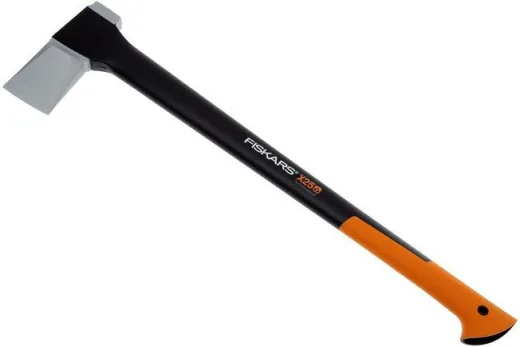
Best for big rounds and tall users: Fiskars X27 Super Splitting Axe (now X36)
If you are over about 5ft 10in, or you regularly split rounds 18in and bigger, the longer X27 earns its place. At 91.5cm and 2.6kg, the 36in handle gives you more force on stubborn wood, and the extra length is also safer: when the blade passes clean through a log, it ends up well clear of your shins rather than swinging back toward them, which is a genuine risk with shorter axes. Taller users find the X27 far less stooped and more comfortable over a long splitting session. It is the X25’s bigger sibling and is being renamed the X36.
Check price on Amazon UK.
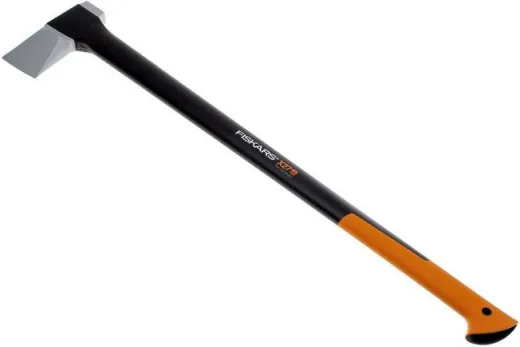
Best mid-light: Fiskars Splitting Axe M X17
Not everyone wants a 2.5kg axe. The X17, at 60cm and around 1.53kg, is the choice for medium logs, shorter users, anyone splitting on a low block, or households short on storage. It still has the Fiskars convex head and FiberComp handle, just scaled down, so it swings faster and tires you less while keeping enough mass to get through seasoned wood up to a moderate diameter. A good first axe if you are unsure you will get on with a heavy one.
Check price on Amazon UK.
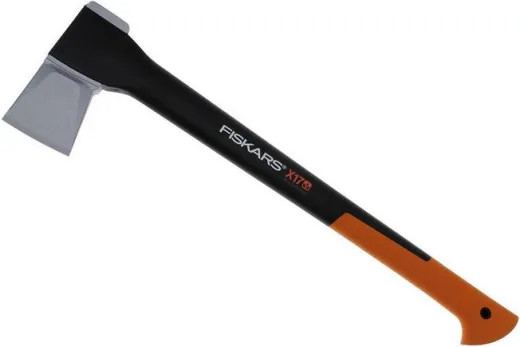
Best lightweight one-hander: Fiskars Splitting Axe S X11
The X11, at 44cm and 1.1kg, is a one-handed small-log splitter. It is not your main axe for a winter’s wood, but it is excellent as a second tool for splitting already-quartered pieces down, for smaller-diameter logs, or for anyone who finds a full-size axe too much. Keep it by the burner for topping up the basket and let the X25 do the heavy lifting outside.
Check price on Amazon UK.
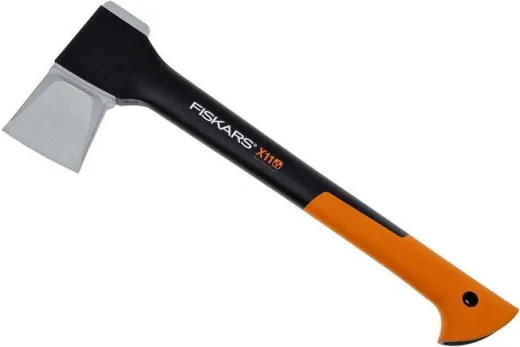
Best budget true splitting axe: Bahco SUS-2.0-800
If you want a wooden-handled splitting axe without the Fiskars price, the Bahco SUS-2.0-800 is the cleanest budget pick. It pairs a genuine 2kg splitting head (a proper wedge geometry, not a felling profile) with a curved ash handle, for 800mm and about 2.4kg total. Ash gives you traditional feel and the option to re-hang the head down the line. Treat the handle with a little care around overstrikes and it will serve you well.
Check price on Amazon UK.
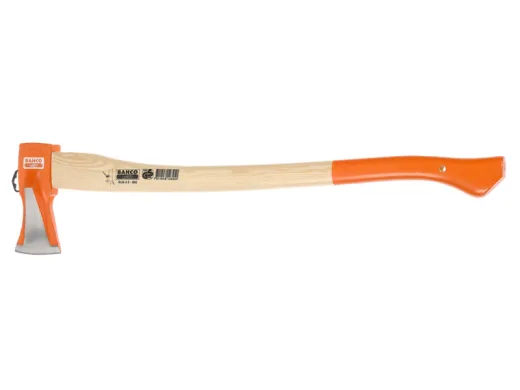
Best buy-it-for-life: Gransfors Bruks Large Splitting Axe
For the buyer who wants one tool for the rest of their life, the Swedish hand-forged Gransfors Bruks Large Splitting Axe is the benchmark. It runs roughly 70cm to 80cm and about 2.3kg total, with a concave, fairly thin bit that bites fast before the broader section levers the wood apart. Each one is forged and stamped by a named smith, and it holds its value. The catch for this guide: it is a specialist tool sold mainly through dedicated stockists rather than a standard Amazon UK listing, so we are not placing an affiliate buy box on it. If you want one, buy it from a reputable axe specialist and check the spec on the Gransfors Bruks page. It is a treat, not a budget buy.
How to match the axe to you
Handle length by height and logs. As a rough rule, the 77cm X25 suits people from about 5ft 6in to 5ft 10in and logs up to around 16in. Go to the 91.5cm X27 if you are taller than 5ft 10in or routinely split 18in-plus rounds. Shorter users, or anyone splitting on a low block, are often happier with the 60cm X17.
Head weight for beginners. If you are learning, start under 2kg so you can place the blade accurately rather than swinging wild. Step up to a 2kg to 3kg head once your aim is consistent and you want more power per stroke.
Sharpening and care. A splitting axe does not need to be razor sharp, but a dull, rounded edge bounces. Fiskars sells the Xsharp tool for its axes; a Gransfors or Bahco edge can be touched up with a file and a stone. Keep the head dry and lightly oiled, and store it off the floor. Most competitor lists skip this entirely, which is why so many axes end up blunt and unloved.
A note on UK law
Splitting axes are perfectly legal to buy and own in the UK. The thing to know is that, like any bladed tool, you need a good reason to carry one in a public place. Keep it in the shed or the boot for the woodpile, not loose in the car for no reason, and you have nothing to think about.
If a hand axe is too much work
Splitting by hand is satisfying and free, but if you are processing several cubic metres a year, or your wrists or back are not what they were, a machine pays off. A mains-powered unit is plenty for most domestic woodpiles; see our pick of the best electric log splitter. For larger or harder wood, compare petrol and higher-tonnage hydraulic machines in the best log splitter guide, and if you already own one that is misbehaving, our fix for a log splitter that won’t start or whose ram won’t return will save you a call-out.
Frequently asked questions
Should I buy a splitting axe or a splitting maul? For seasoned or kiln-dried logs up to about 25cm to 30cm across, which is what most wood-burner owners split, a splitting axe is faster, lighter, and more accurate. Choose a maul only if you regularly tackle big, knotty, green rounds like oak or elm, where its extra mass earns its keep.
Fiskars X25 or X27: which length should I get? Go for the 77cm X25 (now sold as the X32) if you are between roughly 5ft 6in and 5ft 10in and split logs up to about 16in. Choose the 91.5cm X27 (now X36) if you are taller than 5ft 10in or regularly split 18in-plus rounds. The longer handle also keeps the blade further from your shins on a clean pass-through.
Hickory or composite handle: which lasts longer? Composite and fibreglass handles, like those on the Fiskars and Husqvarna axes, are near unbreakable and need no maintenance, which is why we recommend them for most people. A hickory or ash handle feels traditional and can be re-hung if it fails, but it is more vulnerable to an overstrike. Pick wood only if you enjoy the feel and will look after it.
Can I split kindling with one of these axes? No. A full-size splitting axe is too powerful and too long to safely tap down a small baton, and you risk your fingers. Use a dedicated kindling splitter for small repetitive splits and keep the axe for the main rounds.
Will a splitting axe get through knotty or green wood? Straight-grained seasoned wood splits cleanly with an axe. Knotty, stringy, or green wood like oak and elm can stop even a good axe dead. For those, drop back to a maul or drive a steel wedge with the axe poll or a separate sledge.
Where are these axes made? The Fiskars X-series is made in Finland, and Gransfors Bruks and other Swedish axes are hand-forged in Sweden. Country of origin is a fair quality signal here: these are long-established axe-making traditions, not anonymous imports.
Want the seasoning calendar and our log-price watch in your inbox?
Join the Kindling List