Best Stove Thermometer UK: Top, Pipe or Twin-Wall Flue
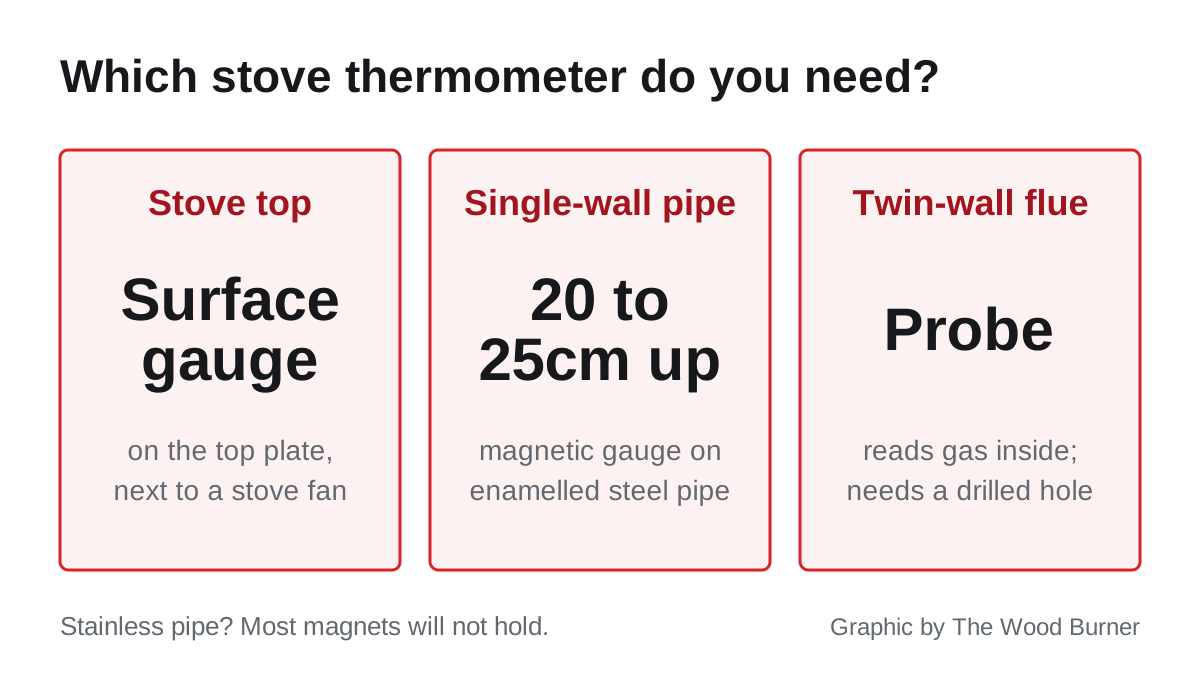
The best stove thermometer in the UK is the one built for the surface you put it on. A stove-top gauge, a flue pipe gauge and a probe for twin-wall flue all read differently, and a thermometer in the wrong place gives you numbers that look precise and mean little. Below are four thermometers sold on Amazon UK with published specifications behind them, matched to the place each one is designed for, plus the trap that catches many UK owners first: a magnetic thermometer will not stick to a stainless steel flue pipe.
Why bother with a thermometer at all
A stove thermometer tells you three things you cannot judge by eye:
- Too cool. A smouldering fire with the air turned right down leaves tar and soot in the flue and blackens the glass. Regin’s flue pipe thermometer marks anything under 120°C as too cold, the zone where creosote builds up fastest.
- Too hot. Over-firing warps baffles and grates, cracks firebricks and can damage the flue. It also cooks a heat-powered stove fan: most Ecofan wood stove models are rated to 345°C on the stove top, and some fans much lower. See our stove fan guide for each model’s limit.
- When to reload. As the gauge drops back out of the working zone, it is time for another log, before the fire dies to embers you have to rescue.
Which type do you need?
| Where it goes | What it reads | Pick this if |
|---|---|---|
| Stove top | The surface of the stove’s top plate | You run a stove fan, cook on the stove, or have no exposed pipe |
| Single-wall flue pipe | The outside surface of the pipe, roughly 20 to 25cm above the stove | You have exposed single-wall pipe, usually vitreous enamel, from the stove to the ceiling or register plate |
| Twin-wall flue (probe) | The gas inside the flue, through a small drilled hole | You have insulated twin-wall flue straight off the stove, where a surface gauge reads only the cool outer skin |
A flue pipe surface gauge reads well below the gas inside the pipe, and a stove top reads hotter than the pipe. That is why the zones printed on each type differ, and why you should not move a thermometer from the pipe to the top plate and use the same zones.
The magnet problem
Nearly every stove thermometer holds on with a magnet. Cast iron and steel stove tops are fine, and so is vitreous enamelled steel flue pipe, which is what most UK installers use between the stove and the register plate. Valiant says its thermometer will hold “to most vitreous enamel, iron or steel flue pipe.”
Stainless steel is the exception. Most stainless flue pipe and twin-wall systems use grades of stainless that are barely magnetic or not magnetic at all, so a magnetic thermometer slides straight off. Before buying, try a fridge magnet on your pipe. If it does not hold, you need a stove-top gauge or a probe.
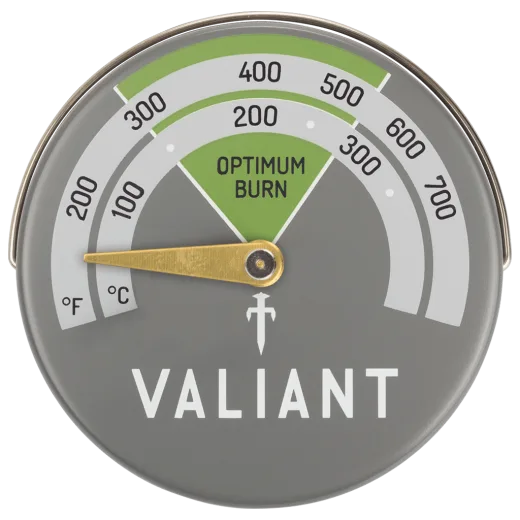
Valiant FIR116: best all-round UK choice
Valiant is a UK fireside brand, and the FIR116 is its standard magnetic thermometer: a 63mm aluminium dial that works on a stove top or a flue pipe. Valiant marks the optimum burn zone as roughly 125°C to 300°C and says the magnet holds on steel up to about 425°C. Its own fitting advice is to put it on the flue collar, or as close to it as practical, for the most stable reading.
It has by far the most customer ratings of any stove thermometer on Amazon UK, and it comes in green or red. It is also sold in packs with Valiant’s stove fans, which is the cheapest way to get both. The one limit is that a single dial is calibrated as a compromise between top and pipe, so treat the zones as a guide rather than gospel.
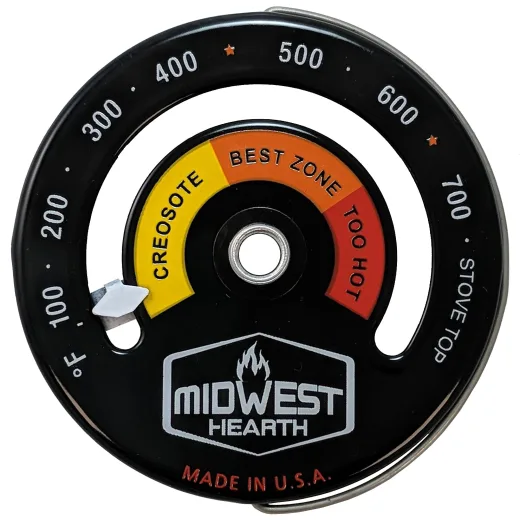
Midwest Hearth Magnetic Stove Top Meter: best for stove tops
If you run a stove fan or cook on the top plate, a gauge calibrated for the stove top surface makes sense. Midwest Hearth’s stove top meter is exactly that: calibrated for the surface of a wood stove, with a porcelain enamel finish, coloured zones for burning too cool, about right and too hot, and a flip-up handle to move it without burning your fingers. The magnet is rated to hold to 800°F, about 425°C.
Midwest Hearth is an American brand, so check the dial scale in the listing photos if you think in Celsius. Put it on the top plate near, but not under, your stove fan, so you can see both the fire’s state and whether you are near the fan’s limit.
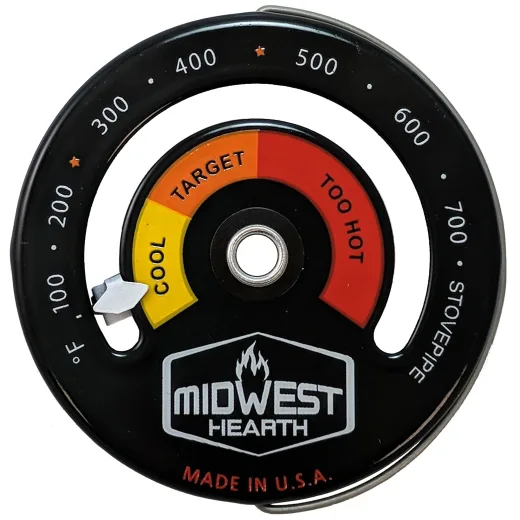
Midwest Hearth Magnetic Chimney Pipe Meter: best for single-wall pipe
The companion to the stove top meter, this one is calibrated specifically for single-wall flue pipe, with the same enamel finish, colour zones, flip-up handle and 800°F magnet. Use it on exposed enamelled pipe a short way above the stove; Regin recommends about 250mm above the stove top for its pipe thermometer and Morsø about 20cm, and the same spot works here. A thermometer right on the collar can read high from the radiant heat of the stove itself.
It is the right pick if you burn with an eye on the flue, for example if you have had a chimney fire scare, a tarred liner or a sweep who has warned you about deposits.
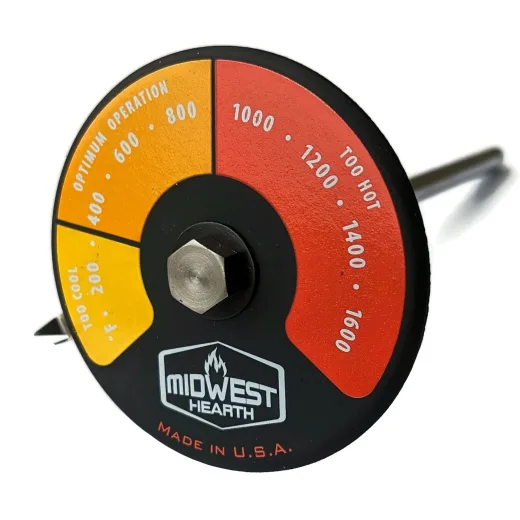
Midwest Hearth Probe Thermometer: for twin-wall flue
Twin-wall insulated flue, common on installations without a masonry chimney, defeats surface thermometers: the insulation keeps the outer skin cool, which is its job. Midwest Hearth’s probe thermometer pushes a 4 inch chrome-plated probe through both walls into the middle of the flue, where the hot gases flow, and is rated to 1,700°F. You drill a small hole to fit it, and the dial is held by a magnet.
Drilling a flue is not a casual job. Twin-wall systems are installed to the manufacturer’s rules, and a hole affects how the system is sealed. Ask your installer or a HETAS registered engineer to fit it, or at least to confirm it will not affect the flue’s warranty. If the outer wall is stainless, check how the dial will be held before you buy.
What about the cheap unbranded gauges?
Search Amazon for a stove thermometer and dozens of near-identical unbranded dials come up, many with thousands of ratings. Some are fine. The issue is that few say whether they are calibrated for a stove top or a pipe, and many print zones without saying what they are based on. If you buy one, use it as a relative gauge: learn where the needle sits when your stove is burning cleanly, with clear glass and no smoke from the chimney, and run to that.
Stove makers sell their own as well. Morsø, Charnwood and Regin thermometers are stocked by UK stove dealers; Regin’s is clear about its zones (120°C to 260°C as the best range on the pipe) and states it is not for twin-wall flue.
Getting a useful reading
- Let it settle. Dial thermometers lag. Give it ten minutes after reloading before you adjust the air.
- Use your stove’s own guidance. The best range varies by model; Regin says so on its own packaging. Your stove manual may give a flue gas or surface temperature.
- Watch the trend, not the number. A needle that keeps climbing with the air wide open is a fire about to run too hot.
- Keep it clean. A sooty dial face is hard to read; wipe it when the stove is cold.
- Check it now and then. A cheap infrared thermometer gun gives a quick second opinion on a stove top, though shiny enamel surfaces can fool it.
Frequently asked questions
Where should a stove thermometer go? On the stove top if you run a fan or cook on it, or on single-wall flue pipe about 20 to 25cm above the stove if you want to monitor the flue. Twin-wall flue needs a probe thermometer.
What temperature should a wood burner run at? On the flue pipe, Regin marks 120°C to 260°C as the best range, and Valiant’s dial marks roughly 125°C to 300°C. Your own stove manual takes priority.
Why won’t my stove thermometer stick to the flue? Your flue pipe is probably stainless steel, which is mostly non-magnetic. Use a stove-top thermometer or a probe instead.
Do stove thermometers work on twin-wall flue? Surface ones do not give a useful reading, because the insulation keeps the outer wall cool. A probe thermometer that reaches into the flue gas is needed.
Do I need a thermometer with a stove fan? It is strongly recommended. Every heat-powered fan has a maximum stove top temperature, and a thermometer next to it tells you when you are close.
Are cheap stove thermometers accurate? Many are fine as a relative guide, but few state whether they are calibrated for a stove top or a pipe. Learn where the needle sits on a clean, steady burn and use that as your target.
Sources
- Valiant, Magnetic Thermometer and Amazon UK listing for FIR116, checked 3 October 2026
- Midwest Hearth, product pages for the stove top, chimney pipe and double wall probe thermometers
- Regin stove pipe thermometer (REGST75) product information, via Stove Supermarket
Want the seasoning calendar and our log-price watch in your inbox?
Join the Kindling List