Lekto Night Briquettes Review: 8 Hours Needs Technique
Every Lekto Night Briquettes review eventually runs into the same split. Some people load one at half past ten, come down at eight the next morning and rake a bed of embers back into life. Others follow the instructions, get four hours, and conclude the product is overrated. Both are describing the same briquette.
The reason is that these are not ordinary heat logs and they do not behave like ordinary heat logs. Getting eight hours from them depends almost entirely on how you run the stove, not on the fuel. Here is what they actually are, what the official specifications say, and the technique that separates the two camps.
What they are
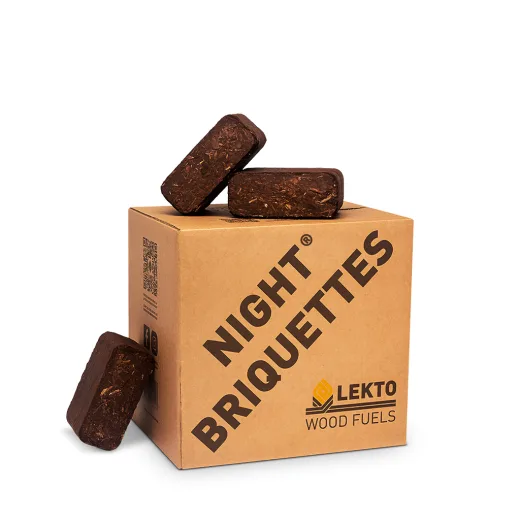
Night Briquettes are made from 100% softwood bark, compressed into a dense block, from sustainably managed forests. Bark is the important word: it is the slowest-burning part of the tree, high in lignin and low in the volatile compounds that make ordinary softwood flare and vanish. That composition is why they smoulder rather than flame, and it is also why they behave nothing like the sawdust briquettes in the same range.
The published figures from Lekto’s own product page:
| Specification | Figure |
|---|---|
| Material | 100% softwood bark |
| Calorific value | 4.5 kWh/kg |
| Burn time claim | Up to 8 hours |
| Individual briquette | 1 kg, 155 x 120 x 70 mm |
| Pack | 20 kg box, 20 briquettes |
| Ready to Burn | Certificate WS370/00004 |
That Ready to Burn certificate matters legally, not just commercially. Under the rules covering solid fuels in England, fuel sold for domestic burning has to be certified, and the certificate number is the thing to look for on any briquette you buy.
At 4.5 kWh/kg these sit slightly below well-seasoned kiln-dried hardwood on paper. The comparison is misleading, because you are not buying them for peak output. You are buying them for duration.
What they are for, and what they are not for
They are not a fire lighter and they are not a main fuel. A Night Briquette put on a cold stove with kindling will smoulder unhappily, produce smoke, and disappoint you. They are designed to go on last, onto an established fire.
They are not for a fast, bright, visible flame. They glow. If you want a stove you sit and look at, burn kiln-dried logs for the evening and use these to close it down.
They are for holding heat overnight so the room is warm in the morning and the stove relights from its own embers rather than from scratch, and for keeping a stove ticking over during a long day out.
Judged against that job they are good. Judged as a general-purpose log they are not, and most of the negative reviews are people using them as a general-purpose log.
The technique that decides your result
This is the whole review, really. Four things:
1. Load onto a bed of glowing embers, not flames. The stove needs to be up to temperature with a decent bed of embers established, and the previous load past its flaming stage. Putting briquettes onto a roaring fire wastes them; putting them onto a nearly dead fire fails to light them properly.
2. Two or three briquettes, touching. One briquette on its own struggles to sustain itself, because these rely on radiating heat back at each other. Two or three sitting against one another hold the reaction going. This is the single most common mistake.
3. Reduce the air, do not shut it off. Here is where the two camps diverge. Close the primary air and bring the secondary air right down, but leave some airflow. Reviewers who report twenty minutes of nothing have generally closed the stove down completely, and a bark briquette with no oxygen simply stops.
4. Give them ten to fifteen minutes before you close down. Let them catch and establish while the air is still reasonably open, then reduce it. Closing the stove the moment they go on is the other reliable way to get four hours instead of eight.
Get all four right and an overnight burn is realistic. Get any one of them wrong and the result is a shorter, cooler burn, which is exactly the pattern in the customer reviews.
Where it goes wrong
Your stove is too small or too leaky. A small stove with a modest firebox cannot hold three briquettes and enough embers, and an old stove with worn door rope leaks air all night and burns through them. If your stove will not hold an overnight burn with hardwood, it will not hold one with these.
Your flue draws too hard. A tall or very well-insulated flue on a windy night pulls air through a closed stove. That is a chimney characteristic, not a fuel problem, and it caps what any overnight fuel can do for you.
You are burning them in an open fire. They need a closed appliance with controllable air. In an open fireplace they will burn through fast and give you very little.
You expect flames. Working as intended, the stove looks nearly dead: dull orange, no visible flame, glass slightly hazed. That is a briquette doing its job, not a fire going out.
How they compare to the rest of the range
Against Lekto’s sawdust briquettes, the Night Briquettes are the slower, cooler, longer-lasting option. Sawdust briquettes give a hotter, brighter burn over a shorter period and make a better main fuel; the bark ones are a specialist overnight product. Many people run both, sawdust or logs for the evening and two or three Night Briquettes at bedtime.
Against kiln-dried hardwood, the honest comparison is that good hardwood in a good stove will also hold overnight, and the briquettes are a more consistent and less skilled way of achieving it. They are also cleaner to store, stack in a cupboard and do not shed bark and beetles across the hearth.
Against other long-burn briquettes on the UK market, the bark composition is the meaningful difference. Most competing products are compressed sawdust or hardwood dust, which burn hotter and faster. Our roundups of the best night briquettes and the best wood briquettes put them alongside the alternatives.
Storage, ash and practical notes
Keep them dry. Briquettes are compressed to a low moisture content and they will reabsorb it from a damp shed or garage floor, swelling and crumbling. Store the box off the ground and under cover; a briquette that has taken on damp burns badly and no technique fixes it. If you own a moisture meter, there is no need to test these on arrival, but it is worth checking anything that has been stored through a wet winter.
Ash volume is modest but the ash is fine and light, so open the door slowly or you will redistribute it around the room. Bark also produces a slightly different deposit from clean hardwood, so keep to your normal sweeping schedule rather than stretching it.
Check price on Amazon UK for the 8 x 20kg pack, which is the size most households settle on for a winter.
The verdict
Good at one job, poor at everything else, and the reviews that call them a con are almost always describing them being used for a job they were not built for.
Buy them if you have a decent closed stove, you want to wake up to a warm room, and you are willing to spend two evenings learning the loading routine. Skip them if you have an open fire, a small leaky stove, or you mainly want something nice to look at.
Frequently asked questions
Do Lekto Night Briquettes really burn for 8 hours? They can, on a preheated stove with a good ember bed, two or three briquettes loaded together, and the air reduced but not closed off. Users who report four hours or less have usually loaded a single briquette, shut the air completely, or put them on a fire that was too cold or too hot.
What are Lekto Night Briquettes made of? 100% softwood bark from sustainably managed forests, compressed into 1kg blocks. Bark burns more slowly than the wood itself, which is what gives them their duration and their low, flameless burn.
How many Night Briquettes should I put on at once? Two or three, placed touching each other. A single briquette on its own struggles to sustain combustion because these rely on radiating heat back at one another.
Can I use Night Briquettes in an open fire? Not effectively. They need a closed appliance with controllable air. In an open fireplace the airflow cannot be reduced, so they burn through quickly and give you little of the duration they are designed for.
Are Night Briquettes Ready to Burn certified? Yes, under certificate number WS370/00004. That certification is the legal requirement for solid fuel sold for domestic burning, and it is worth checking on any briquette before you buy.
Are Night Briquettes better than kiln-dried logs? Not better, different. Kiln-dried logs give a hotter, brighter, visible fire for the evening. Night Briquettes give a long, low, slow burn for overnight. Most people who use them run logs during the evening and switch to briquettes at bedtime.
Want the seasoning calendar and our log-price watch in your inbox?
Join the Kindling List