Lekto Sawdust Briquettes Review: 5.1 kWh/kg, 2-Hour Burn
This Lekto Sawdust Briquettes review starts with the number that decides everything: 5.1 kWh per kilogramme, at a moisture content under 9 per cent. Compare that with well-seasoned kiln-dried hardwood at 20 per cent moisture and the briquette wins on heat per kilo, because you are not paying to boil off water. That is the whole case for compressed sawdust, and it holds up.
What the case does not cover is burn time, and that is where most people buy the wrong Lekto product.
The specification
From Lekto’s own product information:
- Moisture content: under 9 per cent
- Calorific value: 5.1 kWh/kg
- Burn time: up to 2 hours per briquette
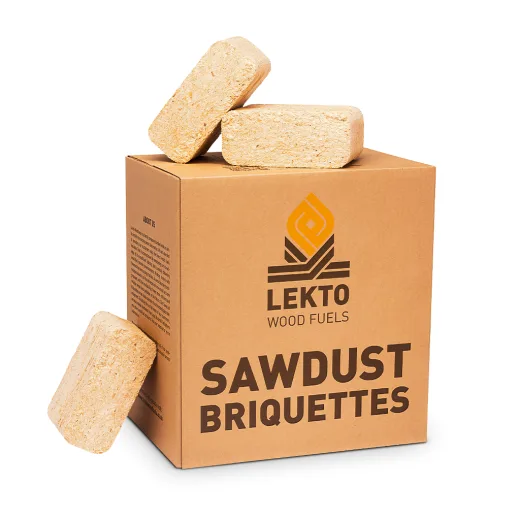
- Pack: 17kg box containing 20 briquettes
- Material: 100 per cent hardwood sawdust, described as birch
- Certification: Ready to Burn, certificate number WS370/00005
Two of those deserve comment.
Under 9 per cent moisture is well below what you can achieve seasoning logs outdoors in Britain, and below typical kiln-dried logs too. The Ready to Burn scheme requires under 20 per cent for firewood sold in small quantities, so this clears the legal bar with a large margin. Since May 2021 all wood sold in England in volumes under 2m³ has had to carry a Ready to Burn logo, a unique certificate number and supplier details, a requirement explained in Defra’s practical guide to open fires and wood-burning stoves. Our Ready to Burn firewood rules page covers what that certification actually requires.
Up to two hours is the figure people misread. It is per briquette, and “up to” is doing work. In practice a briquette in an open air setting or a hot stove goes faster than one damped down in a well-controlled stove. Two hours is the ceiling, not the average.
What they are actually good at
Getting to temperature fast. Low moisture plus high density means they light quickly and reach useful heat quickly. If your evening routine is to come in cold and want a warm room in 25 minutes, this is the product that does it. Lekto describes them as easy to light and non-sparking, and users generally report the same.
Storage. A 17kg box of 20 briquettes stacks in a cupboard. That matters if you have no log store, which is most flats and a lot of terraced houses. Twenty briquettes take up a fraction of the space of the equivalent heat in split logs. Our log store size calculator shows the difference in volume terms.
Consistency. Every briquette is the same size, same density, same moisture. You learn how your stove behaves with one, two or three of them, and that behaviour repeats. Logs never do this, which is why people with a moisture meter still get surprises. See our firewood heat comparison calculator to compare against your usual logs on a like-for-like heat basis.
Ash. Low ash relative to poorly seasoned logs, and Lekto notes the ash is suitable for the garden. Fewer emptyings of the ash pan across a season is a small but real convenience.
Where they are the wrong product
Overnight burning. Two hours a briquette means feeding the stove repeatedly through an evening, and it means the fire is out long before morning. If what you want is to bank the stove at eleven and find embers at seven, sawdust briquettes are not it. Lekto’s Night Briquettes are the product for that, and we covered them in our best night briquettes guide.
Very hot, fast stoves. A dense briquette in a stove with a strong draw and the air open burns hard and fast. You will get through them quicker than the specification suggests. Control the air. Our wood burner air vent calculator covers the settings.
Anyone who wants a fire to look at. Briquettes burn with a steadier, less theatrical flame than split logs. Functionally better, visually flatter. Some people mind this a great deal.
How they compare on cost
The comparison people get wrong is price per kilogramme against price per unit of heat.
At 5.1 kWh/kg you get roughly 87 kWh from a 17kg box, before stove efficiency. Kiln-dried hardwood at 20 per cent moisture typically delivers around 4 kWh/kg, so the same weight of logs gives roughly 68 kWh. That is around a 28 per cent advantage per kilogramme for the briquettes, which is the number to apply when you compare delivered prices.
Run your own comparison with our firewood price comparison calculator, because delivery cost swings this considerably. Briquettes travel in boxes on pallets; logs travel in bulk bags. The delivered price per kWh, not the headline price per bag, is the figure that matters.
The 17kg box of 20 briquettes is the standard unit, and larger multipacks carry the same briquette specification.
The verdict
Buy Lekto Sawdust Briquettes if you want fast, clean, storable heat and you are happy to feed the stove through the evening. The 5.1 kWh/kg at under 9 per cent moisture is a genuine advantage over any log you can buy, and the consistency makes a stove much easier to run predictably.
Do not buy them expecting an overnight burn. Two hours a briquette is what the manufacturer claims and roughly what you get, and no amount of damping down changes that meaningfully without choking the fire and dirtying the glass.
The sensible arrangement for most British households is both: sawdust briquettes to get the room warm quickly in the evening, and a slower fuel to hold it. See our best wood briquettes roundup for the wider field, and best kiln-dried logs if you would rather stay with logs.
Frequently asked questions
How long do Lekto Sawdust Briquettes burn for? Lekto states up to two hours per briquette. Treat that as the ceiling. A stove with a strong draw and the air open will get through them faster, and the figure assumes reasonable air control.
What is the moisture content of Lekto Sawdust Briquettes? Under 9 per cent, which is well below the 20 per cent required by the Ready to Burn scheme and below typical kiln-dried logs. They carry Ready to Burn certificate number WS370/00005.
How much heat do they give compared with kiln-dried logs? 5.1 kWh per kilogramme against roughly 4 kWh/kg for kiln-dried hardwood at 20 per cent moisture, so around 28 per cent more heat for the same weight. Compare delivered price per kWh rather than price per bag.
How many briquettes are in a box? Twenty briquettes in a 17kg box. Larger multipacks are sold, and the individual briquette specification is the same across pack sizes.
Can you burn Lekto Sawdust Briquettes overnight? Not effectively. At around two hours each they will not hold a fire through the night. Lekto’s Night Briquettes are the product designed for a slow overnight burn.
Do they produce a lot of ash? Less than poorly seasoned logs, because there is far less moisture and no bark. Lekto states the ash is suitable for use in the garden, and in practice the ash pan needs emptying less often than with mixed logs.
Want the seasoning calendar and our log-price watch in your inbox?
Join the Kindling List