Wood Burning and PM2.5: All 43 UK Zones Within the Limit
The government’s annual air pollution report has landed, and for the first time in a while the headline for stove owners is a calm one: every part of the UK met the legal limit for fine particles last year. Meanwhile Burnley wants to bring its whole borough under smoke control rules, and heating oil in Northern Ireland edged up again.
Every UK zone met the PM2.5 limit in 2025; home wood burning is about 11% of emissions
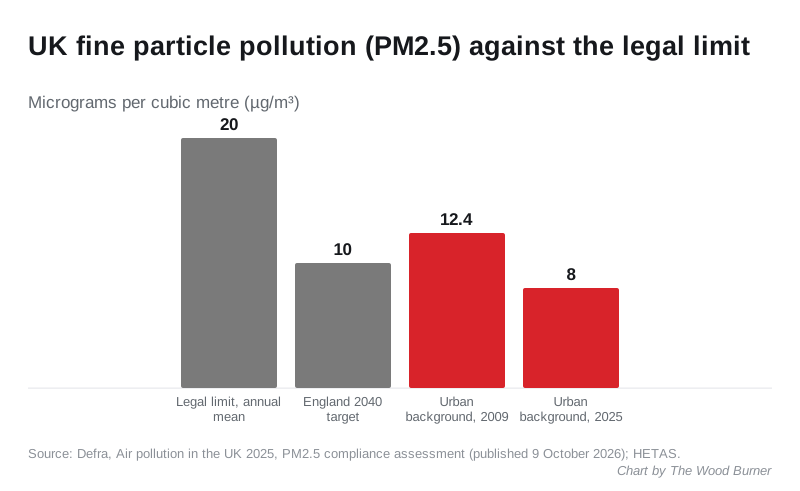
The Department for Environment, Food and Rural Affairs published Air Pollution in the UK 2025 on 9 October 2026. For PM2.5, the fine particles that wood smoke adds to, all 43 of the UK’s air quality zones met the legal limit, an annual mean of 20 micrograms per cubic metre, and the UK continues to meet its 2020 national target for cutting average exposure. Average PM2.5 at urban background monitoring sites has fallen from 12.4 micrograms per cubic metre in 2009 to 8.0 in 2025. Defra adds a caution: the 2025 results use a new national model, so some of the change since the 2024 report is down to the method rather than the air.
Wood burning still features. Defra’s assessment says that in 2024, households burning wood indoors produced more PM2.5 than industrial combustion. HETAS, the solid fuel certification body, published its own reading of the figures on 21 October. It puts indoor household wood burning at about 11% of UK PM2.5 in 2024, around 6,000 tonnes, against about 13% (around 7,000 tonnes) from outdoor burning: bonfires, garden waste, fire pits, chimineas and barbecues. By its analysis, emissions from indoor wood burning have fallen by around 14% since 2018, mostly by 2022, which it links to Ecodesign stoves and the Ready to Burn scheme. HETAS also notes that England’s tougher 2040 target is 10 micrograms per cubic metre, and that the trade is still waiting for the outcome of Defra’s solid fuel consultation, which closed in March.
Why it matters: compliance does not mean the pressure is off. Defra says no safe threshold for PM2.5 has been found, and wood burning is one of the few sources a household controls directly. The two things that cut smoke the most are dry fuel and a hot fire. Wood should be under 20% moisture, which is what Ready to Burn rules require for small bags of logs; a moisture meter settles the question for a few pounds, and lighting from the top down gets the stove up to temperature faster. Sources: Defra, Air pollution in the UK 2025 and PM2.5 compliance assessment; HETAS.
Burnley consults on a borough-wide Smoke Control Area
Burnley Borough Council opened a consultation on 15 October on extending Smoke Control Area coverage to the whole borough. Most of Burnley is already covered, but some areas, including newer housing developments, fall outside the existing boundaries, and the council proposes to bring everything under one borough-wide order. Inside a Smoke Control Area you must burn an authorised fuel unless your stove is approved by Defra for the fuel you want to burn. The survey takes about 15 minutes, is open to anyone who lives, works, studies or visits the borough, and closes on Friday 11 December 2026.
Why it matters: if you live in one of the newer estates outside the current boundary and burn logs in a stove that is not Defra-exempt, this would change what you can legally put in it. Check your stove’s model against the Defra exempt appliance list before the order is made, and if it is not on it, plan on authorised fuels such as approved briquettes or smokeless fuel. Source: Burnley Borough Council.
Heating oil in Northern Ireland: £1,023.79 for 900 litres
The Consumer Council for Northern Ireland’s weekly survey put the average price of 900 litres of home heating oil at £1,023.79 on 22 October 2026, up £4.43 on last week’s £1,019.36. A 500 litre order averaged £577.57 and 300 litres £357.04. A year ago, on 23 October 2025, 900 litres averaged £460.91, so the price is now more than twice that.
Why it matters: after last week’s £55 jump this is a small move, but it keeps oil above £1,000 for a second week. If your stove takes load off an oil boiler, the firewood heat comparison calculator puts logs and oil side by side at your own prices. Source: Consumer Council for Northern Ireland, heating oil price archive.
Want the seasoning calendar and our log-price watch in your inbox?
Join the Kindling List