Valiant Premium IV Stove Fan Review: 50°C Start, 300°C Cap
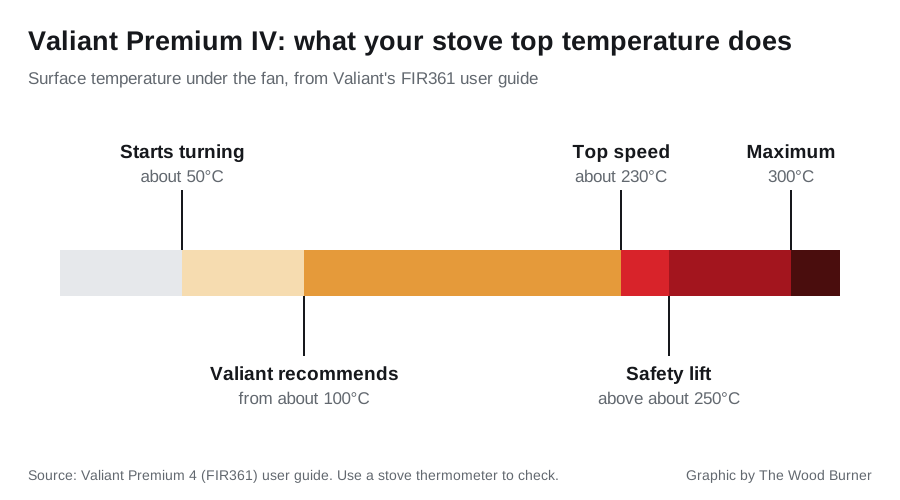
This Valiant Premium IV stove fan review comes down to one number most listings bury: the temperature of your stove top. Valiant’s user guide says the fan starts to turn at about 50°C, reaches top speed at about 230°C, lifts itself off the hot plate above about 250°C and should not be used where the surface goes past 300°C. If your stove sits in that window, the Premium IV is one of the most sensible branded fans you can buy. If your stove runs hotter, or you put the fan in the wrong place, it is the fan that pays.
The Premium IV, model number FIR361, is a four-blade heat-powered fan from Valiant, the Hertfordshire accessories brand. It is one of the best-known stove fans on Amazon UK, with more than 5,500 ratings averaging 4.5 stars when we checked on 5 October 2026. We have read the manufacturer’s user guide, the product listings and what owners report, and set them against the Ecofan models in our best stove fan comparison.
Valiant Premium IV at a glance
| Valiant Premium IV (FIR361) | |
|---|---|
| Blades | 4 |
| Height | 199mm including the blades |
| Weight | 550g |
| Starts turning | About 50°C stove surface |
| Valiant recommends using it from | About 100°C |
| Top speed | About 230°C |
| Safety lift | Above about 250°C, bimetallic strip in the base |
| Maximum surface temperature | 300°C |
| Power | None: thermoelectric (Peltier) module |
| Guarantee | 24 months, materials and workmanship |
| Airflow figure | Not published in CFM |
Temperatures, guarantee and placement rules are from Valiant’s FIR361 user guide. Height is from Valiant’s product page; weight is from the Amazon UK listing.
What it does well
It starts early. A start point of about 50°C is low for a stove fan. Ecofan’s UltrAir 810 needs 100°C and the AirMax 812 needs 85°C. On a modern clean-burn stove with an insulated top plate, or during the slow warm-up after lighting, the Premium IV gets moving sooner. Valiant still recommends using it once the top reaches around 100°C, which is when the airflow becomes worth having.
It fits under a low mantel. At 199mm tall it is noticeably shorter than the 250mm-plus fans aimed at big rooms. That matters in a fireplace recess where a beam or shelf sits low over the stove.
It protects itself. A bimetallic safety device in the base tilts the front of the fan up when the surface goes above about 250°C, lifting the hot base away from the plate to protect the Peltier module and motor. It drops back down as the stove cools. Plenty of cheap unbranded fans have no protection of this kind and publish no temperature limit at all.
It is quiet. Owners consistently describe a soft whirr that disappears into the background. Valiant calls it “virtually silent”. We would not lean on any decibel figure, because listings disagree: some retailers quote 30dB and the Amazon listing says 45dB, and none say how it was measured.
It is easy to warranty. Two years on materials and workmanship, from a UK company with a UK address, is better than most budget fans. Keep the receipt and the batch number, which Valiant asks for with any claim.
Where it falls short
No airflow figure. Valiant says the blades generate up to 70% more airflow than competitor products but publishes no CFM figure to check that against. Ecofan publishes tested airflow, so if you want to compare air movement on paper, only Ecofan lets you.
A lower ceiling than Ecofan. The Premium IV’s maximum surface temperature is 300°C. Ecofan rates its classic wood stove models to 345°C. If your stove top often runs above 300°C, a fan with a higher limit, or a better-controlled fire, is the answer.
Value divides opinion. Most owners say it is worth the money. A minority say it made no difference. That usually comes down to the room: a fan moves warm air off the stove top, it does not create heat, so in a small room where the stove already overheats the space, the difference is modest.
What kills one early
Read through owner complaints about stove fans and two causes come up again and again. Valiant’s own guide warns about both.
Placing it in front of the flue pipe. The fan generates power from the difference in temperature between its hot base and its cooler top fins. Put it in front of the flue and hot air rising from the stove heats the fins too. Valiant says this makes the fan slow down and causes “premature failure to the motor and generator”. The correct spot is at the rear of the stove top, to one side of the flue, so the fan pulls in cooler air from behind. On small stoves where there is no room behind, put it to the left or right of the flue, never in front.
Running it too hot. The safety lift buys time, but a stove regularly driven above 300°C will shorten the life of any fan. Valiant recommends a stove thermometer for this reason. Its own FIR116 magnetic thermometer sits on the stove top or flue pipe next to the fan.
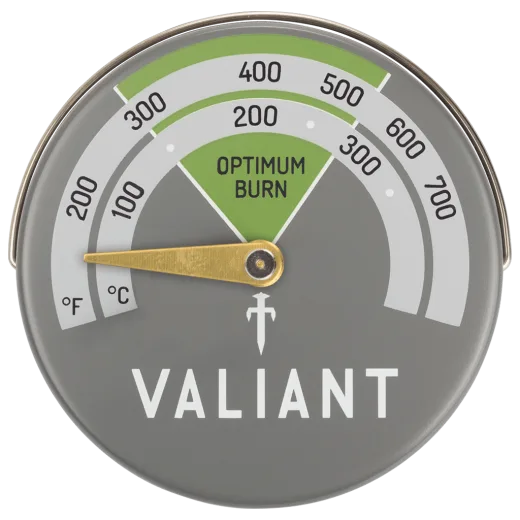
Two lesser points from the guide: never lay the fan flat on its back, and if it vibrates, let it cool and check that each blade tip sits the same distance from the top. A misaligned blade can be bent gently back into line.
How it compares
- Against the Ecofan UltrAir 810: the Ecofan publishes tested airflow and tolerates a hotter stove, but needs 100°C to start. Choose the Valiant for a cool-running stove or a low mantel, the Ecofan for a stove that runs hot.
- Against the Valiant Vanquish 250: the Vanquish is Valiant’s tall fan for large rooms. Choose it only if you have the headroom.
- Against the Valiant Whirlwind: the twin-blade Whirlwind is shorter again at 136mm and starts at 45°C, for very tight spaces. Our best budget stove fans guide covers it.
- Against unbranded six and eight-blade fans: cheaper, often with a thermometer included, but usually with no stated temperature limit or protection. More blades do not mean more air.
Should you buy the Valiant Premium IV?
Buy it if you have a wood burner whose top runs between roughly 100°C and 250°C in normal use, little headroom above the stove, or a modern stove with a cool top plate that leaves high-start fans sitting idle. Pair it with a thermometer and put it beside the flue, not in front of it.
Look elsewhere if your stove often runs above 300°C, if you want published airflow figures to compare, or if you need a tall fan to push air across a large open-plan room.
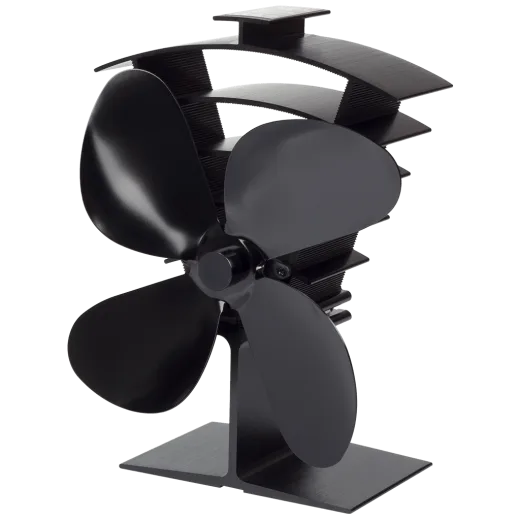
Check price on Amazon. Stove fan stock and prices move once the weather turns.
Frequently asked questions
At what temperature does the Valiant Premium IV start? About 50°C, according to Valiant’s user guide. It speeds up as the stove gets hotter, reaching top speed at about 230°C. Valiant recommends using it once the stove top reaches about 100°C.
What is the maximum temperature for the Valiant Premium IV? 300°C surface temperature. Above about 250°C, a bimetallic strip in the base lifts the front of the fan to protect the motor and generator, then lowers it again as the stove cools.
Why is my Valiant stove fan slow or not spinning? The most common cause is placement. If the fan sits in front of the flue pipe, its top fins get too hot and it slows down. Move it to the rear of the stove, to one side of the flue. Check too that the stove top is above about 50°C, and that the safety lift has not tilted it.
Is the Valiant Premium IV noisy? Owners describe it as quiet, with a soft whirr. Published noise figures vary between listings, from 30dB to 45dB, with no stated test method.
How long is the Valiant stove fan guarantee? 24 months for materials and workmanship. It does not cover wear and tear or damage from misuse, such as running the fan above its maximum temperature.
Can I use the Premium IV on a multi-fuel stove or range? Yes. Valiant says it works with any fuel and on kitchen ranges, hobs, narrowboat and mobile home stoves, provided the surface stays within its temperature range.
Sources
- Valiant, Premium 4 Heat Powered Stove Fan FIR361 user guide, hosted on the B&Q product listing, checked 5 October 2026.
- Valiant, Premium 4 Stove Fan product page.
- Amazon UK listing for the Valiant FIR361, ratings and weight checked 5 October 2026.
Want the seasoning calendar and our log-price watch in your inbox?
Join the Kindling List