How to Store Firewood: Outdoors It Hits 22% in January
Every guide to how to store firewood says the same three things: keep it off the ground, cover the top, leave the sides open. All three are correct and none of them are the whole story, because they describe how to stop rain reaching your logs. They do not address the thing that actually decides what your moisture meter reads in January.
Wood is hygroscopic. Left in air, it gives up or takes up water until it settles at whatever moisture content that air supports, and British winter air supports a great deal more than you want. We ran the numbers on a full year of real weather to find out how much.
What that chart is, and what it means
We took hourly temperature and relative humidity for a Midlands location, latitude 52.48N, longitude 1.84W, at 150 metres, for the twelve months from August 2025 to July 2026. That is 8,760 hourly readings. For each hour we calculated the equilibrium moisture content of wood in that air using the Hailwood-Horrobin model published in the USDA Wood Handbook, then averaged by month.
The result is blunt. From November to February, wood sitting in open British air heads for 20.9%, 21.4%, 22.1% and 21.9% moisture content. Across the whole October to March heating season the mean is 20.4%, at a mean relative humidity of 87%. In 53% of the hours in that period, the air will support wood at 20% moisture or higher.
Compare that with July, when the same air supports 11.6%, and you have the real explanation for why firewood is seasoned over a summer and not over a winter. An open log store dries wood beautifully from April to September and does close to nothing from November to February.
Two important qualifications, because we would rather be accurate than dramatic:
- Equilibrium takes time. A large split log does not reach the air’s equilibrium in a week. Wood at 15% in October will drift upwards through the winter rather than jump, and the surface responds far faster than the core. This is a direction of travel, not an overnight change.
- This is one location and one year. Wetter western and northern parts of Britain will run higher, drier eastern parts slightly lower. The pattern is not going to reverse anywhere in the UK.
The practical conclusion, which almost nobody states plainly: an outdoor log store cannot get your wood under 20% in winter, and it is not supposed to. Its job is to keep liquid water off and air moving. Getting the last few points out is a job for indoors.
The two-store system
This is the setup that actually works in a British climate, and it costs nothing to adopt.
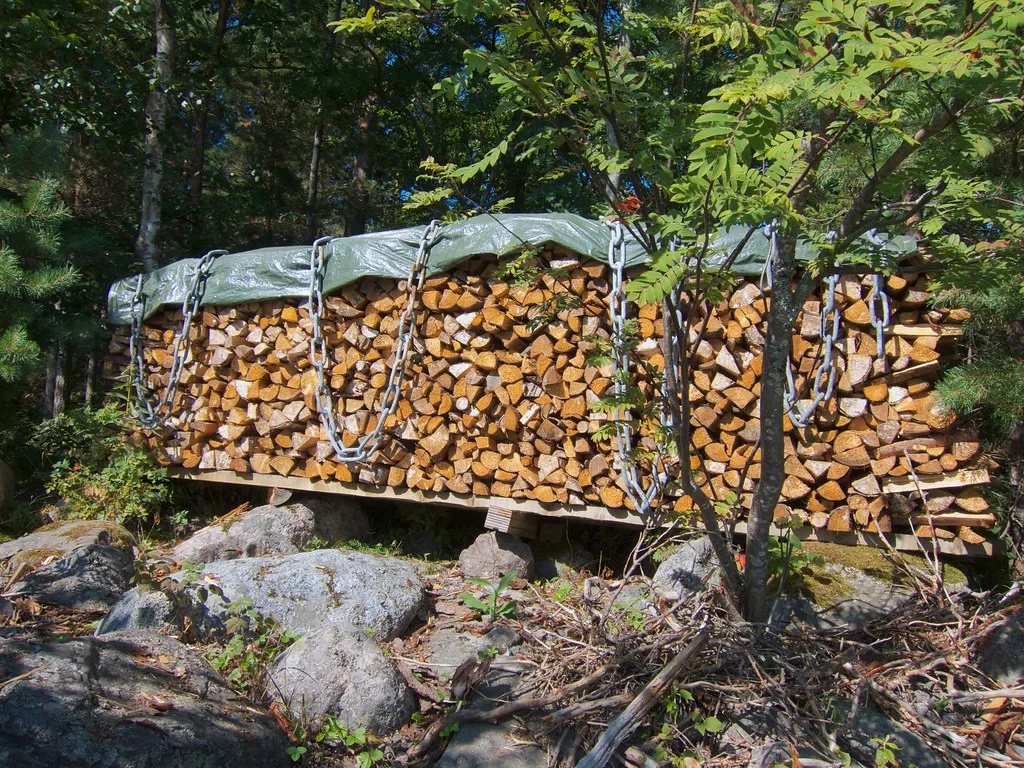
Store one, outdoors: the bulk. Everything you are not about to burn. Off the ground on pallets or bearers, roof over the top, sides open to the wind, ideally on the sunniest and most exposed side of the house rather than tucked behind it. This is where a summer’s seasoning happens and where winter wood waits.
Store two, indoors: the next few days. A rack, basket or alcove inside the heated envelope of the house, holding two or three days of logs. A heated room at 20°C and 45% relative humidity supports wood at about 8.5% moisture content, and even at a damper 55% indoors it is still only about 10.1%. That is a gap of more than ten percentage points against the winter outdoor figure, and it works in your favour every hour the logs sit there.
Bringing logs in is not a nicety or a rustic affectation. It is the only step in the whole chain that lowers moisture content during the months you are actually burning. A few days indoors on a rack, with air able to circulate round the logs rather than a solid stack against a wall, will take the surface moisture out and measurably improve how the wood lights and burns.
Check it rather than trust it: split a log from the indoor rack and read the freshly exposed face, as set out in how to use a moisture meter on firewood. A reading taken on the outside of a log that has been sitting in November air tells you about November air.
Getting the outdoor store right
The outdoor store still matters enormously, because everything above assumes the wood arrives at the door in reasonable condition.
Roof it, do not wrap it. A tarpaulin over the top with the sides open is fine. A tarpaulin down the sides traps evaporating moisture against the stack and is worse than no cover at all. If you can only do one thing, cover the top 30 centimetres or so of the stack and leave everything below it open.
Get it off the ground. Pallets, battens or gravel, anything that stops the bottom row wicking up ground moisture and stops the stack sitting in a puddle. The bottom row is where rot starts.
Point it at the weather, not away from it. The instinct is to shelter a log store. The physics wants the opposite: wind moving through the stack carries moisture away faster than anything else. A south or west-facing wall, exposed, beats a sheltered north-facing corner every time.
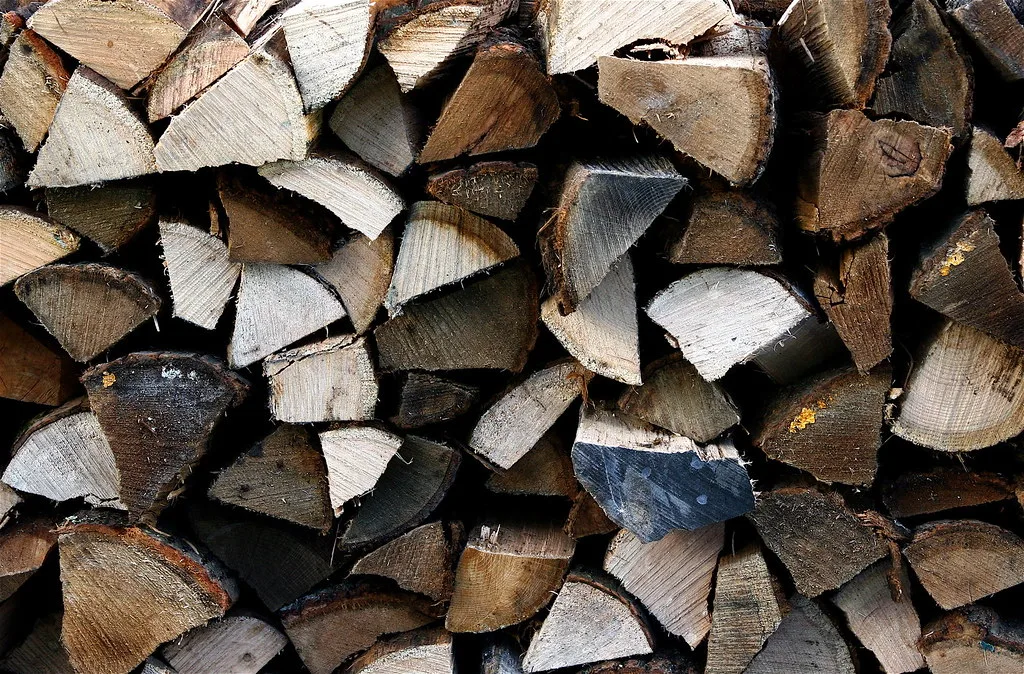
Stack for air, not for tidiness. Leave a gap between the stack and the wall behind it, a few centimetres is enough, and do not pack the rows so tightly that air cannot move between logs. Bark side up on the top row sheds water; bark side down lower in the stack lets the cut faces breathe.
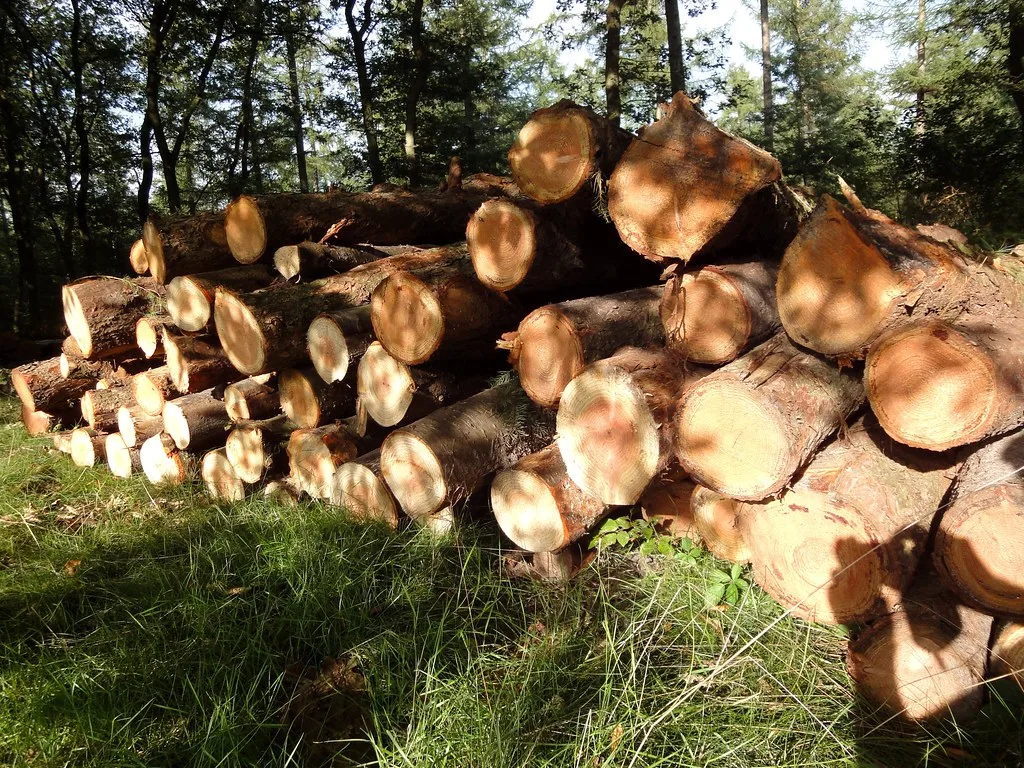
Split before you store, not after. Moisture leaves through the split face far faster than through bark. A round log stored whole for two years can still be wet in the middle. If you are splitting by hand, see how to split logs by hand, or our log splitter guide if the volume justifies a machine.
Rotate the stack. Oldest wood at the front, new deliveries behind. Wood that sits at the back for three years does not get drier, it gets colonised.
Briquettes and heat logs are a different problem entirely
This is where most storage advice goes wrong, because it treats briquettes as small logs. They are not.
A wood briquette is sawdust compressed under high pressure into a dense block, typically at a much lower moisture content than even kiln-dried logs. That compression is the entire product: it is what gives a briquette its density, its long burn and its heat output. It is also completely reversible. Take up water and the fibres swell, the bond breaks, and the briquette crumbles back into damp sawdust. A wet log is a log you have to dry. A wet briquette is no longer a briquette.
They also have no bark and a far greater surface area per kilogram than split wood, so they take up ambient moisture much faster than a log does in the same store.
So the rules invert:
- Store briquettes indoors, or in a genuinely dry outbuilding, not in the open-sided log store. A garage, a shed with a sound roof, a utility room or under the stairs.
- Leave them in their wrapping until you need them. The shrink wrap is a moisture barrier, not just packaging.
- Keep them off a concrete floor. Concrete wicks and it is cold, so it condenses. A pallet or a shelf.
- Buy to your storage, not to the discount. A pallet of briquettes bought in bulk and stored outdoors under a tarpaulin is money spent on future sawdust. Our briquettes buying guide and the kiln-dried logs versus briquettes comparison cover the trade-offs.
Where this leaves the Ready to Burn logo
Wood sold in units under two cubic metres in England must be certified under the Ready to Burn scheme at 20% moisture or less, and the certification applies at the point of supply. It says something true about the wood on the day you bought it. It says nothing about the wood after a winter in your log store, and the chart above is the reason.
That is not a criticism of the scheme, which does exactly what it was designed to do. It is a reminder that the last few metres of the journey are yours. Full detail of what the rules require and who they bind is in the Ready to Burn rules, and the target and how to hit it is in how to season firewood under 20%.
The short version
- Bulk wood outdoors: off the ground, roof only, sides open, exposed to wind and sun, split not round, oldest at the front.
- Two or three days of wood indoors at all times, in a rack with air round it. This is the step that lowers moisture content in winter.
- Briquettes indoors or in a dry outbuilding, wrapped, off the floor.
- Measure on a freshly split face, from the indoor rack, not the outdoor stack.
- Do your seasoning between April and September. British air will not dry wood for you between November and February.
Frequently asked questions
How do you store firewood so it stays dry? Outdoors, keep it off the ground, cover only the top and leave the sides open to the wind, which stops rain wetting it and lets air carry moisture away. Indoors, keep two or three days of logs in a rack inside the heated part of the house, because that is the only place in a British winter where the surrounding air will actually pull moisture out of the wood.
Can firewood get too wet in a log store? It can get wetter than you want without a drop of rain touching it. From November to February, outdoor air in Britain supports wood at roughly 21 to 22% moisture content, above the 20% Ready to Burn threshold, so wood that was dry in September will drift upwards over the winter even under a perfect roof.
Should I cover firewood with a tarp? Cover the top only. A tarpaulin taken down the sides traps evaporating moisture inside the stack, which is worse than leaving it uncovered. Roof over, sides open, is the rule.
How long does firewood need to be indoors before burning? A few days is enough to make a noticeable difference to lighting and burning, and the effect is largest on split faces. Keep a rack topped up rather than carrying in a single armful at a time, and check with a moisture meter on a freshly split face rather than guessing.
Where should I store wood briquettes? Indoors or in a dry outbuilding, still wrapped and off the floor. Briquettes are compressed sawdust, so taking up moisture makes them swell and break apart rather than simply making them wet, and the compression is what you paid for. They should never go in an open-sided log store.
Is it better to store firewood in a shed or outside? Outside in an open-sided store, as long as it has a roof, beats a closed shed for seasoning, because a shed with no through-draught traps evaporated moisture. A closed shed or garage is the right place for briquettes and for the wood you are about to burn, not for the bulk of a seasoning stack.
Does stacking bark up or bark down matter? On the top row, bark up sheds water. Lower in the stack it matters much less than airflow does, and cut faces exposed to moving air will always dry faster than covered ones.
Weather data from the Open-Meteo historical reanalysis, retrieved 28 August 2026; the equilibrium moisture content model is the Hailwood-Horrobin equation as published in the USDA Forest Products Laboratory Wood Handbook, Wood as an Engineering Material.
Want the seasoning calendar and our log-price watch in your inbox?
Join the Kindling List