Lekto vs Ecoblaze: Only One Publishes Its kWh Per Kilo
Comparing Lekto vs Ecoblaze looks like a straight brand fight and is not one. They are different kinds of business selling overlapping products, and the practical difference for a stove owner comes down to information: Lekto publishes a calorific value and a Ready to Burn certificate number against each individual product, and Ecoblaze largely does not. When two 10kg bags of compressed sawdust look identical, the published number is the only thing you can actually compare, and only one of these companies gives you one.
That does not make Ecoblaze the wrong buy. It makes it a buy you have to judge on price and availability rather than specification.
What each company actually is
Lekto Woodfuels is a wood fuel specialist selling direct, with a range built almost entirely around briquettes and heat logs. Everything is sold in 20kg boxes and scaled up to pallets, and each product line has its own published technical specification.
Ecoblaze is part of Zebra Renewables and sells a broader home fuel range: firelighters, kiln-dried hardwood firewood in bags and hessian sacks, BBQ charcoal, and two briquette lines, per its own site. Briquettes are one shelf of a wider business rather than the whole business.
That structural difference explains almost everything else, including the depth of the published specifications and the fact that Ecoblaze’s range moves around more.
The specifications, side by side
Every Lekto figure below is from Lekto’s own product pages for the Hardwood Heat Logs and Night Briquettes. The Ecoblaze figures are what is published, and the gaps are real gaps rather than omissions on our part.
| Made from | Calorific value | Burn time | Pack | Ready to Burn number | |
|---|---|---|---|---|---|
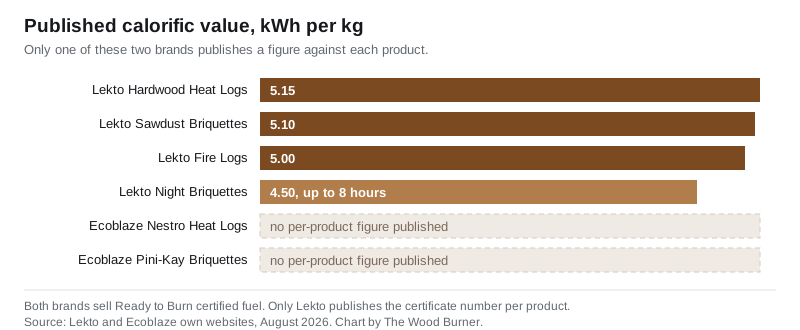
| Lekto Hardwood Heat Logs | 100% hardwood birch sawdust | 5.15 kWh/kg | — | 20kg, 10 logs of 2kg | WS370/00002 |
| Lekto Sawdust Briquettes | Compressed sawdust, under 9% moisture | 5.10 kWh/kg | About 2 hours each | 20kg box | — |
| Lekto Night Briquettes | 100% softwood bark | 4.5 kWh/kg | Up to 8 hours | 20kg, 20 briquettes of 1kg | WS370/00004 |
| Lekto Fire Logs | Compressed wood | 5 kWh/kg | Up to 3 hours | 20kg box | — |
| Ecoblaze Nestro Heat Logs | Hardwood sawdust, no binders | Not published per product | — | Sold in 4, 8 or 16 packs | Ready to Burn certified |
| Ecoblaze Pini-Kay Briquettes | Compressed recycled sawdust | Not published per product | — | 10kg pack, 12 briquettes, 26cm x 6.5cm | Ready to Burn certified |
Two things jump out of that table.
First, Lekto’s Hardwood Heat Log at 5.15 kWh/kg is the highest published figure across either range, and at 2kg a log that is 10.3 kWh from a single piece of fuel. If you are buying on heat per kilo, that is the number to beat and nothing in Ecoblaze’s published information beats it, because nothing in Ecoblaze’s published information competes with it at all.
Second, the Night Briquette has no Ecoblaze equivalent. It is made from softwood bark rather than sawdust, and bark burns differently: lower calorific value at 4.5 kWh/kg, but slow, dense and long, quoted at up to 8 hours. That is a different product category from a heat log, not a worse one, and it is the single strongest reason to buy Lekto specifically. Our Lekto Night Briquettes review covers whether the 8-hour claim holds up in a real stove.
The Ecoblaze availability problem
If you have gone looking for a specific Ecoblaze product and hit dead ends, it is not you. When we reviewed the Ecoblaze RUF fire blocks, the Amazon UK listing showed as unavailable and RUF blocks had disappeared from Ecoblaze’s own site, which now leads with Nestro heat logs and Pini-Kay briquettes.
This is a recurring pattern with Ecoblaze rather than a one-off. Products appear at multiple third-party stockists, then move or vanish, and the range on the company’s own site is not always the range you find at retailers. Ecoblaze briquettes turn up at builders’ merchants, stove shops and general DIY retailers, and stock varies by region and by season.
The practical consequence: do not standardise your winter on an Ecoblaze product until you have confirmed a supply you can restock from. Running out in January and finding your line discontinued is a genuinely annoying way to discover this. Lekto, selling direct in a fixed range, is more predictable, which matters more than a few pence per kilo if you burn every day.
Which to buy for what
Buy Lekto if:
- You want a published kWh/kg to compare against, and a Ready to Burn certificate number you can check
- You want an overnight burn. The bark Night Briquette has no equivalent in the Ecoblaze range
- You burn daily and want a consistent, restockable supply through the season
- You are buying in volume. The 20kg box and pallet structure suits stocking up in summer
Buy Ecoblaze if:
- You have found it locally at a good price and you want fuel now rather than a delivery slot
- You are also buying firewood, charcoal or firelighters and would rather buy from one supplier
- You want kiln-dried hardwood logs as well as briquettes. Ecoblaze sells both, Lekto is briquette-led, and our Ecoblaze kiln-dried logs review covers that side
- You are topping up rather than committing to a winter’s fuel
The comparison that matters more than the brand
Before you spend time on Lekto vs Ecoblaze, be sure a briquette is what you want. Compressed briquettes carry roughly 5 kWh/kg at under 10% moisture against kiln-dried hardwood at around 20% moisture, so you get more heat per kilo because you are not paying to boil water out of the fuel. What you give up is the flame character: a briquette burns steadily and looks less like a fire than a split log does.
Most people who burn seriously end up using both, briquettes for heat and logs for the look, and our page on kiln-dried logs vs briquettes sets out where each wins. If you want the wider field rather than these two brands, see the best wood briquettes in the UK and the best night briquettes.
One thing that applies to both brands and to every briquette: do not overload the stove. High-density briquettes expand as they burn and release heat faster than a split log, and a firebox packed as you would pack it with logs will overfire. Two or three briquettes is usually a full load where four or five logs would have been.
The verdict
On published specification, Lekto wins, and it wins because it is the only one that publishes. The Hardwood Heat Log at 5.15 kWh/kg is the highest stated figure either brand offers, the Night Briquette occupies a category Ecoblaze does not enter, and the per-product Ready to Burn numbers mean you can verify what you are buying rather than trusting a logo.
On buying rather than comparing, Ecoblaze has a real advantage if it is on a shelf near you at a price you like, and the broader range means one delivery instead of two if you also need firewood and firelighters. Its weakness is churn: the range moves, individual products disappear, and it is not a brand to build a winter around without checking your supply first.
If you burn most evenings from October to March, buy Lekto and stock up in summer. If you burn occasionally and buy as you go, buy whichever is in front of you at the right price, and neither will disappoint you.
Frequently asked questions
Are Lekto or Ecoblaze briquettes better? Lekto on specification, because it is the only one of the two that publishes a calorific value and Ready to Burn certificate number for each individual product. Its Hardwood Heat Log is stated at 5.15 kWh/kg. Ecoblaze briquettes are Ready to Burn certified but the per-product figures are not published, so they have to be judged on price and availability instead.
What is the highest heat output briquette between the two? Of the published figures, Lekto’s Hardwood Heat Logs at 5.15 kWh/kg, made from 100% hardwood birch sawdust, with 10.3 kWh from each 2kg log. Lekto’s Sawdust Briquettes follow at 5.10 kWh/kg and its Fire Logs at 5 kWh/kg. Ecoblaze does not publish comparable per-product figures.
Why can’t I find Ecoblaze RUF fire blocks any more? They have gone from Ecoblaze’s own range, which now leads with Nestro heat logs and Pini-Kay briquettes, and the Amazon UK listing has been showing as unavailable. Some general retailers may still hold stock. This kind of range change is a recurring pattern with the brand rather than a one-off.
Do Lekto Night Briquettes really burn for 8 hours? That is Lekto’s stated figure, and the reason it is plausible is the material: they are 100% softwood bark rather than compressed sawdust, which burns slower and denser at a lower calorific value of 4.5 kWh/kg. Real burn time depends heavily on how far down you close the air, and a well-damped stove is what the claim assumes.
Are both brands Ready to Burn certified? Yes, both sell Ready to Burn certified fuel, which is the Defra scheme confirming moisture content below 20%. The difference is traceability: Lekto publishes the certificate number against each product, such as WS370/00002 for its Hardwood Heat Logs, so you can verify it. Ecoblaze states certification without publishing per-product numbers.
Can I mix Lekto and Ecoblaze briquettes in the same stove? Yes, there is no reason not to, and mixing a heat log with a longer-burning bark briquette is a common way to run a stove overnight. What matters is total load rather than brand. Briquettes burn hotter and faster than split logs of the same weight, so load fewer of them than you would logs, whichever brand they came from.
Want the seasoning calendar and our log-price watch in your inbox?
Join the Kindling List