Best Firelighters for Wood Burners UK: the 10-Minute Test
Start with something the roundups do not tell you. There is no quality standard for firelighters in this country. If you are hunting the best firelighters for wood burners in the UK and you have been using the Ready to Burn logo as a shortcut, that logo is not certifying the firelighters. It certifies wood fuel for moisture content, and a wax-dipped bundle of wood wool is not wood fuel in the sense the scheme means.
So the badge you see on a firelighter supplier’s website is almost always earned by their logs, sitting on a page that also sells firelighters. Both of the natural brands below display it, and in both cases it belongs to the firewood.
That leaves exactly one comparable number that manufacturers actually publish: burn time. Flamers claim up to 10 minutes. Ecoblaze claim up to 8. That gap is the whole argument, because a firelighter’s only job is to stay alight long enough for your kindling to catch, and nothing else on the packaging is measurable.
What Ready to Burn actually covers
Worth being precise, because this is where most firelighter advice goes wrong.
Under the Air Quality (Domestic Solid Fuels Standards) (England) Regulations 2020, wood fuel sold in volumes under 2m³ in England must be certified as Ready to Burn. The scheme’s own site sets out the split: Woodsure administers it for wood fuels, HETAS administers it for manufactured solid fuels, and the criterion is a moisture content of 20 per cent or less, verified by independent inspection.
Firelighters are not in that list, and the test would be meaningless if they were. Nobody is checking the moisture content of a wax-coated firelighter. What that means for you as a buyer is simple and slightly uncomfortable: on firelighters, there is no certification to fall back on, so you are judging on composition, published burn time and the manufacturer’s own description. Our page on the Ready to Burn rules covers what the scheme does apply to, which is your logs, and it is the part of the fire that is actually regulated.
The only number that matters, and it is short
A firelighter has one job: hold a flame under your kindling long enough for the kindling to be burning on its own. If it dies first, you are back to square one with a stove full of scorched sticks.
Here is what the manufacturers publish about their own products:
| Firelighter | Composition | Published burn time |
|---|---|---|
| Flamers (Certainly Wood) | natural wood wool dipped in wax | up to 10 minutes |
| Ecoblaze Natural Firelighters | 100 per cent natural | up to 8 minutes |
| Zip 100 per cent Natural Firelighter Cubes | natural | “long burning”, no figure given |
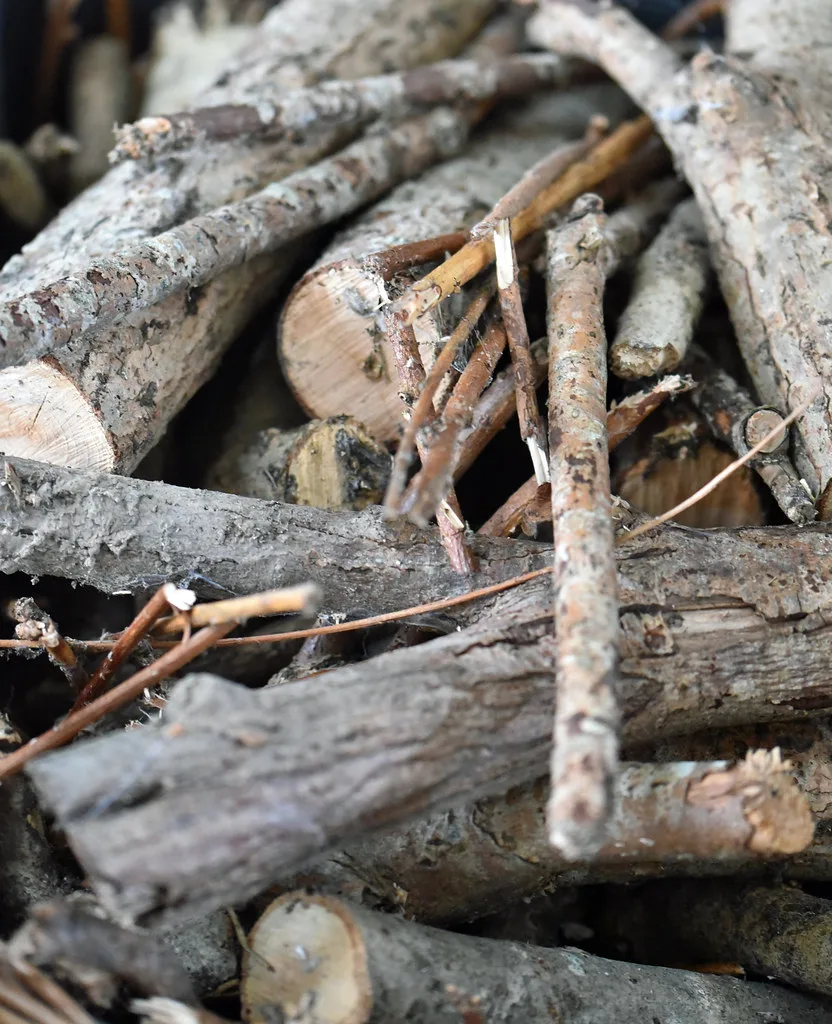
Two things follow. First, eight to ten minutes is not long. If your kindling is damp, or too thick, or you have stacked it so tightly that air cannot get through, the firelighter will burn out before anything catches. Nine failed lights out of ten are a kindling problem wearing a firelighter costume, which is why making your own kindling properly does more for your success rate than switching brands.
Second, a supplier who will not give a burn-time figure at all is telling you something. “Long burning” is not a number.
Best overall: Flamers
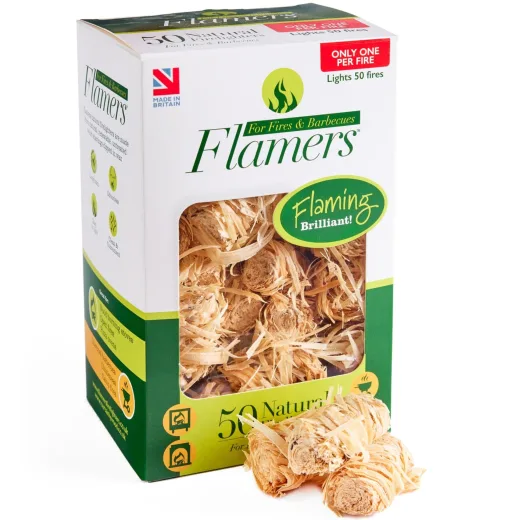
Flamers are the reference product in this category, and the specification is unusually plain. Certainly Wood describes them as natural wood wool dipped in wax, with no chemicals and no odour, burning for up to 10 minutes, sold in boxes of 24, 30, 50 and 200.
Ten minutes is the longest published figure of the natural firelighters here, and in a wood burner that margin matters more than it does on a barbecue, because you are lighting a closed appliance where you cannot easily poke things back into life without dumping the door draught. They are also the cleanest of the three to handle: wood wool does not leave a film on your fingers the way a paraffin block does, which matters when the next thing you touch is the stove door handle.
The 50 box is the sensible starting size if you have not used them before. Do the arithmetic before you commit to a bigger one, though, and see the section on pack sizes below.
Best value in bulk: Ecoblaze Natural Firelighters
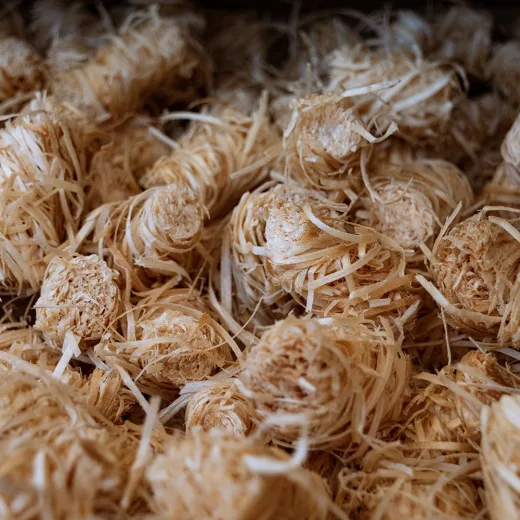
Ecoblaze publish up to 8 minutes and describe the product as 100 per cent natural, clean, odourless and smokeless. Two minutes less than Flamers, and in practice that is the difference between a comfortable margin and a tight one if your kindling is not perfect.
Where they earn their place is the 200 box, which is the size that actually matches how much you get through in a season. We rate the same company’s RUF fire blocks elsewhere on the site, so the brand is not new to us, and the firelighters are consistent with the rest of the range: unglamorous, honest about what they are, sold in quantities that assume you burn regularly.
If your kindling is bone dry and finely split, eight minutes is plenty and this is the one to buy in volume. If your kindling comes out of a shed that is only half dry, buy the ten-minute option instead and stop trying to save a firelighter.
Best for pizza ovens and food: Zip natural cubes
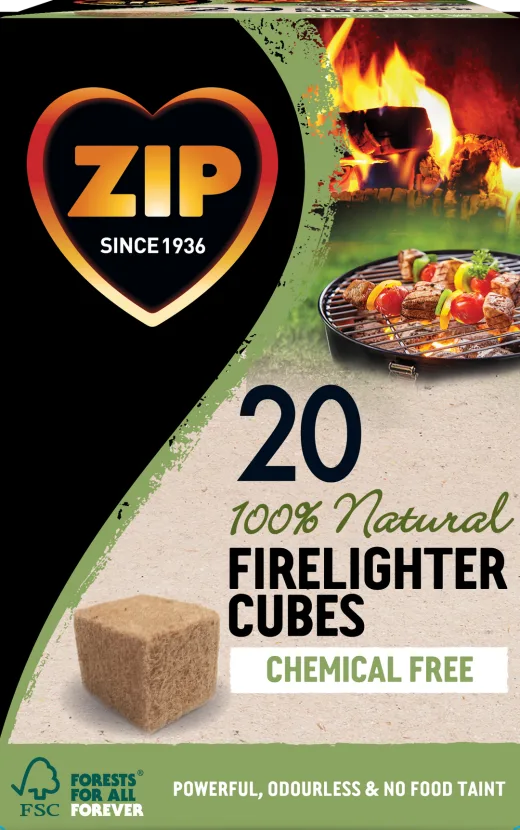
The reason to separate this one out is food. Zip describes its 100 per cent natural cubes as clean burning and says they “will not taint your food”, and calls them its most powerful natural firelighter. That is a claim aimed squarely at pizza ovens, fire pits and barbecues, where anything paraffin-based is a genuine problem, and it carries over to a wood burner in a room you are sitting in.
The cubes come in a 20 pack, so this is not the format for a household lighting a stove daily through the winter. It is the format for someone who lights a stove at weekends and cooks outside in the summer and wants one product for both. If you are also burning in a pizza oven or fire pit, the fuel choice matters at least as much as the firelighter.
What to avoid in a stove
The traditional white block, the paraffin or kerosene-soaked kind sold in supermarkets, lights reliably and costs very little. It is also the one product here we would not use in a wood burner, for a reason that has nothing to do with performance.
An open fire vents almost everything up the chimney. A stove is a closed box in a room you are sitting in, and it is opened and closed while it is lighting. Anything with a petrochemical smell will put some of that smell into the room, and it lingers in a way it does not on a barbecue in a garden. Manufacturers of the natural products lead on “odourless” precisely because their customers care about this.
There is a second, quieter reason. A stove has an airwash system keeping the glass clear, and a modern one may have secondary and tertiary air paths designed around clean combustion. Nothing sooty and nothing that leaves a residue is doing that system any favours. Zip’s own all-purpose blocks are marketed on “unique energy granules” that burn hotter for longer and light difficult fuels including hard smokeless coal and damp wood, which is exactly the job they are good at. That job is not lighting a clean, dry stove in a living room.
How many you actually need per season
This is the calculation nobody does, and it changes which pack you buy.
The manufacturers assume one. Flamers print “only one per fire” on the box and rate the 50 pack at “lights 50 fires”, which is a usefully honest way to size a pack: the count on the front is the number of fires, not the number of pieces you will get through. Most people use more than one, so treat the manufacturer’s figure as the best case and your own habit as the real one.
Light the stove once a day through a five-month burning season and that is roughly 150 lights. At the one-per-fire rate Flamers print on the box, a 200 box lasts the winter with a wide margin. At two firelighters a time, which is what most people use in practice and what a top-down light asks for, 150 lights is 300 firelighters and a 200 box runs out in early February.
So the honest answer on pack size: if you burn daily, buy 200 and expect to buy again. If you burn at weekends, roughly 40 lights a season, a 50 box does a whole winter. Buying 24 or 30 makes sense only as a first try of a brand you have not used.
The other lever is using fewer per light. A top-down light puts the firelighter and kindling on top of the logs rather than under them, so the fire burns downwards, and it needs less firelighter and produces markedly less smoke in the first ten minutes than building a pile and lighting the bottom.
The three things that beat a better firelighter
Before you spend anything, these matter more than which box you buy.
- Dry kindling. If your kindling is above 20 per cent moisture, no firelighter saves you, because the first two minutes of the flame go into boiling water out of the wood instead of raising it to ignition. Our guide on what moisture firewood should be applies to kindling just as much as to logs.
- Thin kindling. Finger-thick catches from a firelighter. Wrist-thick does not, whatever the packet says. A kindling splitter is the fastest way to get consistently thin sticks out of an ordinary log.
- Air. Open every air control fully for the light, and leave gaps in the stack. A firelighter smothered under tightly packed kindling burns for its ten minutes inside a box with no oxygen and achieves nothing.
Get those three right and an eight-minute firelighter is ample. Get them wrong and a fifteen-minute one will not rescue you.
Frequently asked questions
Are firelighters Ready to Burn certified? No. Ready to Burn certifies wood fuel and manufactured solid fuel, on a criterion of 20 per cent moisture content or less, under the Air Quality (Domestic Solid Fuels Standards) (England) Regulations 2020. Firelighters are not covered by the scheme. Where you see the logo on a firelighter supplier’s site, it belongs to their logs or briquettes, not to the firelighters.
How long does a natural firelighter burn? Manufacturers publish between about eight and ten minutes. Certainly Wood state up to 10 minutes for Flamers, Ecoblaze state up to 8 minutes for their natural firelighters. Treat those as best-case figures with good air supply, and assume less if your kindling is packed tightly around them.
How many firelighters do I need to light a wood burner? One is enough with dry, finely split kindling and a good air supply. Two is realistic for most people, and is what a top-down light typically uses. If you find yourself reaching for a third, the problem is the kindling or the airflow, not the firelighter.
Are natural firelighters better than white paraffin blocks in a stove? For a stove in a living room, yes, mostly on odour. Natural wood wool and wax products are sold as odourless and residue-free, and a stove is opened and closed inside the room while it lights, so any petrochemical smell ends up in the air you are breathing. Paraffin blocks light more aggressively and are better at difficult fuels such as hard smokeless coal, which is a different job.
Can I use firelighters in a DEFRA exempt stove? Yes. Exemption applies to the appliance and to the fuels you burn in it, not to how you light it. What the exemption does restrict is the fuel: in a smoke control area you must burn an authorised fuel or use an exempt appliance with the fuels it was approved for. Read the Ready to Burn rules for what that means when you are buying logs.
Do firelighters go off? Wax-based firelighters do not spoil, but they do dry out and lose some wax if stored warm, and they absorb damp if stored badly, which is why a box left open in an unheated outhouse lights worse in February than it did in October. Keep them sealed, indoors, and away from the stove itself.
What is the best firelighter for a pizza oven? One that explicitly says it will not taint food. Zip make that claim for their 100 per cent natural cubes. Anything paraffin-based is a poor choice near food, and the same logic applies to your choice of logs, which we cover in logs for pizza ovens and fire pits.
Want the seasoning calendar and our log-price watch in your inbox?
Join the Kindling List