Best Kindling for Wood Burners UK: the Number on the Bag
Here is the test almost nobody applies when buying the best kindling for wood burners in the UK, and it takes four seconds in a shop. Turn the bag over and look for a number. Not the Ready to Burn logo, a certificate number, next to the name of the company that holds it. If it is not there, the bag is not compliant, and that tells you more about the supplier than any amount of packaging copy.
We covered elsewhere that Ready to Burn does not certify firelighters, because a wax-dipped bundle of wood wool is not wood fuel in the sense the scheme means. Kindling is the opposite case. Kindling is wood, sold in units well under two cubic metres, for burning in a home. It sits squarely inside the regulations, and most people do not realise it.
What the law actually requires on a bag of kindling
The rules are the Air Quality (Domestic Solid Fuels Standards) (England) Regulations 2020. Part 2 defines a “relevant unit of wood” as wood supplied for combustion in domestic premises in England, “in a unit, whether comprising one piece of wood or more, the volume of which is less than two cubic metres”. A net of kindling is exactly that. There is no exemption for small pieces.
Regulation 4 then sets three separate prohibitions, and this is the part worth reading properly. A supplier must not supply that wood unless it has been certified by an approved certification body. They must not supply it if there is reason to believe the moisture content is above 20%. And, under regulation 4(3), they must not supply it unless it is accompanied, “whether on its packaging or otherwise”, by both the logo and the relevant information, which the regulation defines as:
(a) the name of the person who obtained the certificate from the approved wood certification body in respect of the relevant unit of wood in question; and (b) the number of the certificate issued by the approved wood certification body.
So the logo on its own is not compliance. The name plus the number is. Each of those three prohibitions carries a summary conviction fine.
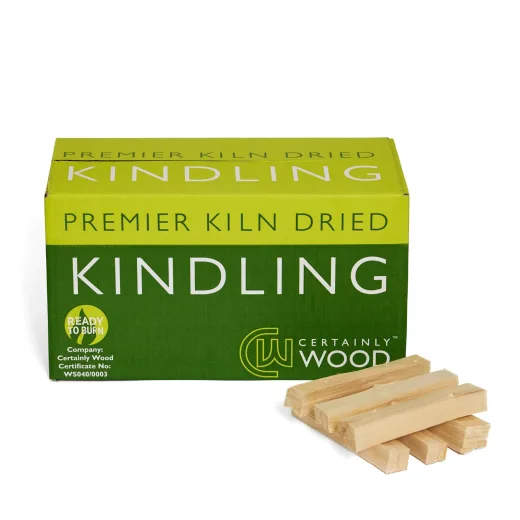
You can see what a compliant bag looks like on the Certainly Wood box further down this page. Beside the Ready to Burn logo, in small type nobody reads, it prints “Company: Certainly Wood” and “Certificate No: WS040/0003”. That block of text is not decoration. It is regulation 4(3) being complied with, and its absence on a bag is the single fastest way to tell an established fuel supplier from someone bagging up offcuts.
Two further details that matter in practice. The moisture test is done to ISO 18134-1 or ISO 18134-2, as referred to in the firewood specification BS EN ISO 17225-5, on a sample supplied at certification, and the certificate holder must then “use best endeavours” to make sure what they sell has the same characteristics as that sample. And the small forester exemption, which delayed compliance for suppliers of under 600 cubic metres a year, ran for twelve months from 1 May 2021 and expired long ago. Everyone selling you a net of kindling in England is covered.
These are the English regulations. Wales has its own equivalent scheme and Scotland does not have this one, so if you are buying north of the border the logo is a quality signal rather than a legal requirement.
Twenty per cent is the ceiling, not the target
The legal limit is a maximum of 20% moisture content. For firewood logs that is a sensible threshold. For kindling it is unambitious, because kindling has one job: to catch from a firelighter and produce enough flame to light a log. A stick at 19% moisture is legal and lights slowly. A stick at 12% catches almost instantly.
This is where the brands genuinely separate, and only some of them publish the number.
Certainly Wood states that its kindling is “dried to below 12% moisture” and that a box holds between 110 and 120 sticks weighing 2.5 to 3.5kg. That is the only headline moisture figure in this category we have seen published well below the legal ceiling, and Certainly Wood is a founding member of the Woodsure Ready to Burn scheme. It also says the wood is not made from pallets, which is worth more than it sounds, because reclaimed pallet offcuts are a common source for cheap kindling and can carry heat treatment stamps, paint, nails and glue.
It also gives a usage figure, four to six sticks per fire, which is the only honest way to work out whether a pack size makes sense for you. If you light a stove five nights a week from October to March, that is roughly 110 fires and something like 550 sticks, or five of those boxes. Buy accordingly and stop paying delivery on small boxes.
Softwood or hardwood kindling
Received wisdom says softwood for kindling because it lights faster. The UK market has largely gone the other way, and the reason is worth understanding rather than arguing with.
Softwood, pine and spruce, is less dense and often resinous, so it takes a flame very readily and burns out fast. That is ideal if your firelighter is good and your logs are dry, and it is why cheap kindling is nearly always softwood offcuts.
Hardwood kindling, typically birch, ash or oak, is denser. It takes slightly longer to catch and then holds a flame considerably longer, which is what you want if you are bridging from a firelighter to a dense hardwood log. Certainly Wood and Ecoblaze both sell hardwood kindling for that reason.
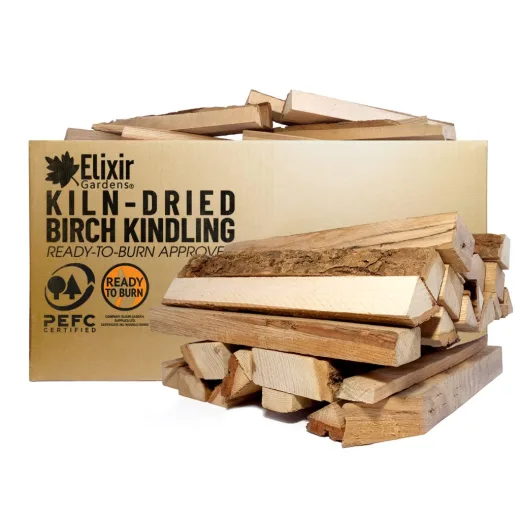
Birch is the specialist’s answer, and Elixir Gardens sells a Ready to Burn certified kiln-dried birch kindling, sawn rather than split, sourced from PEFC certified forests, with moisture stated as under 20%. Birch bark is the best natural firelighter in Britain: it contains oils that will take a match even when damp. If you want one kindling that behaves like a softwood on ignition and a hardwood after it, birch is it.
The others worth naming
Ecoblaze sells a 6.5kg bag of kiln dried hardwood kindling and states that its kiln drying gets moisture below 20%, giving it Ready to Burn accreditation. The bag size is the point: 6.5kg is a realistic season-opening quantity rather than a token box, and we rate the same company’s RUF fire blocks and kiln dried logs elsewhere.
Log Barn sells kindling in roughly 10kg bumper packs of four 15 litre bags, and is unusually explicit in its own listing, describing the product as certified Ready to Burn and “compliant with 2020 Air Quality Regulations”, kiln-dried to 20% or less. Splitting a bulk order across four sealed bags is genuinely better than one large sack, because kindling reabsorbs moisture from a damp shed faster than logs do, given its surface area.
Oak pizza sticks are a separate category rather than a better kindling. Certainly Wood sells an oak stick aimed at small and portable pizza ovens, where density and a clean hardwood flavour matter more than fast ignition. If that is your use case, our guide to logs for pizza ovens and fire pits covers the fuel side properly.
Making your own, and why the moisture number still applies
The cheapest kindling in Britain is the offcuts you already have, and a kindling splitter turns a single log into a fortnight of sticks in about a minute. Our guide to making kindling covers the method.
The catch is the same as with logs. Home-split kindling from a log that is at 25% moisture is at 25% moisture, and it will smoulder rather than catch. Kindling dries much faster than a log because of its surface area, so a batch split in spring and stored under cover will be ready by autumn, but it does not dry sitting in a basket next to a cold stove. If you are unsure, that is what a moisture meter is for, and the reading you want on kindling is well under the 20% you would accept on a log.
What to avoid
- Bags with the logo and no certificate number. Regulation 4(3) requires both. A missing number means either a supplier who has not certified, or one who has not read the rules. Neither inspires confidence about the moisture.
- Pallet offcuts sold loose. Heat treatment stamps, paint, staples and glue. You cannot tell what has been on a pallet, and a stove is a closed box in the room you are sitting in.
- Buying by volume without checking weight. Kindling is sold in litres, kilograms and “nets” interchangeably, which makes comparison almost impossible. Convert everything to kilograms before deciding anything is good value.
- Storing it in the shed with the logs. Kindling has an enormous surface area to volume ratio, so it takes up moisture from damp air far faster than a log does. Keep a week’s worth indoors and leave the rest sealed.
Frequently asked questions
Does kindling have to be Ready to Burn certified in the UK? In England, yes, if it is sold in a unit under two cubic metres for burning at home. The Air Quality (Domestic Solid Fuels Standards) (England) Regulations 2020 define that as a “relevant unit of wood” and there is no exemption for small pieces. The bag must carry the logo, the name of the certificate holder and the certificate number. Wales runs an equivalent scheme; Scotland does not have these regulations.
What moisture content should kindling be? Legally it must be 20% or less in England, the same limit as firewood. Practically you want lower. Kindling exists to turn a small flame into a large one, and a stick close to the legal limit does that slowly. Certainly Wood publishes below 12% for its kindling, which is the sort of figure that makes lighting a stove a single-match job.
Is softwood or hardwood kindling better? Softwood catches faster and burns out faster, hardwood catches a little slower and sustains a flame longer. If your logs are dense hardwood, hardwood kindling bridges the gap better. If you are lighting a fire pit or you use plenty of firelighter, softwood is fine and usually cheaper. Birch is the useful middle: the bark takes a flame like a softwood and the wood behaves like a hardwood afterwards.
How much kindling do I need for a season? Work backwards from fires, not from bags. Certainly Wood puts it at four to six sticks per fire alongside a firelighter. Five fires a week from October to March is about 110 fires, so roughly 550 to 660 sticks. At 110 to 120 sticks a box that is five or six boxes, which is worth knowing before you order a single box and pay delivery six times.
Can I use pallet wood as kindling? Not in a stove, unless you know exactly where it came from. Pallets are frequently treated, painted, glued and full of staples, and heat-treated timber is not the same as untreated. Reputable kindling producers say explicitly that their product is not made from pallets, which tells you they consider it a real distinction rather than marketing.
Why won’t my kindling light? Almost always moisture, occasionally size. Kindling stored in a damp shed reabsorbs moisture much faster than a log because of its surface area, so a batch that lit fine in November can fail in February. Keep a few days’ worth indoors. If it still will not catch, the sticks are too thick: you want pieces you can snap with your fingers, not miniature logs.
Want the seasoning calendar and our log-price watch in your inbox?
Join the Kindling List