Valiant Stove Thermometer Review: 140°C to 280°C Green Band
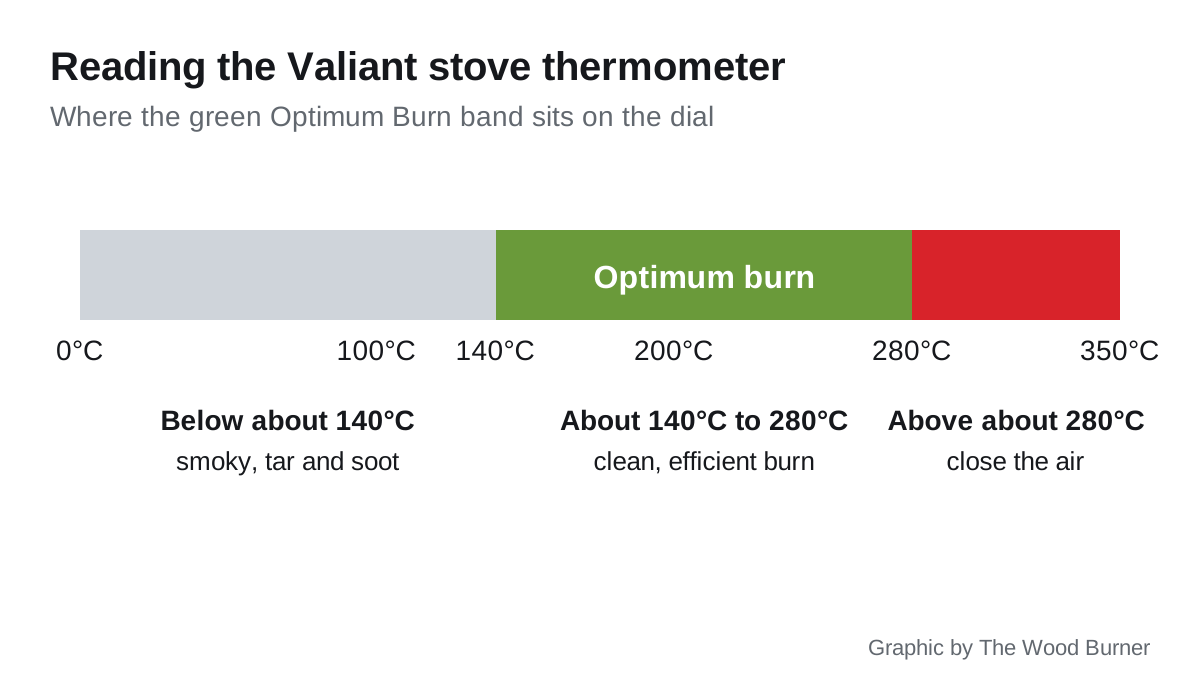
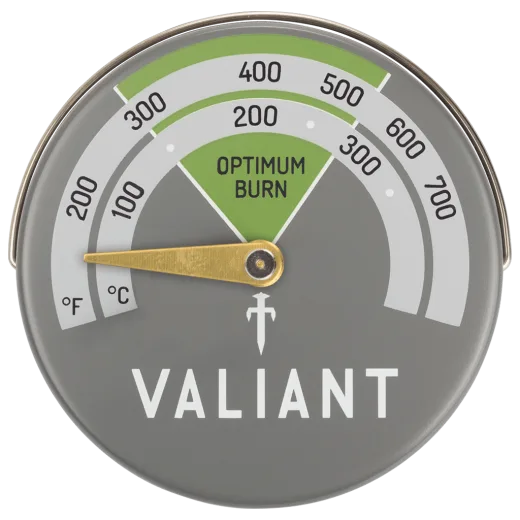
This Valiant stove thermometer review is about one small dial and one question: what is it actually telling you? The Valiant FIR116 is a 63mm magnetic thermometer that sits on a stove top or a steel flue pipe. Its face has a single green “Optimum Burn” band, which on the Celsius scale runs from about 140°C to about 280°C. Keep the needle in the green and you are burning cleanly; let it sit below and you are making smoke and tar; let it climb past and you are wasting wood and stressing the stove. It is simple, cheap and very popular. It also has limits that the listing does not spell out, mostly about where you put it.
It is the thermometer we rate as the best all-round UK choice in our best stove thermometers roundup. This review goes into the detail.
Valiant FIR116 at a glance
| Valiant magnetic stove thermometer | |
|---|---|
| Model | FIR116 (green and grey); FIR138 is the red and black version |
| Dial | 63mm, °C and °F scales |
| Weight | 50g |
| Fixing | Built-in magnet, holds on steel up to about 425°C (800°F) |
| Optimum Burn band | About 140°C to 280°C (about 280°F to 540°F), read from the dial |
| Works on | Stove tops, and most vitreous enamel, iron or steel flue pipes |
| Not for | Stainless steel or twin-wall insulated flue pipe |
| Amazon UK | 4.6 stars from more than 6,000 ratings, checked 11 October 2026 |
Dimensions, magnet rating and fitting rules are from Valiant’s product page and its printed instructions. The band figures are our reading of the dial on Valiant’s product photo; the dial marks the green band, not exact numbers, so treat them as approximate.
Reading the burn zones correctly
The dial has one coloured zone, not three. There is no printed “too cool” or “too hot” label, so here is what each part of the scale means in practice:
- Below the green (under about 140°C): the fire is smouldering. Wood burning this cool gives off smoke, and that smoke condenses in a cold flue as tar and soot. If the needle sits here for long, give the fire more air or a smaller, drier log on a better bed of embers. Our guide on what moisture firewood should be explains why wet wood keeps you stuck down here.
- In the green (about 140°C to 280°C): the clean, efficient zone. Glass stays clear and the chimney shows little or no smoke.
- Above the green (over about 280°C): too hot. You are burning wood faster than you need to and putting the stove, the flue and anything on the stove top under strain. Close the air down and do not add more wood until it settles.
Two things make the reading more useful:
It lags. A dial thermometer takes several minutes to catch up with the fire. After reloading or changing the air, wait about ten minutes before you adjust again, or you will chase the needle up and down.
Your stove’s manual comes first. The green band is a general guide. Some stoves run happily a little cooler or hotter, and the manufacturer’s figures override the dial.
Where Valiant says to fit it
This is where most people go wrong. Valiant’s instructions give three positions, in order:
- On the flue pipe just as it leaves the stove (the flue collar). Valiant’s listing calls this the optimum position, because it gives a stable reading that tracks both the stove and the flue gas.
- High up on the side of the stove, towards the front.
- Flat on the stove top.
Valiant sells one dial for all three, so it is a compromise. A surface reading on a flue pipe is lower than the temperature of the gas inside it, and a stove top reading depends on where on the plate you put it. That is why our best stove thermometers page suggests choosing one spot and learning what “right” looks like there, rather than treating the number as exact.
If you run a heat-powered fan, put the thermometer on the stove top beside it. Every fan has a maximum surface temperature, and the dial tells you when you are close. Valiant’s own Premium IV fan lifts itself off the plate above about 250°C and should not be used where the surface goes past 300°C, so the top of the green band on this thermometer is already close to its limit.
Where it does not work
Stainless steel flue pipe. Most stainless steel is not magnetic enough to hold the dial. Valiant says not to try: fit it to the stove collar or put it on the stove top instead.
Twin-wall insulated flue. Valiant’s instructions say it is not suitable. The insulation keeps the outer skin cool, so even if it stuck, it would read far too low. You need a probe thermometer that reaches into the flue; our stove thermometers roundup covers one.
Very high temperatures. Valiant warns that extreme heat can weaken the magnet and, in extreme cases, make the thermometer fall off. If yours keeps dropping off a hot flue, that is a sign the stove is running far too hot, not a fault with the magnet.
What owners say
With more than 6,000 ratings averaging 4.6 out of 5 on Amazon UK, the FIR116 is one of the most reviewed stove accessories there is. The repeated praise is that it is easy to read across a room, stays put and helps new stove owners learn how to run a fire. The repeated complaint is that it is delicate: knock it with a log or a poker and the needle can be pushed out of true. Reviews also note it works on range cookers, barbecues and chimineas, which Valiant confirms on its instructions.
Read the reviews and you will also find people saying it “reads wrong”. Usually it is on a stainless or twin-wall flue, or being compared with an infrared thermometer pointed at a shiny surface. Neither is a fair test.
Should you buy it?
Buy it if you have a stove with a steel or vitreous enamel flue pipe or a steel or cast iron top, you are new to running a wood burner, or you run a stove fan and want to protect it. It does one job well and it is the obvious first accessory after a moisture meter.
Look elsewhere if your flue is twin-wall or stainless, where you need a probe or a stove top thermometer only, or if you want exact flue gas temperatures, which no surface dial gives you.
Frequently asked questions
Where should I put a Valiant stove thermometer? Valiant says the best spot is on the flue pipe just as it leaves the stove. If that is not practical, put it high on the side of the stove towards the front, or flat on the stove top. If you use a stove fan, the stove top next to the fan is the most useful place.
What temperature is the Valiant Optimum Burn zone? The green band on the FIR116 dial runs from about 140°C to about 280°C (about 280°F to 540°F), going by Valiant’s product photo. Your stove manual’s own figures take priority.
Does the Valiant thermometer work on a stainless steel flue? No. Stainless steel is usually not magnetic enough to hold it. Valiant says to fit it to the stove collar or place it on the stove top instead.
Can I use a Valiant thermometer on twin-wall flue? No. Valiant’s instructions say it is not suitable for twin-wall insulated flue, because the outer wall stays cool. Use a probe thermometer that reaches into the flue gas.
Why does my stove thermometer keep falling off? Very high temperatures weaken the magnet, so a thermometer that drops off a hot flue usually means the stove is running too hot. On stainless steel flue, it will never hold well.
What is the difference between the FIR116 and FIR138? Only the colour. The FIR116 is green and grey and the FIR138 is red and black; both are the same 63mm magnetic thermometer.
Sources
- Valiant, Magnetic Thermometer product page: model codes, 63mm, 50g, magnet rated to about 425°C, fitting rules, stainless steel warning.
- Valiant, stove thermometer printed instructions (PDF from the product page): fitting positions, twin-wall and stainless warning, magnet weakening at high temperature.
- Amazon UK listing for the Valiant FIR116, checked 11 October 2026: rating count and owner reviews.
Want the seasoning calendar and our log-price watch in your inbox?
Join the Kindling List