Valiant vs Ecofan Stove Fan: 50°C Start or 175 CFM?
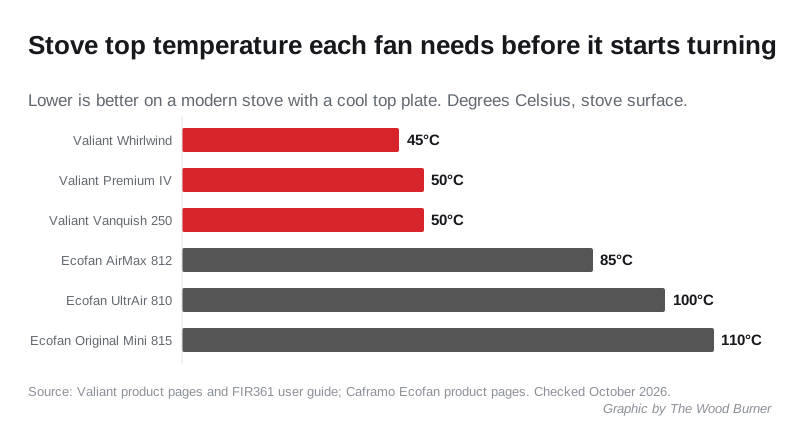
The Valiant vs Ecofan stove fan choice comes down to how hot your stove top runs. Valiant’s fans start turning at around 45 to 50°C, which suits modern clean-burn stoves with cool top plates. Ecofan’s wood stove fans need 85 to 110°C to start, but they are the only mainstream fans with independently standardised airflow figures, up to 175 cubic feet per minute, and they tolerate a hotter stove, up to 345°C.
Both are proper branded fans with two-year cover and real temperature limits, which puts them a step above the unbranded fans that fill Amazon. Ecofan is the original, made by Caframo in Wiarton, Ontario. Valiant is the UK accessories brand from Hertfordshire whose fans are, in its words, designed and engineered in the UK. Here is how the two ranges line up.
The two ranges side by side
| Fan | Starts at | Maximum stove top | Height | Airflow published |
|---|---|---|---|---|
| Valiant Whirlwind FIR365 | 45°C | Not stated in our source | 136mm | No |
| Valiant Premium IV FIR361 | About 50°C | 300°C (lifts itself above about 250°C) | 199mm | No |
| Valiant Vanquish 250 | 50°C | 340°C (best between 80 and 250°C) | 251mm | No |
| Ecofan AirMax 812 | 85°C | 345°C | 25.4cm | 175 CFM |
| Ecofan UltrAir 810 | 100°C | 345°C | 22.9cm | 125 CFM |
| Ecofan Original Mini 815 | 110°C | 345°C | Compact | 85 CFM |
Sources: Valiant’s Vanquish 250 page and Premium IV user guide; Caframo’s Ecofan product pages, checked for our Ecofan AirMax review. Ecofan’s airflow is tested to ANSI/AMCA standards, according to Caframo.
The start temperature: Valiant’s big advantage
A heat-powered fan makes its own electricity from the temperature difference between its hot base and its cool top fins. Below its start temperature it does nothing at all, and just above it, it barely turns.
That matters more than it used to. Stoves built to Ecodesign rules burn cleaner and often have well-insulated tops, so the plate can sit at 100 to 150°C for long stretches of a slow evening burn. A Valiant starting at 50°C will be well into its stride there. An Ecofan UltrAir, which only starts at 100°C, will be turning slowly or not at all, and the Original Mini at 110°C even less.
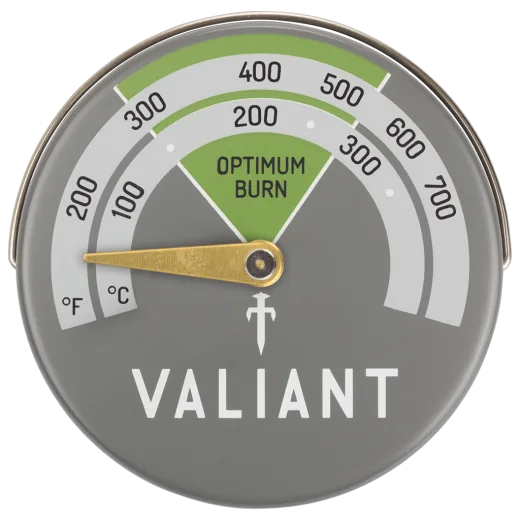
If you do not know how hot your stove top runs, find out before you buy. A magnetic stove thermometer costs far less than either fan and settles the question in one evening. Our stove thermometer guide covers where to put it.
Airflow and build: Ecofan’s advantage
Ecofan publishes airflow; Valiant does not. Valiant claims its Premium IV moves up to 70% more air than competitors and the Vanquish up to 90% more, but gives no CFM figure for either, so there is nothing to compare those claims with. Caframo publishes a figure for every model: 175 CFM for the AirMax, 125 CFM for the UltrAir and 85 CFM for the Original Mini. Airflow is what pushes warm air across the room instead of letting it rise to the ceiling, so it is the number that matters most on a big or open-plan room.
Ecofan copes with a hotter stove. Ecofan’s classic wood stove fans are rated to a 345°C surface. The Valiant Premium IV is rated to 300°C, with a bimetallic strip that tips the fan up off the plate above about 250°C. The taller Vanquish 250 goes to 340°C. On an older cast-iron stove, or one you run hard on cold nights, that headroom is worth having.
Ecofan sells the spare parts. The small motor is the part of any stove fan that wears out. Caframo’s own payback table allows for a replacement motor kit, MRKCA01BX, roughly every 4.5 heating seasons, and the kit fits the UltrAir, AirMax and AirDeco models with push-fit connectors. That turns a failing Ecofan into a five-minute repair. We have not found an equivalent motor kit sold by Valiant.
Which to buy for your stove
| Your stove and room | Our pick | Why |
|---|---|---|
| Modern Ecodesign stove, top often under 150°C | Valiant Premium IV | Starts at about 50°C, so it actually turns |
| Low beam or mantel over the stove | Valiant Premium IV, or the Whirlwind if very tight | 199mm and 136mm tall |
| Hot stove, average lounge | Ecofan UltrAir 810 | 125 CFM, rated to 345°C |
| Hot stove, large or open-plan room, plenty of headroom | Ecofan AirMax 812 | 175 CFM, the most published airflow of any mainstream fan |
| Large room, prefers Valiant, stove runs cooler | Valiant Vanquish 250 | Tall, starts at 50°C, rated to 340°C |
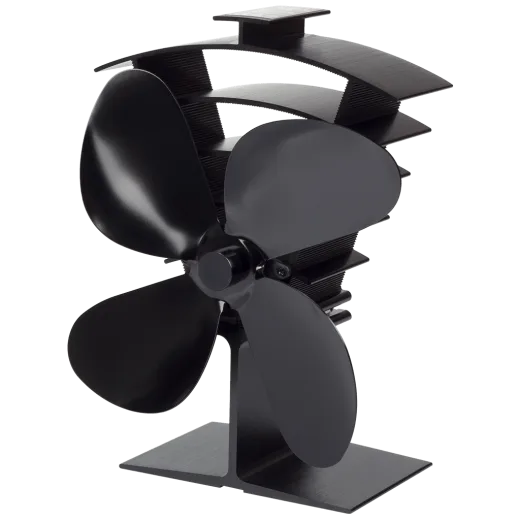
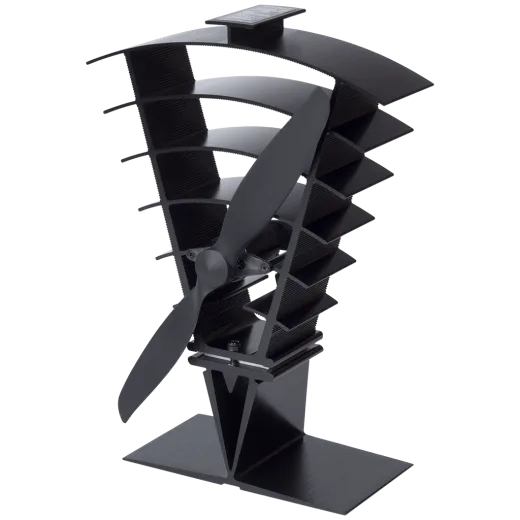
Valiant Premium IV
The default pick for most UK living rooms with a modern stove. It starts early, it is short enough for most fireplace recesses, and Valiant gives a 24-month guarantee. The full detail, including the placement mistake that kills fans early, is in our Valiant Premium IV review.
Ecofan UltrAir 810
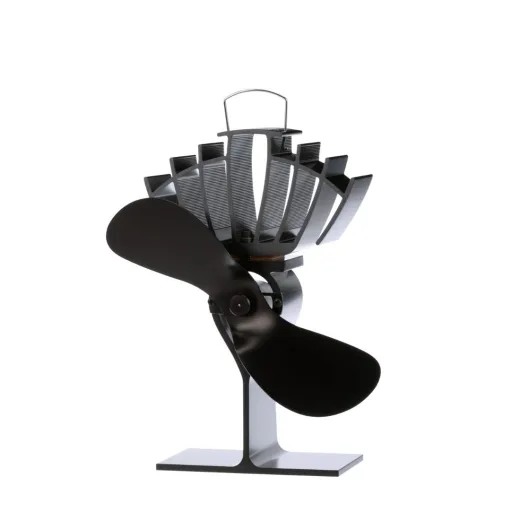
The sensible Ecofan for a typical lounge with a stove that runs properly hot. At 22.9cm it is shorter than the AirMax, and at 125 CFM it still moves more air on paper than any fan with an unpublished figure. It is wasted on a stove that rarely reaches 150°C.
Ecofan AirMax 812
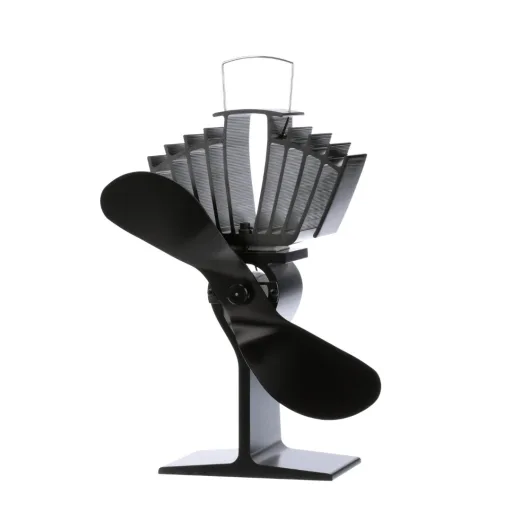
The most capable fan in either range, for a hot wood stove in a big room, and the one you can keep repairing for years. Check you have at least 30cm of clear space above the stove top. Our AirMax review covers who should skip it.
Valiant Vanquish 250
Valiant’s answer to the AirMax: 251mm tall, 0.7kg, with a 50°C start and a 340°C maximum. Valiant gives its best working range as 80 to 250°C. It is the one to pick if you want a tall fan for a larger room but your stove does not run hot enough to wake an Ecofan.
Check price on Amazon. Both brands’ fans sell out in cold snaps, and prices move with the season.
Where to put either fan
Both makers give the same advice, and getting it wrong shortens the life of any fan:
- Stand it at the rear of the stove top, to one side of the flue pipe, so it draws cooler air from behind.
- Never put it in front of the flue, where rising hot air heats the top fins and the fan slows down. Valiant warns this causes premature failure of the motor and generator.
- Keep the stove top below the fan’s maximum: 300°C for the Premium IV, 340°C for the Vanquish, 345°C for the Ecofans.
If you are also weighing up the number of blades, our 4-blade vs 6-blade stove fan comparison explains why more blades does not mean more air.
Frequently asked questions
Is Valiant or Ecofan better? Neither is better across the board. Valiant fans start at about 45 to 50°C, which suits modern stoves with cooler tops and low mantels. Ecofan fans need 85 to 110°C to start but publish tested airflow up to 175 CFM, handle stove tops up to 345°C and can be repaired with a replacement motor kit.
Why won’t my Ecofan spin on my new stove? Most likely the stove top is not hot enough. The UltrAir needs 100°C and the Original Mini 110°C before they move, and many modern stoves run cooler than that on a slow burn. Check with a stove thermometer, and make sure the fan is beside the flue, not in front of it.
Where are Ecofan and Valiant fans made? Caframo says every genuine Ecofan is designed and manufactured at its facility in Wiarton, Ontario, Canada. Valiant describes its fans as designed and engineered in the UK; it does not say where they are manufactured.
How long does a stove fan last? The thermoelectric module should last many years; the small motor is the part that wears. Caframo’s own figures allow for a replacement motor roughly every 4.5 heating seasons on the AirMax, and it sells the kit. Running any fan above its maximum temperature shortens its life.
Does a Valiant fan move as much air as an Ecofan? There is no way to say for certain, because Valiant publishes no airflow figure in CFM. Ecofan’s figures are tested to ANSI/AMCA standards, according to Caframo.
Which stove fan is best for a low mantel? The Valiant Premium IV at 199mm, or the twin-blade Valiant Whirlwind at 136mm. Ecofan’s UltrAir is 22.9cm and the AirMax 25.4cm, and both need clear space above them to work well.
Sources
- Valiant, Vanquish 250 product page, checked 13 October 2026.
- Valiant, Premium 4 Heat Powered Stove Fan FIR361 user guide.
- Caframo, the Ecofan story, and the AirMax 812 and UltrAir 810 product pages.
- Amazon UK listings for each fan, availability checked 13 October 2026.
Want the seasoning calendar and our log-price watch in your inbox?
Join the Kindling List