Best Eco Firelighters UK: Why 'Natural' Still Means Paraffin
Hunting for the best eco firelighters UK stoves and pizza ovens can use, you will find every box on the shelf saying “natural”, “chemical-free” and “odourless”. Some of those claims are meaningful. Some are marketing on a technicality. The difference is worth understanding before you buy a box of 250, because it decides whether you can cook over the fire an hour later.
This page explains what is actually in a natural firelighter, what the labels do and do not tell you, and which ones are worth the money for a wood burner.
What you are replacing
The traditional white firelighter block is a compressed sawdust or wood-flour carrier soaked in kerosene, a petroleum distillate. It lights instantly in any conditions and it is cheap. It also gives off a strong solvent smell as it burns off, which is why nobody uses them under food, and it usually takes two or three to get a stove going from cold.
That smell is the practical reason people switch, more than the environmental one. If you light a pizza oven or a barbecue with a kerosene block, you wait for the smell to clear before anything goes near the heat.
The three things “natural” can actually mean
Here is where the labelling gets slippery. Almost every natural firelighter on the UK market is wood wool, which is fine shavings of softwood packed into a nest, held together and made to light by a wax coating. What varies is the wax, and the boxes rarely make it obvious.
Wood wool plus fully refined paraffin wax. Paraffin wax is petroleum-derived, but it is a solid, odourless, inert wax rather than a volatile solvent, which is why these still burn cleanly and without smell. Certainly Wood is refreshingly straight about this: its Flamers are described as “natural wood shavings coated in fully refined paraffin wax, rather than the chemical solvents used in some firelighter brands”. They still work, they still do not smell, and they are still made in Britain. They are just not petroleum-free.
Wood wool plus a natural or vegetable wax. This is the genuinely petroleum-free version. Lekto describes its Natural Firelighters as wood wool with a thin coating of natural wax, “odourless and kerosene-free”, and safe to cook on from the moment they light.
Compressed wood and vegetable oils. A smaller group uses no wool nest at all, just compressed sustainable wood impregnated with vegetable oil. These tend to burn slightly shorter and are usually the cheapest of the natural options.
None of these produces a fire that is meaningfully “cleaner” once it is running. What determines the smoke coming out of your chimney is the moisture content of your logs, not the thing you lit them with. See our guides to seasoning firewood under 20 per cent and the Ready to Burn rules.
The four worth buying
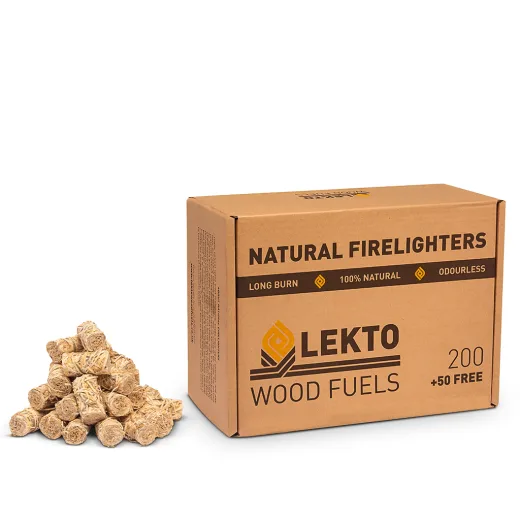
Lekto Natural Firelighters
The one to pick if petroleum-free actually matters to you. Wood wool with a thin coating of natural wax, kerosene-free and odourless, and Lekto is explicit that fires lit with them are safe to cook on immediately. They come in a box of 250, they are physically large, and the maker’s claim is that one is enough per fire against two or three of the kerosene type. Burn time is quoted at up to 10 minutes, which is long enough to get proper kindling away without babysitting it.
The box size is the catch: 250 is a lot of firelighters if you have one stove and light it twice a week. It is the right buy for a household that lights a fire most days, or that also runs a pizza oven and a fire pit.
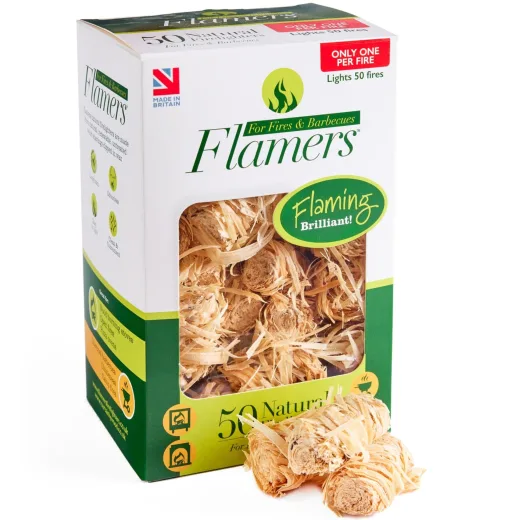
Certainly Wood Flamers
The best-known British option and the one you will find in most stove shops. Wood wool dipped in wax, made in Britain, no chemical odour, up to 10 minutes of burn, and one per fire. Certainly Wood also notes they will light when wet, which is a real advantage for an outdoor log store or a camping trip.
Buy these with your eyes open on the wax: they are fully refined paraffin, not vegetable. If your objection to standard firelighters is the smell and the solvent, Flamers solve it completely. If your objection is petroleum, they do not. The 50 pack is the sensible size to try before committing to a bulk box.
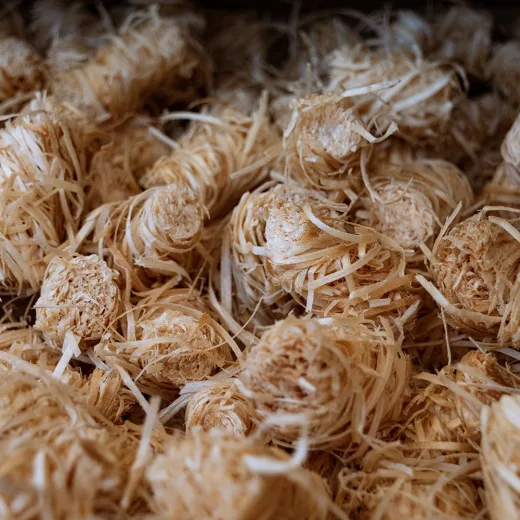
Ecoblaze Natural Firelighters
The value option in a big box. Fast lighting, odourless, and sold in a 200 box that works out considerably cheaper per light than the smaller packs. They are aimed at wood burners, stoves, fireplaces and BBQ ovens, and they do the job without any ceremony.
Worth buying if you get through a lot and are not fussy about which wax. Check current price on Amazon before committing, because the bulk boxes swing around more than the small packs do.
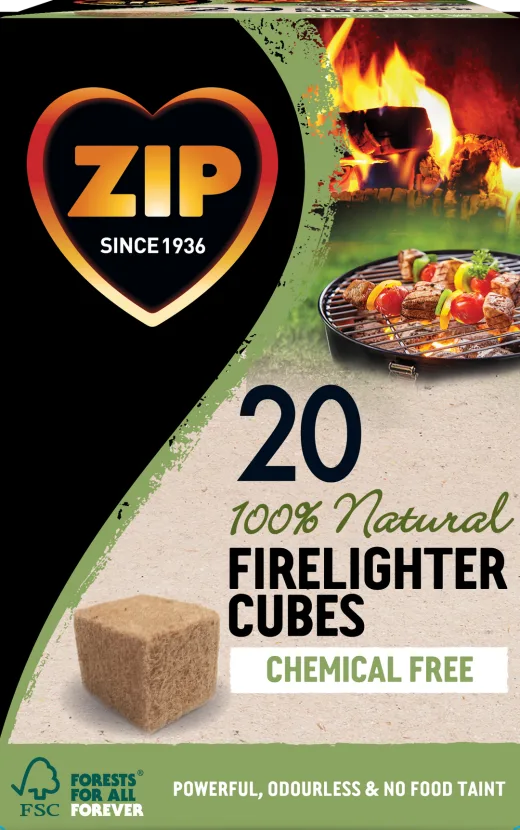
Zip 100% Natural Firelighter Cubes
The supermarket-adjacent option, and useful because Zip is the brand most people already recognise from the kerosene blocks. The 100% Natural cubes are the different product in that range: they are marketed as not tainting food, which is the whole point of switching.
A pack of 20 cubes is small, which makes this the right one to buy first if you want to test whether a natural firelighter actually lights your particular stove from cold before you order 250 of anything.
How to use one so it actually works
Natural firelighters fail for one reason: people use them like kerosene blocks, buried under a heap of logs, and then complain they went out.
Use one, not three. The wood wool nest has a large surface area and burns for the best part of ten minutes. Two of them in the same spot mostly just burn each other.
Light it in the open, not under a pile. Put the firelighter on the grate or the base, build a small tent or a top-down stack of kindling around and above it, and give it air. Our guide to making kindling covers the sizes that catch, and the best kindling to buy if you would rather not split your own.
Open everything. Primary air fully open, air wash open, door on the latch for the first few minutes if your stove allows it. A natural firelighter produces less aggressive initial flame than a solvent-soaked block, so it needs the draught.
Do not put a log on it. The firelighter’s job is to light kindling. The kindling’s job is to light a small log. Skipping the middle step is why the fire dies four minutes in.
Use long matches or a long lighter. Reaching into a stove with a standard match to light something at the back is how people burn their knuckles. See the best long matches for wood burners.
Are they worth the extra?
Per light, a natural firelighter costs more than a kerosene block. Two things claw most of that back. You need one instead of two or three, and you are not throwing away the first ten minutes of a barbecue or pizza oven waiting for a smell to clear.
The honest case against is that if you only ever light an indoor stove, never cook over it, and do not mind the smell, the cheap blocks work perfectly well. The case for is everything else: pizza ovens, fire pits, chimineas, campfires, and any household where somebody objects to the smell of paraffin in the sitting room. Our firelighters guide for wood burners covers the wider range, and if you are lighting outdoors, the best logs for pizza ovens and fire pits is the companion piece.
Whatever you light it with, the fire will only be as good as the fuel. Dry wood at or under 20 per cent moisture, checked with a moisture meter, makes far more difference than any firelighter ever will.
Frequently asked questions
Are natural firelighters really chemical-free? Most are wood wool held together with wax, and the wax is the part that varies. Some brands, including Certainly Wood’s Flamers, use fully refined paraffin wax, which is petroleum-derived but odourless and solid rather than a volatile solvent. Others, such as Lekto, use a natural wax and describe their firelighters as kerosene-free. “Natural” on the box does not automatically mean petroleum-free.
Can you cook over a fire lit with natural firelighters? Yes, and that is the main practical reason to buy them. Lekto states its firelighters are safe to cook on from the moment they light because there is no kerosene involved. With a standard white block you have to wait for the solvent to burn off before food goes near the heat.
How many natural firelighters do I need per fire? One. Wood wool firelighters are larger and burn for up to about ten minutes, against the two or three kerosene blocks people typically use. If you find yourself needing two, the problem is usually damp kindling or a closed air control, not the firelighter.
Do eco firelighters work when damp? Some do. Certainly Wood states that Flamers will light when wet, which matters for an outdoor log store or a camping trip. That is not a universal property of wood wool firelighters, so check the specific product if you store them outside.
Do natural firelighters make less smoke? Not meaningfully once the fire is going. Smoke from a wood burner is overwhelmingly a function of how wet your logs are and how much air the fire is getting. A firelighter burns for ten minutes at the start; the logs burn for hours.
Which natural firelighter should I try first? A small pack, so you find out whether it lights your stove from cold before you buy in bulk. The 20-cube Zip pack or the 50 pack of Flamers are both small enough to be a low-risk test.
Sources
Want the seasoning calendar and our log-price watch in your inbox?
Join the Kindling List