Do Stove Fans Work? What the 14% Wood Saving Test Shows
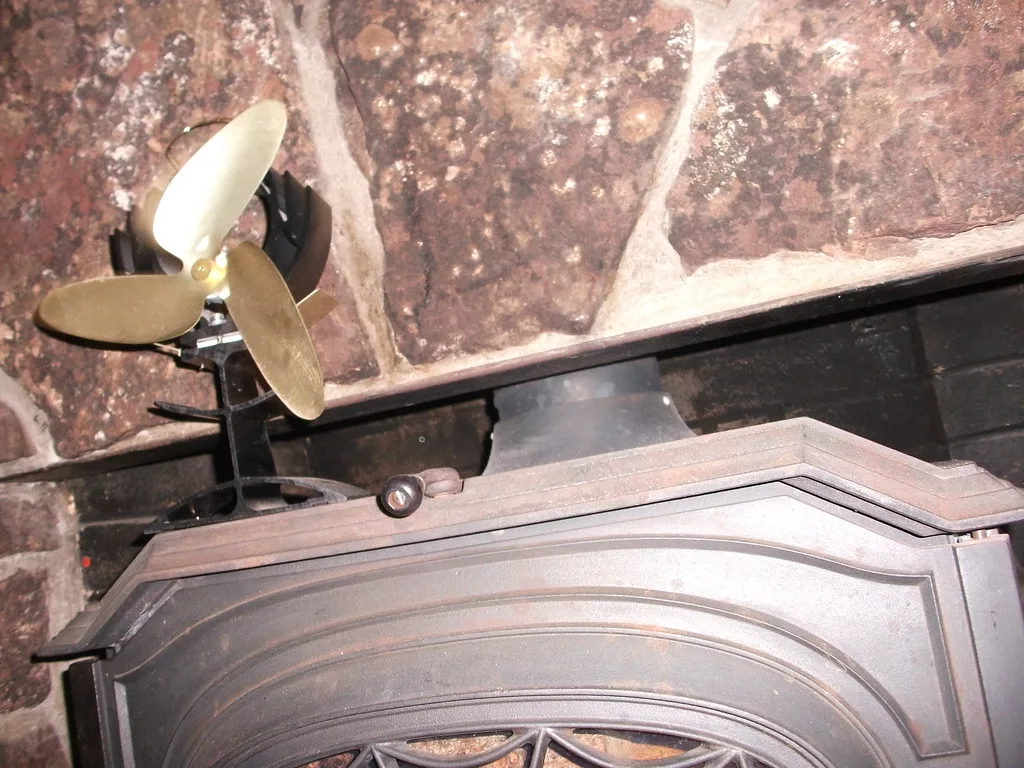
Do stove fans work? Yes, at the one thing they are designed to do: moving warm air off the top of the stove and out across the room, so the sofa gets warm sooner and the far corner is not left cold. The best evidence, a 2010 test run with University of Waterloo engineers, found a fan cut the wood needed to keep a room at the same comfortable temperature by about 14%. What a fan cannot do is make your stove produce more heat, warm a room you cannot see from the stove, or work on a stove whose top never gets hot.
That study was run with the manufacturer, and most of the other numbers you will see on boxes are the makers’ own. Below is what the physics says, what the evidence actually shows, where fans make no difference, and a simple way to find out whether one is doing anything in your room.
How a heat-powered fan turns without electricity
A stove fan has no battery and no plug. At its base is a thermoelectric module, a thin wafer that produces a small electric current when one side is hotter than the other (the Seebeck effect). The base sits on the hot stove top; the fins above it are cooled by the room air. The temperature difference between the two drives a tiny motor that turns the blades.
That has two consequences people miss:
- It needs a difference, not just heat. The hotter the stove top and the cooler the fins, the faster it spins. That is why a fan crawls when you first light the stove and speeds up as the top plate heats.
- There is a minimum start temperature. Ecofan’s Original Mini is designed for top plates of about 110 to 325°C. Valiant says its Premium IV starts at about 50°C. A stove with a cool top, such as many inset and cassette stoves, may never turn a fan at all. Check your top plate temperature with a stove thermometer before buying.
The fan uses only a tiny fraction of the stove’s heat to run. It does not “steal” warmth from the room in any meaningful way.
Why a stove needs help spreading heat
A wood burner heats a room in two ways: radiant heat, which you feel on your face in front of the glass, and convection, where the air touching the hot stove body rises. That warm air goes straight up and collects at the ceiling. In a room with a high ceiling, the air near the ceiling can be far warmer than the air at seating height, while the far side of the room stays cool.
A fan sitting on the stove top pushes some of that rising air out horizontally across the room before it reaches the ceiling. It is not adding heat. It is moving the heat you already paid for to where you are sitting.
What the evidence actually shows
The Waterloo study (2010). Caframo, which makes Ecofan, built a “room within a room” test facility with researchers from the University of Waterloo’s Faculty of Engineering. The inner room was furnished like a living room with a wood stove; the outer room controlled the “outdoor” temperature. Fifty-four sensors measured air and surface temperatures. The tests ran in pairs, with and without a fan, keeping the room at a comfort temperature of 22.5°C, and the researchers weighed the wood burned. The result announced in November 2010 was about 14% less wood with the fan, with Caframo saying savings could reach 19%.
That is a careful method: it measured wood burned to stay equally comfortable, which is the question that matters. But it was a single study, run with and published by the manufacturer, in one test room.
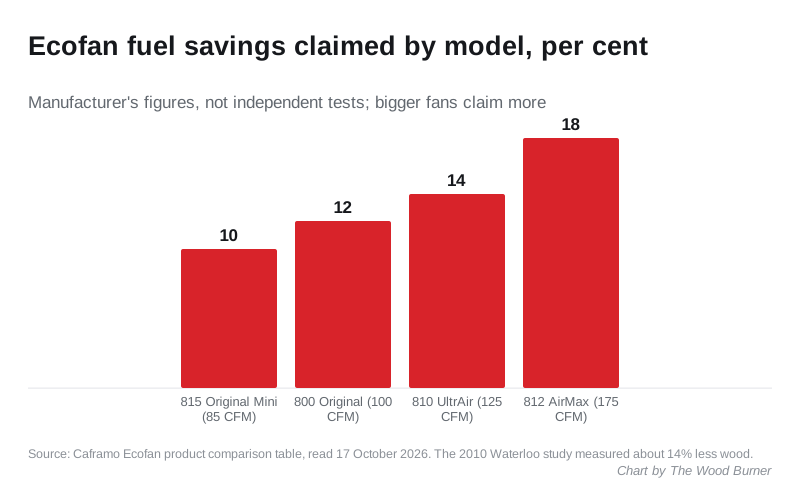
The makers’ per-model claims. Caframo now lists fuel savings by model, rising with fan size. It also claims each fan gets the room from 17°C to 20°C faster, by 17% for the smallest up to 38% for the AirMax, in what it calls a standard test environment. These are the maker’s figures.
Cheap unbranded fans. Marketplace listings claim savings of 20% or more with no test behind them. We have found no published test for any of these figures. That does not mean the fans do nothing, only that the number on the box is not evidence.
Our reading: a fan genuinely helps, and in the right room you will feel it. Expect “the sofa warms up sooner and I add a log less often”, not a transformation of your fuel bill.
How much air a fan really moves
Airflow figures are in cubic feet per minute (CFM). Converted to cubic metres an hour, Ecofan’s range runs from about 144 m³/h for the 85 CFM Original Mini to about 297 m³/h for the 175 CFM AirMax.
A typical living room of 4m by 5m with a 2.4m ceiling holds 48 cubic metres of air. So the smallest fan moves the room’s volume about three times an hour, and the largest about six times. That is gentle: you will see the air moving across the stove top, but you will not feel a draught from the sofa. It is enough to stop warm air pooling, not enough to push heat through a doorway into another room.
When a stove fan makes little or no difference
- The stove top is too cool. Inset stoves, cassette fires and some modern clean-burn stoves keep the top plate below the fan’s start temperature, and Ecofan says its fans are not recommended for wood or gas stove inserts. If it will not turn, or barely turns, it is doing nothing.
- The stove is in a small room. In a snug room that is already warm everywhere, there is no cold corner for the fan to fix.
- You want to heat another room. Three to six air changes an hour in the stove room will not carry heat up the stairs or down a corridor. That is a job for an open door and the house’s own air movement.
- The fan is in the wrong place. Ecofan’s own advice is to place the fan near the side or back of the stove top, where cooler air can be drawn from behind over the fins, and never in front of the stove pipe or at the front of the stove. In the wrong spot the fins run hot, the temperature difference shrinks and the fan slows.
- The stove is too small for the room. A fan spreads the heat you have. If the stove’s output is not enough for the space, no fan will fix that.
Test it in your own room
You do not have to take anyone’s word for it. Two cheap digital room thermometers will tell you.
- Put one thermometer at seating height on the far side of the room from the stove, and one high up, on a shelf or picture rail near the ceiling.
- Light the stove as normal for three or four evenings without the fan. Note both readings an hour after lighting, and how many logs you use in an evening.
- Repeat for three or four evenings with the fan, on similar outdoor temperatures.
If the fan is working, the gap between the ceiling and seating-height readings narrows and the seating-height reading rises sooner. If neither changes, the fan is not doing much in your room, and the start temperature or the placement is the first thing to check.
Is it worth buying one?
A fan is worth it if your stove top regularly gets above the fan’s start temperature, the room is open-plan or has a high ceiling, or you sit some distance from the stove. It is not worth it on a cool-topped inset stove, in a small room, or as a way to heat the rest of the house.
If you are buying, our how to choose a stove fan page sets out the checks in order, starting with start temperature. Our best heat-powered stove fans page compares the models, and our Valiant vs Ecofan comparison covers the two brands most UK buyers choose between. You can read Caframo’s own placement and temperature advice in the Ecofan UK FAQs.
Frequently asked questions
Do stove fans really save wood? The best evidence is a 2010 study run by Caframo with University of Waterloo engineers, which found about 14% less wood was needed to keep a room at the same temperature. It was a single study by the manufacturer, so treat the figure as a guide rather than a guarantee.
Do stove fans need electricity or batteries? No. A thermoelectric module in the base turns the temperature difference between the hot stove top and the cooler fins into a small current that drives the motor.
Why does my stove fan spin slowly? The stove top is not hot enough, or the fins are too warm to give a big temperature difference. It speeds up as the top plate heats. If it barely turns at full burn, your stove top may be too cool for that fan.
Will a stove fan heat another room? Not really. Even the largest fans move a typical living room’s air only a few times an hour, which spreads heat within the room but will not push it through a doorway.
Do stove fans work on inset stoves? Usually not. Inset and cassette stoves often keep the top plate below the start temperature of a heat-powered fan, so check the top temperature with a thermometer first.
Can a stove fan overheat? Yes. Every fan has a maximum surface temperature, and running above it can damage the thermoelectric module or the motor. Ecofan’s Original Mini, for example, is rated to 325°C at the top plate.
Want the seasoning calendar and our log-price watch in your inbox?
Join the Kindling List