How to Choose a Stove Fan: Start Temperature Comes First
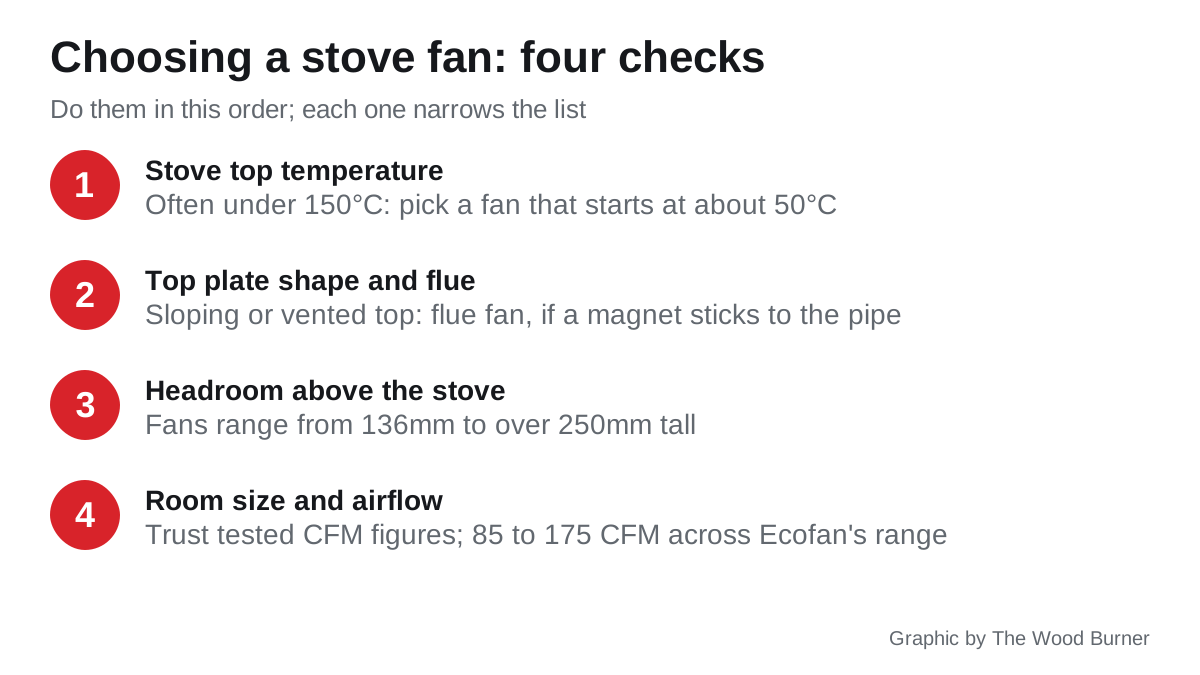
How to choose a stove fan comes down to four checks, and most buyers do them in the wrong order. They compare blade counts and airflow figures first, then discover the fan barely turns on their stove. The single most important number is the stove top temperature the fan needs before it starts spinning, because a modern Ecodesign wood burner often runs a cooler top plate than older stoves and the fan has to suit it.
Work through the checks below in order. Each one rules models out, and by the fourth you will usually be choosing between two or three fans. Every figure here comes from the makers’ published specifications, which we have also checked in our individual reviews.
Check 1: how hot does your stove top actually get?
A heat-powered fan runs on the temperature difference between its base, sitting on the stove, and its cooling fins up in the room air. Too little heat and it will not start. Too much and you can damage the thermoelectric module inside.
Published start temperatures vary a lot:
| Fan | Starts at (stove top) | Maximum stove top |
|---|---|---|
| Valiant Whirlwind FIR365 | 45°C | Not stated in our source |
| Valiant Premium IV FIR361 | About 50°C | 300°C; lifts itself off the plate above about 250°C |
| Valiant Vanquish 250 | 50°C | 340°C |
| Ecofan AirMax 812 | 85°C | 345°C |
| Ecofan UltrAir 810 | 100°C | 345°C |
| Ecofan Original Mini 815 | 110°C | 345°C |
| Ecofan BelAir 806 | 75°C | 200°C (built for cooler-topped stoves) |
So measure before you buy. A magnetic stove thermometer on the top plate, read over a few normal evenings, tells you more than any review. As a rule of thumb:
- Top often under about 150°C (common on modern, well-insulated stoves and when running low and slow): choose a low-start fan, such as the Valiant models, which begin at 45 to 50°C.
- Top regularly 150 to 300°C: every mainstream fan will work; you can choose on airflow and size.
- Top over 300°C: check the maximum carefully. Ecofan’s instructions say to take the fan off if the surface goes above 345°C, and overheating can damage the module and void the warranty.
Our comparison of Valiant and Ecofan goes through this trade-off in detail.
Check 2: is the top flat, and what is the flue?
A stove top fan needs a flat, solid, hot area big enough for its base, with the fan able to draw cooler air from behind it. Some stoves have sloping, vented or soapstone tops, or almost no flat area beside the flue collar. For those, a fan that clamps magnetically to the flue pipe is the alternative, and it only works on a single-wall steel pipe that a fridge magnet sticks to. It does not work on twin-wall insulated flue. Our stove top vs flue pipe fan page covers the magnet test and the main flue-mounted model.
On a flat top, placement matters as much as the fan. Ecofan’s instructions say to sit the fan at a back corner of the stove, and if there is less than 150mm between the fan and the wall behind, to move it forward along the side and turn it in slightly, so it can draw cooler air from the back and side. They say not to use it directly in front of the stove pipe or at the front of the stove. Check that the spot you plan to use is free before you buy a fan with a wide base.
Check 3: how much headroom do you have?
Inglenooks, low beams and mantel shelves catch people out. Measure from the stove top to the lowest thing above it, then compare:
- Valiant Whirlwind: 136mm, the lowest of the mainstream fans.
- Valiant Premium IV: 199mm.
- Ecofan UltrAir 810: 22.9cm.
- Ecofan AirMax 812: 25.4cm.
- Valiant Vanquish 250: 251mm.
Leave a few centimetres of clear air above the blades. A fan wedged under a beam recirculates its own warm air and cannot cool its fins, which slows it down.
Check 4: airflow, blades and how much you can trust the figures
Only now does airflow matter. Air volume is quoted in cubic feet per minute (CFM). The important thing is whether the figure is tested:
- Ecofan publishes airflow it says is tested to ANSI/AMCA standards: 175 CFM for the AirMax 812, 125 CFM for the UltrAir 810 and 85 CFM for the Original Mini 815.
- Valiant does not publish CFM at all and gives start and safe temperatures instead.
- Many budget fans print large CFM figures on the listing with no test method. Treat these as marketing, not measurement.
Blade count is a weak guide. The best-documented fan, the AirMax, has two blades on one large rotor, while one maker’s 4-blade and 6-blade models differ by only 10 CFM on their own figures. Blade size and the efficiency of the module matter more. See 4 blade vs 6 blade stove fans for the numbers.
For room size, a fan does not heat the room; it moves the warm air off the stove and out across the room instead of letting it rise to the ceiling above the stove. A small snug is well served by a compact, low-start fan. A large or open-plan room benefits from the most tested airflow you can fit.
Quick picks once you have done the checks
| Your situation | Fan to look at | Why |
|---|---|---|
| Modern stove, top often under 150°C | Valiant Premium IV | Starts at about 50°C and lifts itself clear when too hot |
| Very low beam or mantel | Valiant Whirlwind | 136mm tall, starts at 45°C |
| Hot stove, average living room | Ecofan UltrAir 810 | 125 CFM tested, 22.9cm tall |
| Hot stove, large or open-plan room, plenty of headroom | Ecofan AirMax 812 | 175 CFM, the highest tested figure of the mainstream fans |
| Sloping top, single-wall pipe | A magnetic flue pipe fan | Works where a top fan cannot sit |
| Tight budget | See our budget roundup | Some cheap fans work well; the airflow claims need care |
Our best stove fans page compares the main branded models, our best budget stove fans roundup covers the cheaper end, and the full Ecofan AirMax review and Valiant Premium IV review go deeper on the two most common choices. Check current prices on Amazon before you buy, as they move often.
What a stove fan will not do
- It will not fix a stove that is too small for the room. It spreads heat; it does not create more.
- It will not work on an electric stove or a gas fire with a cool top. For cooler gas, pellet and contemporary stove tops, Ecofan makes the BelAir 806, which runs between 75 and 200°C.
- It is not a safety device. A carbon monoxide alarm is still essential in a room with a wood burner, and is a legal requirement in rented homes in England with a solid fuel appliance.
Frequently asked questions
How do I choose the right stove fan? Start with your stove top temperature and pick a fan that starts below it. Then check for a flat spot at a back corner, measure the headroom, and only then compare tested airflow figures.
What temperature does a stove fan need to work? It depends on the model. Valiant fans start at about 45 to 50°C on the stove top; Ecofan’s range needs 85 to 110°C. Most are rated to about 300 to 345°C at the top end.
Are more blades better on a stove fan? Not necessarily. Blade size, motor and module efficiency matter more. Ecofan’s highest-airflow model has two blades on one large rotor, and one maker’s 6-blade fan moves only 10 CFM more than its 4-blade fan on its own figures.
Where should a stove fan go on the stove? At a back corner of the top plate, with room behind it to draw cooler air. Ecofan says to move it forward along the side if there is less than 150mm to the wall behind, and not to use it in front of the flue pipe or at the front of the stove.
Do stove fans work on modern Ecodesign stoves? Yes, if you choose one with a low start temperature. Modern stoves can run cooler top plates, so a fan that needs 100°C or more may turn slowly or not at all on a low burn.
Can I use a stove fan with a twin-wall flue? A stove top fan, yes. A flue-mounted fan, no: it needs a single-wall steel pipe that a magnet sticks to.
Sources
- Ecofan UK (Caframo) 810 and 812 instructions: placement, maximum surface temperature and overheating.
- Valiant and Ecofan product specifications as recorded in our individual reviews.
Want the seasoning calendar and our log-price watch in your inbox?
Join the Kindling List