Flue Pipe Stove Fan vs Stove Top Fan: The Magnet Test Decides
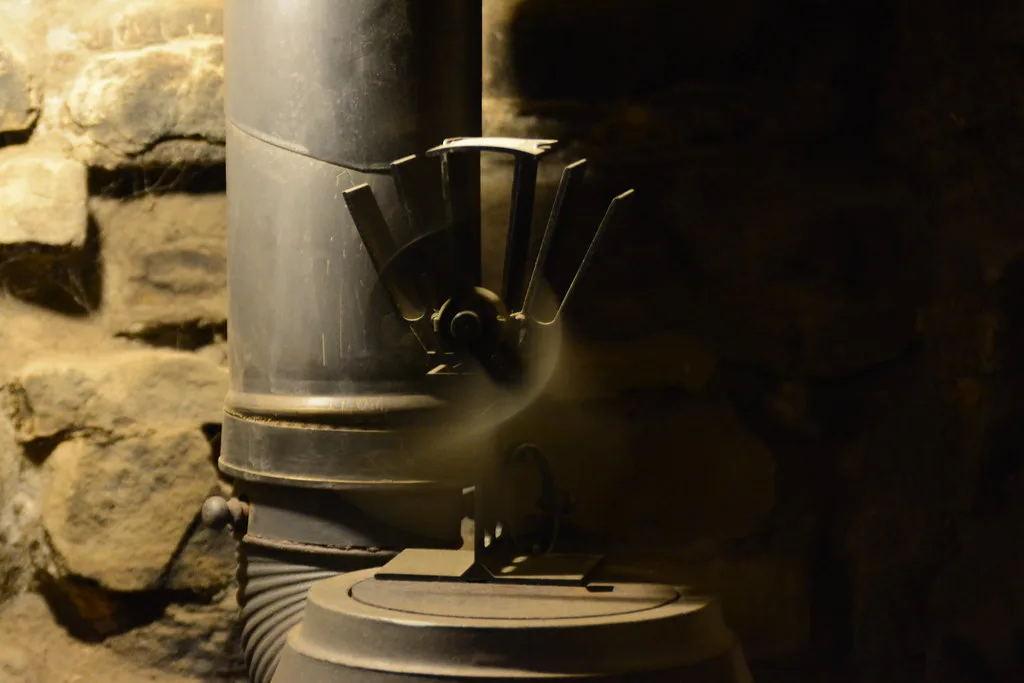
The flue pipe stove fan vs stove top fan choice usually makes itself. A stove top fan is the default: it sits on the hot plate, there are dozens to choose from, and it works on most stoves. A flue pipe fan clamps to the stove pipe instead, and it is the answer when your stove top is too cool, sloping, vented, or too close to the lintel for a fan to stand on it. But it only works on a single-wall pipe that a magnet will stick to, which rules out twin-wall flue and some stainless pipes.
Here is how to tell which one your stove needs, and what to expect from each.
How the two types work
Both are heat-powered. Inside each is a thermoelectric module, the Peltier device, that makes a small current from the difference in temperature between its hot base and its cooler top. That current turns a motor, and the blades push warm air out into the room instead of letting it rise straight to the ceiling. Neither needs batteries or mains power.
The difference is where they draw their heat:
- A stove top fan stands on the flat top plate, usually towards the back so it pulls cooler air in from behind and pushes warm air forward.
- A flue pipe fan clamps to the vertical flue pipe above the stove with magnets, and blows warm air out from that height.
Side by side
| Stove top fan | Flue pipe fan | |
|---|---|---|
| Sits on | The stove’s flat top plate | The flue pipe, 20 to 50cm above the stove (Valiant Remora) |
| Needs | A flat, hot enough top, with headroom | A single-wall pipe a magnet sticks to |
| Typical start temperature | About 45 to 110°C depending on model | About 50°C (Valiant Remora) |
| Choice of models | Wide: Valiant, Ecofan, Voda, VonHaus and many unbranded | Narrow: Valiant Remora is the main branded model |
| Works with twin-wall flue | Yes | No |
| Works on a sloping, vented or soapstone top | No | Yes |
When a stove top fan is the right choice
For most stoves with a flat cast iron or steel top and room above it, a stove top fan is simpler and gives you far more choice. It suits:
- Modern clean-burn stoves, as long as you pick a fan with a low start temperature. Many Ecodesign stoves run with a cooler top plate than older stoves. Valiant’s fans start at about 45 to 50°C; Ecofan’s need 85 to 110°C. Our Valiant vs Ecofan comparison covers this in detail.
- Stoves in a fireplace recess with enough headroom. Measure from the top plate to the underside of the lintel or mantel. Valiant’s Premium IV is 199mm tall, and there should be clear space above it for air to flow.
- Anyone who wants to compare a lot of models. Our best heat-powered stove fans and best budget stove fans pages rank the options.
When a flue pipe fan is the right choice
Valiant’s guide says the Remora was designed for stoves “where the top surface is uneven, vented, reluctant to reach high temperature, or otherwise not suited for a conventional stove top fan”. In practice that means:
- Stoves with sloping, curved or decorative tops, including many Scandinavian designs.
- Soapstone or tiled stoves, where the top is stone and warms slowly.
- Stoves with a vented top plate, where a fan would sit over the convection outlet.
- Stoves set tight under a lintel, where a stove top fan will not fit.
- Cool-running stove tops. If a stove thermometer shows your top plate rarely gets past 50°C, the pipe just above may run hot enough to drive a flue fan.
The magnet test: will a flue fan fit your pipe?
Flue pipe fans hold on with magnets, so the pipe has to be magnetic. Valiant puts it simply: “A simple fridge magnet will identify whether or not your Flue Pipe is sufficiently magnetic.” It also warns that “a very small number of Flue Pipes are made from Stainless Steel and as such will not support the magnetic clamp.”
- Single-wall vitreous enamel pipe, the black or coloured pipe on most UK stove installs, is steel underneath and usually passes.
- Twin-wall flue pipe does not suit a flue fan. The outer skin is designed to stay cool, so there is not enough heat to drive the fan, and retailers including Stovefitters Warehouse list the Remora as unsuitable where twin-wall flue is used.
- Stainless steel single-wall pipe may not hold a magnet at all.
Try the fridge magnet on a cold pipe before you buy anything.
The Valiant Remora in numbers
The Remora (model FIR350) is the best-known branded flue pipe fan in the UK. From Valiant’s product page and the user guide supplied with it:
- Fits most flue pipes of 4 to 7 inches diameter that a magnet attaches to, with a magnetic clamp rated above 400°C.
- Starts at around 50°C and reaches top speed at around 230°C.
- Maximum flue pipe temperature 300°C; hotter can damage the fan and the flue.
- Position at least 20cm and no more than 50cm above the stove top, with about 40cm the optimum, and always with the wings at the top.
- Warranty 24 months on materials and workmanship.
The guide adds that the fan works best when its top section stays as cool as possible, which is why it should sit higher up the pipe rather than right against the stove. Do not slide it on the pipe to reposition it, as that can mark the enamel; lift it off once everything is cold.
Valiant Remora Magnetic Flue Pipe Heat Powered Stove Fan (FIR350). Check price on Amazon UK.
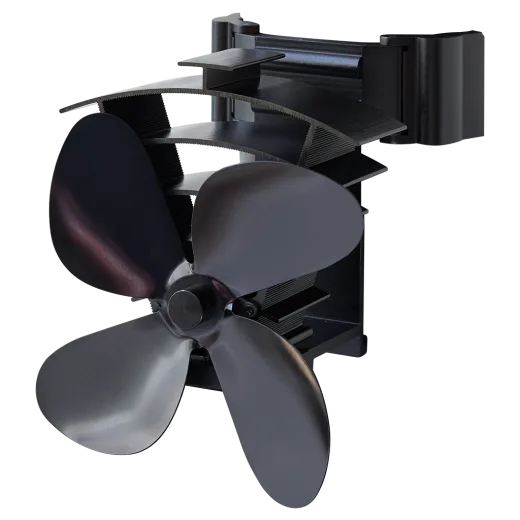
There are also unbranded magnetic “chimney pipe” fans on Amazon, but few publish a start temperature, a maximum pipe temperature or a warranty. Those figures are what protect the fan’s Peltier module, so we would stick with a fan whose maker states them.
Safety points that apply to both
- Keep within the temperature limits. Over-firing the stove to make a fan spin faster is the most common way to kill one. A flue pipe thermometer shows you where you are.
- Both get hot. Move a fan only when it has cooled, or with heat-proof gloves, and keep children and pets clear.
- A fan is not a substitute for a carbon monoxide alarm or an annual sweep. Approved Document J requires a CO alarm in any room where a new or replacement solid fuel appliance is installed.
- Never block the blades while the fan is hot, or the motor and Peltier module can be damaged.
Frequently asked questions
Is a flue pipe stove fan better than a stove top fan? Not in general. A stove top fan suits most stoves and offers far more choice. A flue pipe fan is better only when the top plate is sloping, vented, stone, too cool or too close to the lintel, and your flue pipe is magnetic single-wall pipe.
Do flue pipe fans work on twin-wall flue? No. The outer skin of twin-wall flue stays cool by design, so it cannot drive a heat-powered fan, and the magnetic clamp may not hold on a stainless outer skin.
Where should a flue pipe fan go on the pipe? Valiant says at least 20cm and no more than 50cm above the stove top, with about 40cm the best spot, and the right way up with the wings at the top.
What temperature does a flue pipe fan need? The Valiant Remora starts at around 50°C, reaches full speed at around 230°C, and should not be used where the pipe goes above 300°C.
Will a stove fan fit under my lintel? Measure from the stove top to the underside of the lintel or mantel and allow clear space above the fan for airflow. Stove top fans range from about 136mm to over 250mm tall, so check the height of the model you want.
Can I use a stove top fan and a flue pipe fan together? Yes, if the stove top suits one and the pipe suits the other. Keep both within their temperature limits, and do not over-fire the stove to drive them.
Sources
- Valiant, Remora Flue Pipe Fan product page and Remora FIR350 user guide, read 14 October 2026.
- Stovefitters Warehouse, Remora Flue Pipe Fan listing (twin-wall suitability).
- GOV.UK, Approved Document J: combustion appliances and fuel storage systems.
Want the seasoning calendar and our log-price watch in your inbox?
Join the Kindling List