Flamers Firelighters Review: 10-Minute Burn, Paraffin Wax
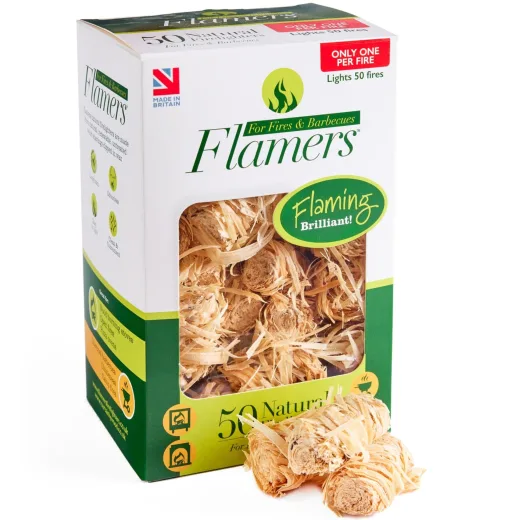
This Flamers firelighters review starts with the thing the packaging does not put on the front: they are wood wool dipped in refined paraffin wax. Certainly Wood, the Herefordshire firewood company behind the brand, says so plainly on its own product page, and it matters, because Flamers are widely bought by people trying to get away from paraffin-based white cubes. What you are actually buying is a much better delivery system for the same fuel.
That is not a criticism. On performance they are the most reliable firelighter we have used in a stove. The question is whether the premium over a supermarket wood wool pack is money well spent, and the answer depends on how you light your fire.
What Flamers actually are
Certainly Wood’s published specification is short and unambiguous:
- Made from natural wood wool shavings and refined paraffin wax, with no other chemicals added.
- Burns for up to 10 minutes.
- Pack sizes of 24, 30, 50 and 200.
- Made in Britain.
- Will light when wet.
- No odour or residue on the hands or in the stove.
The full specification is on the Certainly Wood Flamers page. Note that Certainly Wood sells a separate product, KindleFlamers, designed to light a fire without kindling. Standard Flamers are not that product: they are a firelighter and they expect kindling above them.
In use: the 10 minutes is real
Most disappointment with firelighters comes from a burn that dies before the kindling has caught. A supermarket white cube gives you a fierce flame for two or three minutes and then goes out, which is fine if your kindling is bone dry and finely split, and useless if it is not.
Ten minutes changes the job. One Flamer under a small stack of kindling gives the wood long enough to dry its surface, char and take, even when the kindling is slightly damp or a bit too thick. In practice this is the single reason to buy them: they are forgiving of imperfect kindling, and most people’s kindling is imperfect.
The wood wool structure also lights easily from a match or a long-reach lighter, because there is a lot of fine, dry surface area for the flame to catch. We have never needed a second attempt on a dry one. If you struggle to reach into a deep firebox, our best long-reach lighters roundup covers the tool for it.
“Will light when wet” is a claim worth being precise about. A Flamer that has been rained on will still light, because the wax repels water and the wool holds air. A Flamer that has been sitting in a damp outhouse all winter absorbing moisture is a slower, more sullen thing. Store them indoors and the claim never gets tested.
The no-residue claim holds up. They do not leave the paraffin smell on your fingers that white cubes do, and there is no visible ash residue distinct from the wood ash. If you cook in a pizza oven or on a barbecue, this is the practical argument for wood wool over cubes.
The honest weaknesses
They are expensive per light. A 50-pack costs several times what a box of white cubes costs, for the same number of fires. If you light one fire a day through a British heating season, that difference is real money over five months.
The “natural” framing is doing some work. Wood wool is natural. Refined paraffin wax is a petroleum product. Flamers are cleaner-burning and less smelly than a standard cube, and they are made in Britain from wood that Certainly Wood also mills for its logs, which is a genuine environmental point. But if you came looking for a firelighter with no fossil fuel in it, this is not it. Vegetable-wax alternatives exist, and we cover them in best eco and natural firelighters.
One is sometimes not enough. With thick or resinous kindling, or a cold flue on the first fire of the season, two Flamers laid apart under the stack works far better than one in the middle. That halves your effective pack size, and it is worth budgeting for.
They do not replace kindling. If that is what you want, KindleFlamers is the product to look at instead, not this one.
Flamers versus the alternatives
Against white paraffin cubes: Flamers burn roughly three times longer, do not smell, and do not coat your fingers. Cubes are far cheaper. If your kindling is properly dry and finely split, cubes will light your fire perfectly well and the money is better spent on logs.
Against own-brand wood wool: this is the closest comparison and the one most people should think hardest about. Supermarket and merchant wood wool firelighters use the same wool-and-wax construction, often at a lower price. The differences are consistency of wax loading and how tightly the wool is spun. Flamers are denser and more uniform than the cheapest wool packs we have tried, which is why they hit the full ten minutes rather than seven.
Against homemade: a handful of dry wood shavings and a stub of candle does the same job for nothing. It is messier and less consistent, but it works, and it costs nothing if you already split your own. See how to make kindling.
Are Flamers worth the premium?
Buy them if any of these apply:
- Your kindling is merchant-bought, thicker than ideal, or stored somewhere less than perfectly dry.
- You light fires occasionally rather than daily, so the per-light cost barely registers.
- You cook over the fire and want nothing paraffin-scented near food.
- You are lighting a stove with a cold or difficult flue.
Skip them if you light a fire every day through winter, split your own fine dry kindling, and would rather put the difference towards better logs. In that case a cheap wood wool pack does the same job.
Check price on Amazon UK before buying, and compare against the 200-box, which is meaningfully cheaper per light than the 24 if you have somewhere dry to keep it.
For the wider field, see our best firelighters for wood burners comparison, and best kindling for wood burners for what goes on top. Whatever you light, the fire only burns well if the logs are under 20% moisture, which is both the law and the physics: our ready to burn rules page covers the requirement.
Frequently asked questions
Are Flamers firelighters any good? Yes. They light reliably from a single match, burn for up to 10 minutes, and leave no smell or residue. The long burn is what makes them forgiving of kindling that is slightly damp or too thick. The trade-off is cost per light.
How long do Flamers firelighters burn? Up to 10 minutes, according to Certainly Wood. That is roughly three times a standard white paraffin cube, and it is the main practical advantage.
What are Flamers firelighters made of? Natural wood wool shavings dipped in refined paraffin wax, with no other chemicals added, made in Britain. The wool is natural; the wax is a petroleum product, so they are not a fossil-fuel-free firelighter.
Do Flamers firelighters work when wet? Certainly Wood states they will light when wet, and a Flamer that has been rained on does still catch, because the wax sheds water. One that has absorbed damp over months in an unheated store will be sluggish. Keep them indoors.
Do you still need kindling with Flamers? Yes. Standard Flamers are a firelighter, not a kindling substitute. Certainly Wood sells KindleFlamers separately for lighting a fire without kindling.
How many Flamers do I need per fire? One is usually enough with dry, finely split kindling. Use two, placed apart rather than together, for a cold flue, the first fire of the season, or thicker kindling.
Want the seasoning calendar and our log-price watch in your inbox?
Join the Kindling List