Flamers vs Lekto Firelighters: 24 in a Box, or 250
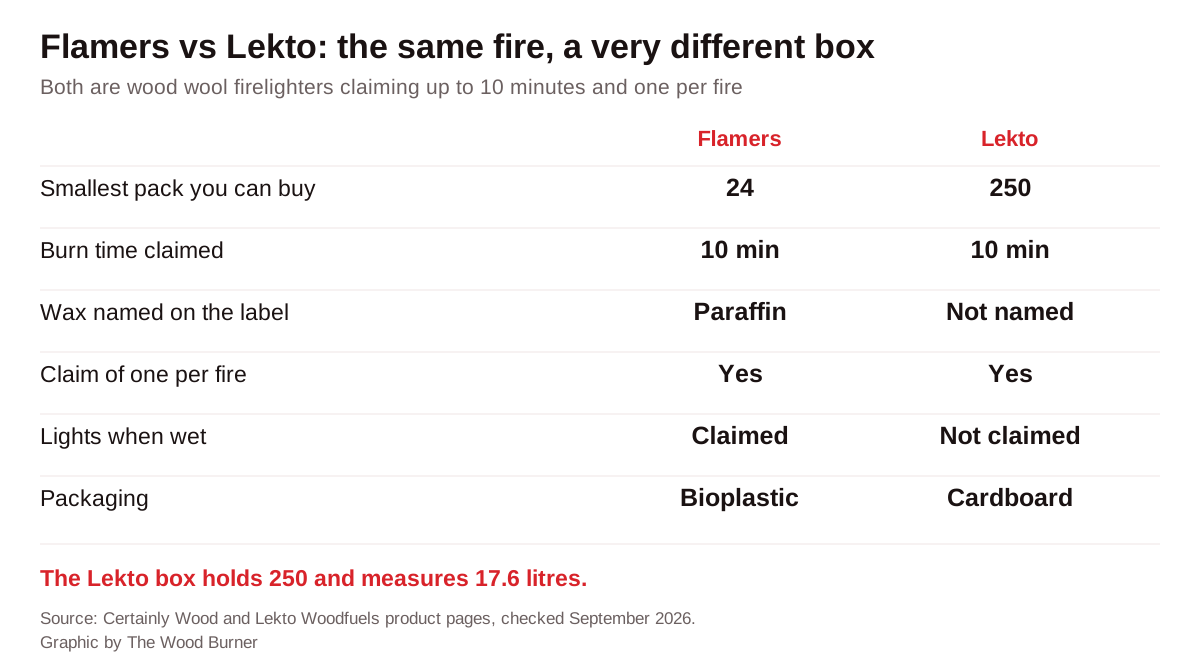
Put Flamers vs Lekto firelighters side by side and the performance argument collapses almost immediately. Both are wood wool coated in wax. Both claim up to 10 minutes of flame. Both claim one per fire. In a stove they behave the same way: a strong flame that builds rather than the sudden flare and early death of a white paraffin cube. If you are hoping one of them lights a fire and the other does not, that is not the comparison.
The two things that genuinely separate them are the wax, which one brand names and the other does not, and the box, because the smallest quantity of Flamers you can buy is 24 and the smallest quantity of Lekto is 250. For most households, the box decides it.
The specifications, side by side
| Flamers (Certainly Wood) | Lekto Natural Firelighters | |
|---|---|---|
| Material | Natural wood wool shavings, fully refined paraffin wax | Densely packed wood wool, thin coating of natural wax |
| Wax named? | Yes, paraffin | No, “a proprietary blend of natural wax” |
| Burn time | Up to 10 minutes | Up to 10 minutes of strong flame |
| Claim per fire | One per fire | One per fire |
| Smallest pack | 24 | 250 (sold as 200 plus 50 free) |
| Other sizes | 30, 50, 200 | 750, 1,250 |
| Made in | Britain | Sawmill byproducts, sourcing stated, country not |
| Lights when wet | Stated on the product page | Not claimed |
| Packaging | Corn starch bioplastic, certified to EN 13432:2000 | 100% cardboard, fully recyclable |
| Box size | Not published | 170mm x 370mm x 280mm, 17.6 litres |
All of that comes from each brand’s own current product page, checked in September 2026.
The wax is the honest difference
Certainly Wood tells you exactly what is on a Flamer: “natural wood shavings coated in fully refined paraffin wax, rather than the chemical solvents used in some firelighter brands”. Paraffin wax is petroleum-derived. Certainly Wood puts that on the page and lets you decide.
Lekto describes its coating as a thin layer of natural wax and markets the product as “100% natural, chemical-free” and kerosene-free. It does not name the wax anywhere we can find on its own site.
Here is why this matters more than it looks. “Kerosene-free” rules out one specific petroleum distillate, the one responsible for the chemical smell on white cubes. It does not, by itself, tell you the wax is not petroleum-derived. So a buyer choosing Lekto specifically to avoid petroleum products is relying on an unspecified claim, while a buyer choosing Flamers knows precisely what they are getting and can reject it on that basis.
If avoiding paraffin is the reason you are reading this page, ask Lekto directly what the wax is before ordering. The published information will not settle it, and no comparison page, including this one, can settle it for you.
For everyone else, this changes nothing practical. Neither product leaves the paraffin smell on your hands or in the room, and both are sold for use with food, on barbecues and in pizza ovens.
The box is what actually decides it
This is the part no other comparison mentions, and it is the one that will affect you.
Lekto’s smallest listed option is 200 firelighters plus 50 free, so 250 units, in a box measuring 170mm by 370mm by 280mm, which Lekto puts at 17.6 litres. The next sizes up are 750 and 1,250.
Flamers come in 24, 30, 50 and 200.
Work out what you actually use. A household lighting the stove four evenings a week through a five-month burning season gets through somewhere around 85 fires, assuming the one-per-fire claim holds and your kindling cooperates. On that pattern:
- A 50-pack of Flamers covers about three months. Two of them see you through a winter.
- A 250 box of Lekto is close to three seasons’ supply, sitting in 17.6 litres of cupboard for most of that time.
Neither firelighter degrades quickly, so a three-year stock is not wasted money in the way perishables would be. But it is cash committed up front, and it is a box the size of a small suitcase that has to live somewhere dry. In a cottage with a coal bunker and a dry outhouse, fine. In a terraced house where the stove things already fight the hoover for space under the stairs, it is a genuine problem.
Run the arithmetic on cost per light rather than cost per box before you decide. A large box usually wins on that measure, and it should, because that is what bulk is for. The question is whether you want to prepay three winters to get it.
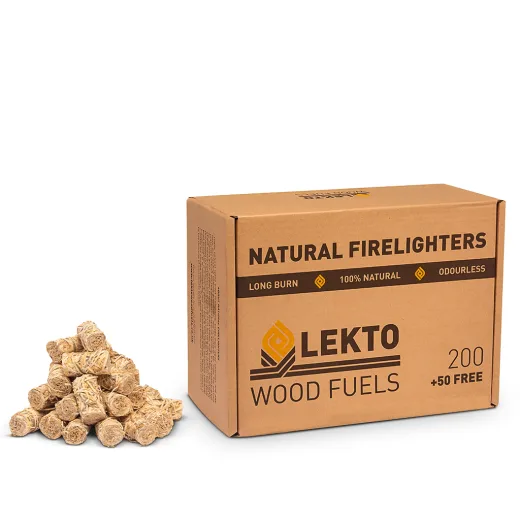
If you burn a lot, or you light more than a stove, a barbecue, a pizza oven and a fire pit through the summer as well, the Lekto box stops looking excessive and starts looking sensible. That is the household it is built for.
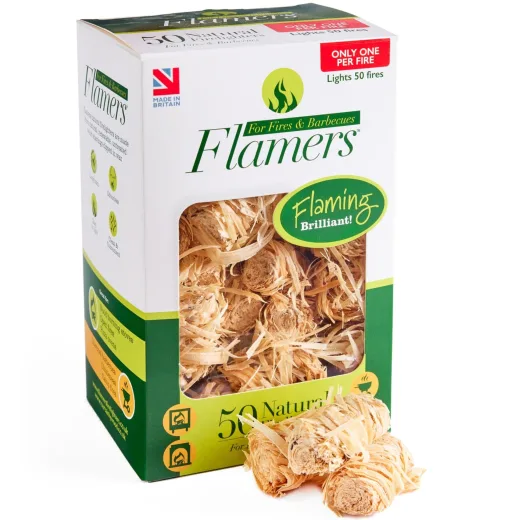
Flamers are the better fit for anyone who lights a stove a few times a week and wants a pack that is used up by spring. The 24 and 30 packs also make them the only one of the two you can sensibly buy to try.
Where Flamers pull ahead
“Will light when wet.” Certainly Wood makes this claim and Lekto does not. In practice it matters for a log store or an outhouse where the pack picks up damp air, and for anyone lighting a fire pit or barbecue outdoors after a shower. A Flamer that has been rained on will still take, because the wax repels water and the wool holds air. One that has spent a winter absorbing damp in an unheated outbuilding will be sullen whatever the packaging says, so store either brand indoors.
Made in Britain, stated plainly. Certainly Wood is a Herefordshire firewood company and says where the product is made. Lekto states that the wood wool is a sawmill byproduct with no trees cut to make it, which is a different and also useful claim, but not the same one.
Small packs. Being able to buy 24 is not a trivial advantage. It is the difference between trying a firelighter and committing to one.
Where Lekto pull ahead
Cardboard, not bioplastic. Lekto’s packaging is 100% cardboard and goes straight in the recycling. Flamers use a corn starch bioplastic, certified to European Standard EN 13432:2000 for packaging recoverable through composting and biodegradation. That certification is real, but it describes industrial composting conditions, and most British councils will not take it in kerbside recycling. If your household waste is a kerbside bin and nothing else, the cardboard box is simply easier to dispose of correctly.
Cost per light at volume. With 250 as the entry point and 1,250 at the top, Lekto is playing a bulk game and the per-unit figure reflects it.
One supplier for the whole fire. If you already buy Lekto briquettes, adding firelighters to the same order is less faff and often lands inside the same free delivery threshold. Our Night Briquettes review covers that side of the range.
Neither, if this sounds like you
Both of these are premium wood wool firelighters and both cost several times what a supermarket white cube costs per light. They earn that when your kindling is imperfect, because 10 minutes of flame will dry and char kindling that a three-minute cube will not.
If your kindling is genuinely dry, finely split softwood, stored indoors, a cheap cube lights it every time and the wood wool premium buys you nothing but a nicer smell. Our comparison of wood wool against cube firelighters sets out where the line falls, and Zip’s natural cubes sit between the two on both count and price.
And if you keep needing two firelighters whichever brand you buy, the firelighter is not the problem. Read how to make kindling and choosing kindling instead. Fixing the kindling is free and it fixes the fire permanently.
The verdict
Buy Flamers if you light a stove a few times a week, you want a pack you will finish this winter, you store firelighters somewhere that is not perfectly dry, or you want the wax named on the label so you can make your own decision about it.
Buy Lekto if you light fires often, you have somewhere dry to keep a 17.6-litre box, you are already ordering from Lekto, and you want the lowest cost per light rather than the smallest outlay.
Buy neither if your kindling is already excellent. In that case a cube does the job and the money is better spent on the wood.
Frequently asked questions
Are Flamers or Lekto firelighters better? Neither outperforms the other. Both are wood wool with a wax coating, both claim up to 10 minutes of flame, and both claim one per fire. Choose on pack size and on wax disclosure: Flamers start at 24 units and name their wax as refined paraffin, Lekto start at 250 units and describe theirs only as a proprietary natural wax.
Do Flamers contain paraffin? Yes. Certainly Wood states on its own product page that Flamers are natural wood shavings coated in fully refined paraffin wax. There are no added chemical solvents, which is why they do not produce the smell associated with white paraffin blocks, but the wax itself is petroleum-derived.
Are Lekto firelighters really chemical-free? Lekto markets them as 100% natural, chemical-free and kerosene-free, and the wood wool element is a sawmill byproduct. The wax coating is described only as a proprietary blend of natural wax and is not named on their site. If the composition of the wax is your reason for buying, contact Lekto before ordering rather than relying on the marketing description.
What is the smallest box of Lekto firelighters? 250, sold as a box of 200 plus 50 free. There is no smaller option. The box measures 170mm by 370mm by 280mm, which Lekto gives as 17.6 litres, so factor in storage space as well as the quantity.
How many firelighters will I use in a winter? Roughly 85 if you light a stove four evenings a week over a five-month season and one firelighter does each fire. That makes a 50-pack of Flamers about a third of a season, and a 250 box of Lekto close to three seasons.
Do wood wool firelighters work in a pizza oven or barbecue? Yes, both are sold for it. Neither leaves the chemical taint that paraffin blocks can, and both are marketed as suitable for use around food. Flamers additionally claim they will light when wet, which is the more useful property outdoors.
Can you use one firelighter per fire? On dry, finely split kindling stacked so air can move through it, yes, and both brands make that claim. On thick or slightly damp kindling you will need two whichever brand you buy, because the limiting factor is the wood rather than the firelighter.
Want the seasoning calendar and our log-price watch in your inbox?
Join the Kindling List