Gas vs Electric Lighter for a Wood Burner: Which Wins?
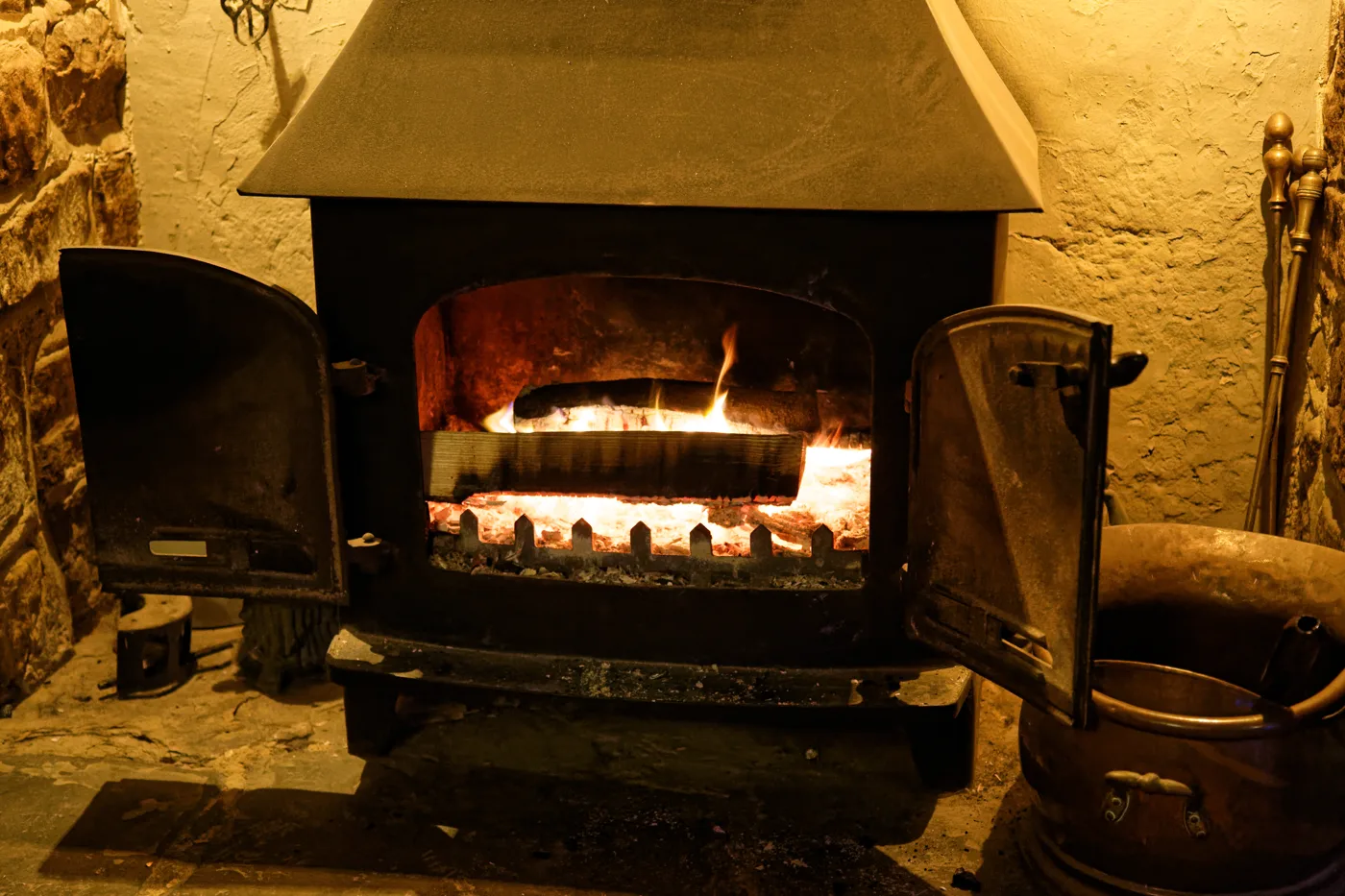
The gas vs electric lighter question for a wood burner gets answered badly almost everywhere, because it is treated as a technology argument when it is really a firelighter argument. A refillable butane lighter and a USB arc lighter both light a stove perfectly well. Which one works better in your hands depends on what you are holding it against, where you store it, and how cold your house gets in January.
Here is the short version, then the detail behind it.
- You use wood wool firelighters: an arc lighter is genuinely better, and quieter to live with.
- You use dense wax blocks, or you light bare kindling: stick with butane.
- Your lighter lives in an unheated porch, log store or outbuilding: butane will let you down below freezing. Arc lighter.
- You forget to charge things: butane, every time.
Why butane stops working in a cold British porch
This is the fact that decides it for a lot of people and almost nobody mentions it. Butane boils at about minus 0.5°C. Below that, it has almost no vapour pressure, which means a butane lighter has nothing to push out of the nozzle. It does not fail dramatically; it just clicks and produces a weak yellow flicker or nothing at all.
If your long-reach lighter lives next to the stove in a warm room, you will never see this. If it lives in the log store, the porch, the shed or the boot of the car, you will see it every cold snap, which is exactly when you most want the stove lit. Warming the lighter in a pocket for a couple of minutes fixes it, but you have to know that is what is wrong.
An arc lighter has no fuel and no boiling point to worry about. Cold reduces lithium battery capacity, so it will hold less charge in an unheated space, but it still fires.
Why an arc lighter needs contact, not heat
Arc lighters work by jumping a high-voltage spark across a small gap. The arc is very hot, but it is also tiny, and it carries almost no thermal mass. That single fact explains every arc lighter review complaint you will read.
To light something with an arc lighter, the material has to sit in the gap. Loose fibres do this beautifully: wood wool firelighters, shredded paper, a teased-out bit of natural wool firelighter, fine dry kindling shavings. Poke the arc into the fibres and they catch in about a second.
Dense material does not. A solid wax block firelighter, a smooth commercial cube, or a stick of kindling with no frayed edge gives the arc nothing to bite on. You can hold the arc against it for thirty seconds and it will scorch a black dot and nothing else. A butane flame, which wraps around the object and heats a whole area, handles it without complaint.
So the real question is not gas or electric. It is: does my firelighter have loose fibres? If you burn wood wool, the arc lighter wins. Our reviews of Flamers, Lekto and Log Barn all cover wood wool products, and all three take an arc beautifully. Our comparison of wood wool versus cube firelighters is worth reading alongside this page, because it is the same decision from the other side.
The gas option: a refillable long-neck butane lighter
The default, and still the safest all-rounder. A refillable flexible-neck butane lighter gives you a flame you can push deep into a firebox, bend around a log, and hold on a firelighter for as long as it takes.
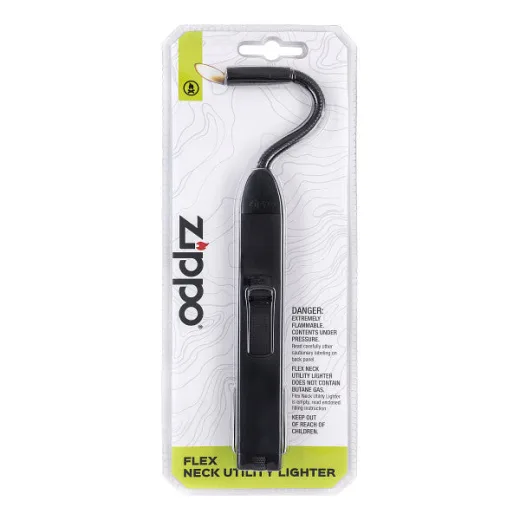
The Zippo Flex Neck Utility Lighter is the version most people end up with. It is butane refillable, has a rubberised flexible neck you can bend to reach past logs, and a wind-resistant flame. Refillable matters more than it sounds: a disposable long-reach lighter thrown away every few months is both wasteful and a worse tool, because the flame height is fixed.
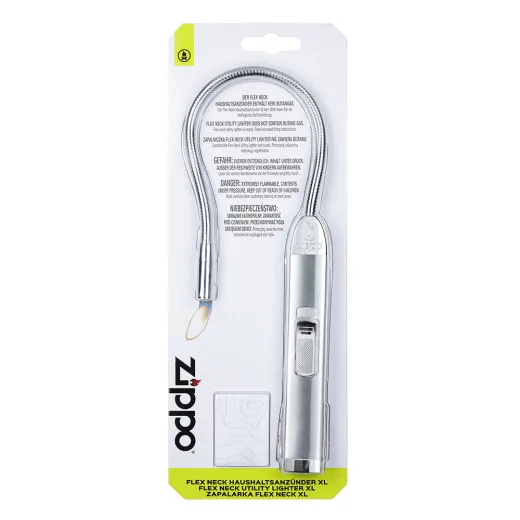
If your stove is deep, or you are lighting top-down and need to reach over a stacked load, the XL version has a longer bendable neck for the same job. That extra reach is the difference between lighting a firelighter cleanly and singeing your knuckles on the stove door frame.
What to know before you buy a butane one:
- Buy a refillable one and a can of butane. Refilling takes ten seconds and the lighter lasts years.
- Refill it warm, indoors. Filling a cold lighter traps air in the tank and it will splutter.
- Bleed the tank if it starts firing unevenly. Press the fill valve with a small screwdriver until the hiss stops, then refill.
- Keep it indoors in winter. See above.
- The flame adjuster is not a gimmick. Turn it down for a wood wool firelighter and up for stubborn kindling.
The electric option: a USB arc lighter
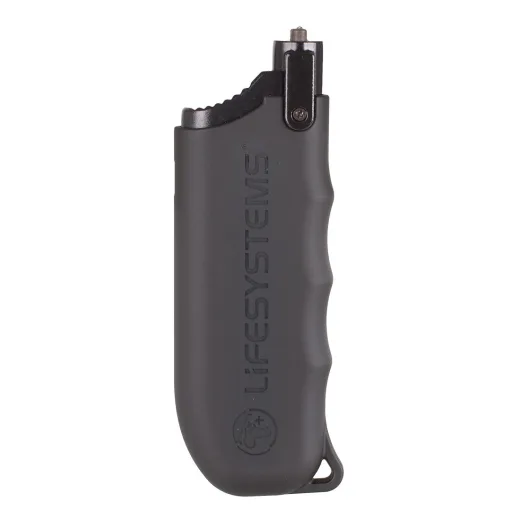
No fuel, no flame, nothing to spill or leak, and nothing to blow out. The Lifesystems Plasma Lighter is the one we keep coming back to, mostly because it is telescopic, so it collapses to pocket size and extends to reach into the firebox. It weighs 118g, measures 94 x 34 x 15mm closed, charges over USB, and Lifesystems describes it plainly as “windproof since there’s no flame”.
Charge life varies enormously between arc lighters, and published figures range from around 60 lights per charge on small batteries up to several hundred on larger ones. For a household stove lit once a day, even the low end of that range is weeks between charges. Our full electric arc lighter review goes into how they behave over a season.
What to know before you buy an arc one:
- Clean the electrodes. Soot and resin build up on the contacts and the arc weakens. A cotton bud with a little isopropyl alcohol, with the lighter off, restores it.
- Most have a timeout. The arc cuts out after several seconds to protect the battery, so you press again rather than hold. That is normal, not a fault.
- Damp kills the arc. Moisture across the gap shorts it. Wet firelighters and a damp shed are its weak points.
- Check for a child lock if there are children in the house. Many have one and it is worth having.
- It will not light a candle wick at an angle as easily as a flame, so if the lighter doubles up for candles, bear that in mind.
Head to head
| Refillable butane | USB arc lighter | |
|---|---|---|
| Works below freezing | No, butane boils at about minus 0.5°C | Yes, though cold cuts battery capacity |
| Lights dense wax firelighters | Yes | Poorly, often not at all |
| Lights wood wool firelighters | Yes | Yes, instantly |
| Lights bare kindling | Yes | Only if it is frayed or shaved |
| Windproof | Wind-resistant, not windproof | Yes, no flame to blow out |
| Running cost | A can of butane lasts a very long time | Electricity to charge, essentially nothing |
| Fails because | Empty, cold, or airlocked | Flat battery, sooty electrodes, damp |
| Reach into a deep firebox | Excellent with a flexible or XL neck | Good on telescopic models, limited on stubby ones |
| Maintenance | Refill, occasional bleed | Wipe the electrodes |
What we would actually own
Both, and that is not a cop-out. They fail in completely different ways, which is the point. A flat arc lighter and an empty butane lighter never happen on the same evening.
If you are buying one: choose the arc lighter if you already burn wood wool firelighters and you want something you never have to refill. Choose the refillable butane lighter if you burn wax blocks, light from cold kindling, keep the lighter somewhere unheated, or simply want the tool that always works without being charged.
For the rest of the lighting setup, see our guide to the best firelighters for wood burners and the best long reach lighters.
Frequently asked questions
Is an electric arc lighter better than a gas lighter for a wood burner? It depends on your firelighter. An arc lighter is excellent with wood wool firelighters and fine dry kindling, because loose fibres sit inside the arc gap and catch instantly. It is poor with dense wax block firelighters and smooth kindling, which a butane flame handles easily. If you burn wood wool, the arc lighter is the better tool.
Why has my butane lighter stopped working in cold weather? Because butane boils at about minus 0.5°C, so in a cold porch, shed or log store it produces almost no vapour and the lighter will not light. Warm it in a pocket for a couple of minutes and it comes back. Storing it indoors is the permanent fix.
How many times can you light a fire with an arc lighter before recharging? Published figures vary widely by battery size, from around 60 lights per charge on small models to several hundred on larger ones. For a stove lit once a day that means weeks between charges. Charge it at the start of the heating season and then whenever the arc sounds weak.
Are arc lighters safe to use with a wood burner? Yes, with the usual sense. There is no fuel to spill and no flame to blow back at you, which is arguably safer than butane. Keep it dry, do not use it when the electrodes are visibly sooted, and pick a model with a child lock if that applies to your house. Never leave any lighter on the stove top.
Why will my arc lighter not light a firelighter? Almost always because the firelighter is too dense. The arc is tiny and carries very little heat, so the material must sit in the gap between the electrodes. Tease out a few fibres, use a wood wool firelighter, or switch to a butane flame for wax blocks. A sooty electrode or a damp firelighter will do the same thing.
Can you refill a Zippo Flex Neck lighter? Yes, that is the point of it. It takes standard butane refill gas through a valve in the base. Refill it at room temperature, and if it starts firing unevenly, bleed the tank first by depressing the valve until the hissing stops, then fill it again.
Want the seasoning calendar and our log-price watch in your inbox?
Join the Kindling List