Stove Fan Not Working? 7 Causes, Checked in Order
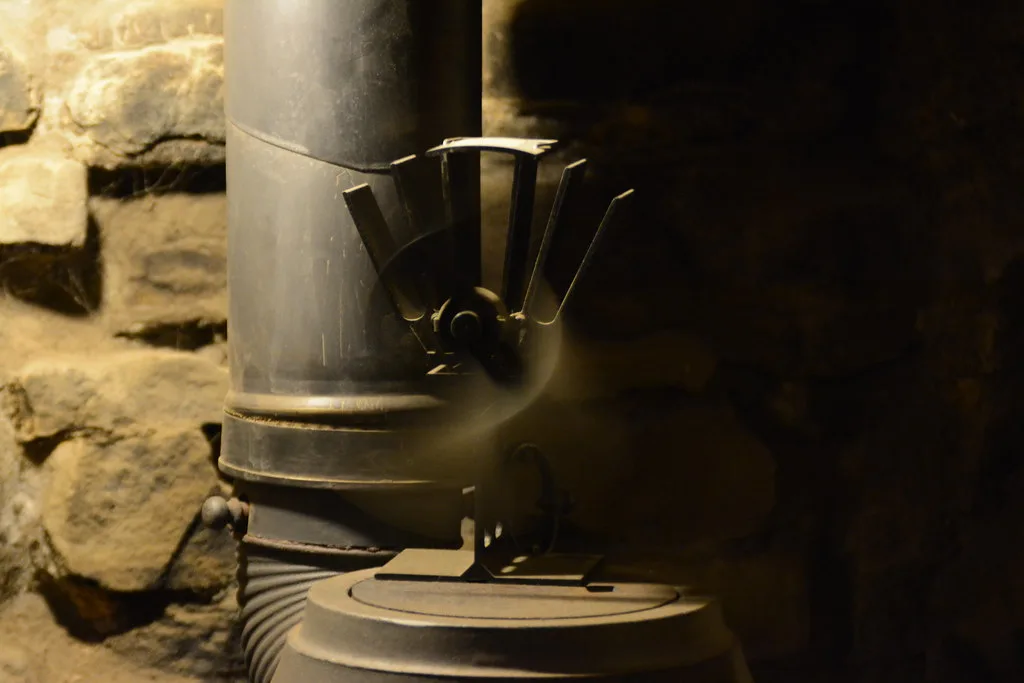
A stove fan not working is rarely broken. Most of the time the stove top is not hot enough for that fan, or the fan is in a spot where its top gets as hot as its base, and it has nothing to run on. Only after those are ruled out is it worth suspecting the motor, and only after the motor is ruled out the part that makes the electricity.
A heat-powered fan runs on the difference in temperature between its hot base and its cool top fins. Anything that heats the top or cools the base slows it down. Work through the checks below in order; the first three cost nothing.
Quick diagnosis
| What you see | Most likely cause | First thing to try |
|---|---|---|
| Never starts on this stove | Stove top below the fan’s start temperature | Check the top with a stove thermometer |
| Starts, then slows as the fire gets going | Fan in front of the flue, or in a recess with no cool air behind | Move it to a back corner, beside the flue |
| Stops or slows when the stove is roaring | Safety lift has raised the fan off the plate | Normal; let the stove cool a little |
| Slow on one stove spot, fine on another | Cool patch on the top plate, or grit under the base | Move it, wipe the base and plate |
| Needs a push to start, or grinds | Worn motor | Spin it by hand when cold; replace the motor |
| Vibrates or rattles | Blade out of line | Check the blade tips against the top, adjust gently |
| Motor replaced and still dead | Thermoelectric module damaged by overheating | Warranty or refurbishment |
1. Is the stove top hot enough?
Every fan has a start temperature, and below it the fan does nothing. They vary more than people expect. Valiant says its Premium 4 starts to build up speed at about 50°C, but recommends using it once the stove top reaches about 100°C, where you feel the benefit. Ecofan’s UK instructions give a minimum stove top of 85°C for the AirMax, 100°C for the UltrAir and 110°C for the Original.
Modern Ecodesign stoves often have well-insulated tops, so the plate can sit well below 100°C on a slow evening burn. An Ecofan that spun happily on your old cast-iron stove may barely turn on a new one. The test is simple: put a magnetic stove thermometer next to the fan and read it when the fan is idle. If it reads below the fan’s start temperature, the fan is fine and the stove is cool. Either run the fire a little harder, or choose a fan with a lower start temperature; our guide to choosing a stove fan starts with exactly this check.
2. Is it in front of the flue?
This is the commonest mistake, and both makers warn about it. Hot air rising off the stove and the flue pipe heats the fan’s top fins, so the temperature difference collapses and the fan slows down. Valiant says placing a fan in front of the flue pipe makes the top run too hot, “which will slow the fan speed and cause premature failure to the motor and generator”.
Put it at the back of the stove top, to one side of the flue, so it draws cooler air from behind. Ecofan’s instructions add a detail most people miss: if the gap between the fan and the wall behind is less than 150mm, move the fan forward along the side of the stove and turn it in slightly, so it can still pull in cool air. On a small stove with no room beside the flue, Valiant says left or right of the pipe, never in front. Our page on where to put a stove fan has layouts for common stove shapes.
3. Has the safety lift raised it?
Some fans protect themselves when the plate gets too hot. Valiant’s Premium 4 has a bimetallic strip in the base that tilts the front of the fan up off the plate when the surface passes about 250°C, then lowers it again as the stove cools. While it is tilted the fan runs slower or stops. That is the fan working as designed, and a sign the stove is running hot: Valiant rates the Premium 4 to 300°C and says higher temperatures may damage any stove fan.
Ecofan fans have no lift. Ecofan says to move the fan to a cooler spot if the surface goes above 345°C, because overheating may damage the thermoelectric module and void the warranty. If your fan slows down only when the fire is at full blast, this is the reason. Take the hint and close the air down a little.
4. Is the base sitting flat?
A fan collects heat through its base, so anything between the base and the plate cuts its power. Ash, grit, a dried drip of stove polish or a warped plate edge all leave an air gap. With the stove cold, wipe the plate and the underside of the fan. Then check the fan does not rock. A fan perched on a raised rim, a hotplate edge or the boss of a top-flue collar will only touch on two points.
Some stoves also have cooler patches on the top, over the baffle or near the front. If the fan turns well in one spot and poorly in another a few centimetres away, that is the plate, not the fan.
5. Is the motor worn?
The small motor is the part that wears out. Ecofan says its motor is designed for several seasons of use, and that if the fan spins much slower than it did, or the blade needs a push to start, a replacement motor may be the fix. Caframo, which makes Ecofan, allows for a new motor about every 4.5 heating seasons on the AirMax.
To check, let the fan go completely cold and spin the blades gently by hand. A healthy fan turns freely and coasts to a stop. Signs of a tired motor are a gritty or notchy feel, a ticking or grinding noise when running, a fan that only starts once you nudge it, or a speed that has dropped over a season at the same stove temperature.
Ecofan sells replacement motor kits: kit MRKCA01BX fits the UltrAir 810, AirMax 812 and AirDeco, and in the UK they come through the distributor, Calfire. Our Ecofan AirMax review covers the fit. For Valiant fans, contact Valiant or the retailer with your batch number. On many cheap unbranded fans there is no spare motor at all, which is one of the costs of buying them; our budget stove fans page covers which brands publish spares.
6. Is a blade out of line?
A fan that rattles, vibrates or walks across the stove usually has a blade bent slightly out of line, often after being knocked or packed away. Valiant’s fix: when the fan is cool, turn the blades slowly and watch the gap between each blade tip and the top of the fan. If one is out, hold the blades and apply slight pressure to the misaligned one to bring it back, then check again. A blade that rubs on the guard or casing can stop a weak fan completely.
7. Has the generator failed?
If a new motor makes no difference, the thermoelectric module that makes the power may be damaged. The usual cause is heat: running the fan above its rated temperature, or for long periods in front of the flue. This is not a home repair on most fans.
Within the warranty, go back to the seller. Valiant guarantees the Premium 4 for 24 months; Ecofan’s UK warranty is two years from purchase, handled by Calfire if you bought from a UK retailer, and you will need the serial number from the underside of the top casting. Both exclude misuse, and overheating counts. After the warranty, Ecofan’s UK distributor runs a refurbishment service, which is worth pricing against a new fan.
Two things that are not faults
It stops as the fire dies down. Every heat-powered fan slows and stops as the stove cools; there is no switch.
A flue pipe fan barely turns on twin-wall pipe. Magnetic flue fans need single-wall pipe that a magnet sticks to. On insulated twin-wall flue the outer skin is designed to stay cool, so there is not enough heat to drive the fan, and some stainless single-wall pipe will not hold the magnet at all. Our comparison of stove top and flue pipe fans explains the magnet test.
Frequently asked questions
Why is my stove fan not spinning? Usually because the stove top is below the fan’s start temperature, or the fan sits in front of the flue where its top fins get too hot. Check the plate temperature with a stove thermometer, then move the fan to a back corner beside the flue.
What temperature does a stove fan need to work? It depends on the fan. Valiant’s Premium 4 starts at about 50°C. Ecofan’s UK instructions give minimum stove tops of 85°C for the AirMax, 100°C for the UltrAir and 110°C for the Original.
Why does my stove fan stop when the fire is really hot? Fans with a safety lift tilt up off the plate when it gets too hot; on the Valiant Premium 4 that happens above about 250°C. The fan lowers itself again as the stove cools.
Can you repair a stove fan? Often. A worn motor is the usual fault and replacement motor kits are sold for Ecofan models. A bent blade can be eased back into line. A failed thermoelectric module is a warranty or refurbishment job rather than a home repair.
How long does a stove fan motor last? Ecofan says its motor is designed for several seasons of use, and Caframo allows for a replacement about every 4.5 heating seasons on the AirMax. Running the fan too hot or in front of the flue shortens that.
Does putting a stove fan in front of the flue damage it? It can. Valiant says it makes the top of the fan run too hot, slowing it down and causing premature failure of the motor and generator.
Sources
- Valiant, Premium 4 heat powered stove fan product page and FIR361 user guide.
- Caframo, Ecofan UK operating instructions and warranty conditions, models 800, 810 and 812.
Want the seasoning calendar and our log-price watch in your inbox?
Join the Kindling List