How to Use a Stove Thermometer: Top 204°C, Pipe 110°C
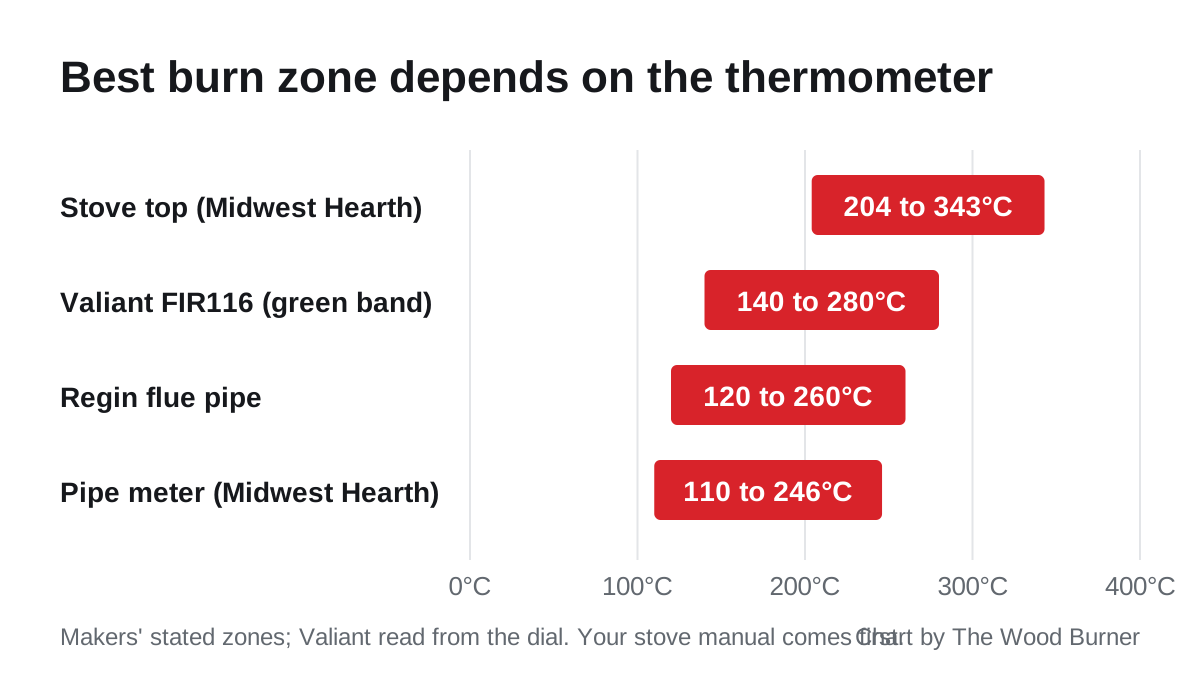
How to use a stove thermometer comes down to one rule most owners miss: the zones on the dial only mean something for the surface the thermometer was made for. The same fire, at the same moment, reads far hotter on the stove top than on the flue pipe. Midwest Hearth, which prints the zone numbers for each of its dials, puts the start of the clean-burning “best zone” at 400°F (about 204°C) for its stove top meter and 230°F (about 110°C) for its flue pipe meter. Read a pipe thermometer as if it were a stove top one, and you will think a good fire is smouldering.
This page explains what the three zones mean, how they differ by thermometer type, how to read the needle through a burn from lighting to reload, and the mistakes that make a thermometer lie. If you have not bought one yet, our best stove thermometers page covers which type suits your stove and flue.
The three zones on a stove thermometer
Most stove thermometers print three coloured bands. The names vary by brand, but the meaning is the same:
- Creosote or too cool. The fire is smouldering. Wood burning this cool gives off smoke, and that smoke condenses in the cooler flue as tar and soot. Glass blackens and the chimney fouls up. Midwest Hearth labels this band “CREOSOTE”.
- Best zone or optimum. The fire is burning cleanly and efficiently: clear glass, little or no visible smoke at the chimney.
- Too hot. You are burning wood faster than the room can use it, sending heat up the flue and putting the stove, the baffle, the flue and anything on the stove top under strain. Midwest Hearth’s instructions say a fire in this band “consumes more wood without additional room heat”.
Some dials, such as Valiant’s FIR116, print only the middle band in green and leave you to read above and below it yourself. Our Valiant stove thermometer review explains how to read that dial.
Why the numbers change with the thermometer type
| Thermometer and where it sits | Best zone as the maker states it | Too cool below | Too hot above |
|---|---|---|---|
| Midwest Hearth stove top meter, on the stove top | 400°F to 650°F (about 204°C to 343°C) | About 204°C | About 343°C |
| Midwest Hearth chimney pipe meter, single-wall pipe 12 inches (about 30cm) above the stove | 230°F to 475°F (about 110°C to 246°C) | About 110°C | About 246°C |
| Regin flue pipe thermometer, single-wall pipe | 120°C to 260°C | 120°C | 260°C |
| Valiant FIR116, stove top or flue collar | About 140°C to 280°C (green band, read from the dial) | About 140°C | About 280°C |
Two things explain the gap. The stove top is a thick steel or cast-iron plate directly over the firebox, so it runs hotter than a pipe that has already lost heat to the room. And a surface thermometer on a pipe reads the outside of the metal, not the gas flowing inside it, which is hotter again. A probe thermometer pushed through the wall of a twin-wall flue reads that gas directly, so its scale is different from both.
The practical rule: only read a dial’s zones on the surface it was made for. If you move a stove top thermometer onto the pipe, the needle will sit lower for the same fire and its zones no longer apply. Your stove manufacturer’s manual overrides all of these figures if it gives its own.
Where to put it so the reading means something
- Stove top meter: on the top plate, where the stove manufacturer recommends or where the stove gets hottest. Midwest Hearth also allows the front or side of the stove. If you run a heat-powered fan, put the thermometer beside it; see stove top vs flue pipe fans for why the fan’s position matters too.
- Single-wall pipe meter: a short way up the pipe, not on the collar. Midwest Hearth says 12 inches (about 30cm) above the stove top, and Regin recommends about 250mm. Too close and it reads stove heat; too high and it reads low.
- Probe on twin-wall flue: Midwest Hearth says 19 to 20 inches (about 48 to 51cm) above the stove, through a drilled hole. Get your installer to fit it so the flue’s seal and warranty are not compromised.
Magnetic thermometers will not hold on most stainless steel flue pipe. If yours keeps sliding off, that is why.
Reading the needle through a burn
Lighting (needle in the cool band). For the first 15 to 20 minutes after lighting, the needle will sit in the creosote zone. That is normal. Keep the air fully open, use dry kindling and small logs, and let it climb. Our top-down lighting method gets most stoves through this phase faster.
Climbing into the best zone. As the needle enters the middle band, start closing the air in steps. Give it five to ten minutes after each adjustment before you touch it again: dial thermometers lag behind the fire, and chasing the needle leads to overcorrecting.
Steady burn (needle mid-band). This is where you want to spend most of the evening. Flames should be lively but not roaring, the glass clear.
Dropping back. As the logs burn down to embers, the needle falls towards the bottom of the best zone. Reload before it drops into the cool band, then open the air for a few minutes until the new logs catch and the needle climbs again.
Heading for too hot. If the needle keeps climbing with the air already turned down, stop adding wood and close the air further. Do not throw water on the fire. If it races into the too-hot band and will not come down, or the flue pipe glows, treat it as an emergency.
Mistakes that make a thermometer lie
- Wet wood. A stove burning wood above 20% moisture spends its energy boiling water, so the needle sits low however much air you give it. The fix is drier wood, not more air. See what moisture firewood should be.
- Reading straight after a reload. Fresh logs knock the temperature down briefly, and a cold reload can show a misleading dip for several minutes.
- The wrong spot. The edge of a stove top can be much cooler than the centre. Move it until you find the spot that reacts to the fire.
- A sooty dial. Wipe the glass when the stove is cold.
- Trusting the numbers too much. Few cheap dials say how they were calibrated. Learn where the needle sits on a clean, steady burn on your stove, and treat that position as your target.
An infrared thermometer gun is a handy cross-check on a stove top, though shiny enamel surfaces can make it read low.
Frequently asked questions
How do you use a stove thermometer? Fit it on the surface it was made for, light the stove with the air open, and close the air in steps once the needle reaches the middle band. Keep it there for the burn, and reload before it falls into the cool band.
What should my stove thermometer read? It depends on the type. Midwest Hearth’s stove top meter shows its best zone from about 204°C to 343°C, its pipe meter from about 110°C to 246°C, and Regin’s pipe thermometer from 120°C to 260°C. Your stove manual’s figures come first.
Why does my stove thermometer show a different reading on the pipe? The flue pipe surface is cooler than the stove top for the same fire, so a pipe thermometer reads lower and uses lower zones. Do not move a thermometer between the two and keep the same zones.
Is it normal for the needle to be in the creosote zone when lighting? Yes, for the first 15 to 20 minutes. Keep the air open until it climbs. If it never leaves the cool band, the wood is probably too wet.
How long does a stove thermometer take to respond? Dial thermometers lag the fire. Wait five to ten minutes after changing the air before judging the result.
Can a stove thermometer tell me about a chimney fire? A needle that races past the too-hot band and will not fall with the air closed is a warning sign, as are roaring sounds in the flue. Close the air, get everyone out and call 999.
Sources
- Midwest Hearth: Magnetic Stove Top Meter, Magnetic Chimney Pipe Meter and Probe Thermometer for Double Wall Flue Pipe, operating and installation instructions (read October 2026)
- Valiant: Magnetic Thermometer product page
Want the seasoning calendar and our log-price watch in your inbox?
Join the Kindling List