Where to Place a Stove Fan: Back Corner, Not by the Door
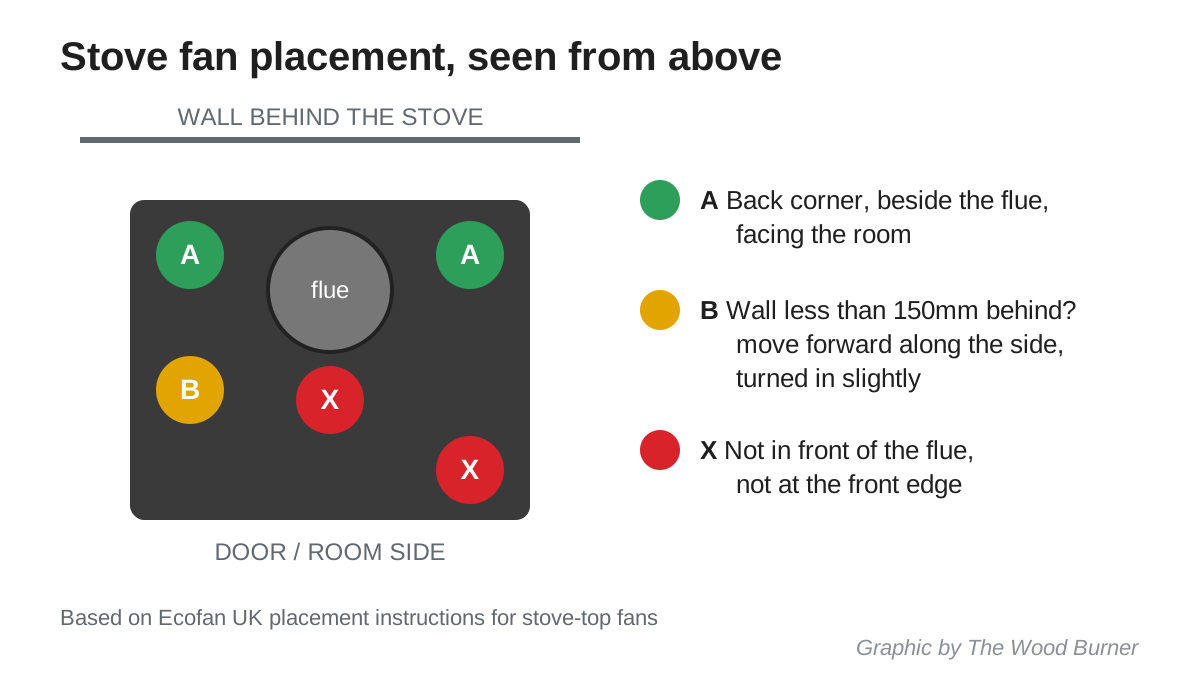
If you are wondering where to place a stove fan, the answer from the makers is the same for almost every stove: on a back corner of the stove top, to one side of the flue pipe, with the blades facing into the room. Not in front of the flue, and not at the front edge by the door. Getting this wrong is the most common reason a heat-powered fan spins slowly or not at all.
The reason is how the fan makes its power. A thermoelectric module in the base produces electricity from the difference in temperature between the hot base and the cooling fins above it. The fan pulls air in from behind, across those fins, and pushes it out across the stove into the room. Put the fan where the air behind it is cool and the base is hot, and it runs fast. Put it where hot air rises around the fins, and the temperature difference collapses.
The right spot, step by step
- Find a flat, clean patch of stove top at the back, to the left or right of the flue collar. The base needs full contact; a lip, a hob ring edge or a raised casting will cut the heat it picks up.
- Face the blades towards the room, so the fan draws from the wall side and blows forwards over the stove.
- Check the gap behind. Ecofan’s UK FAQ says that if there is less than 150mm (6 inches) between the back of the stove and the wall, move the fan forward along the side of the stove and turn it in slightly, so it can still draw cooler air.
- Light the stove and watch. Most fans start turning once the stove top passes their start temperature and speed up as it heats. Our stove thermometer guide explains how to read what your stove top is actually doing.
Where not to put it
- In front of the flue pipe. Hot air rising off the stove and around the pipe heats the fins, so the fan loses the temperature difference it runs on. Ecofan’s FAQ says plainly that the fan should not be used directly in front of the stove pipe.
- At the front edge of the stove. The fan has warm air from the room-facing side of the stove behind it rather than cooler air, and it is easy to knock off when loading logs.
- On a hotplate or the hottest point of a cooking stove. Hotter is not better beyond a point. Ecofan lists a maximum stove surface of 345°C for its wood-stove models (the 800 Original, 810 UltrAir and 812 AirMax) and says to move or remove the fan if the stove goes over that; its low-temperature 806 BelAir is rated only to 200°C. Overheating can damage the module and void the warranty.
Ecofan’s published working ranges show why the spot matters: the 812 AirMax runs from 85°C, the 810 UltrAir from 100°C and the 800 Original from 110°C. A spot that is too cool will not start the fan; a spot that is too hot will damage it.
Common stove layouts
| Your stove | Where the fan goes |
|---|---|
| Top flue, freestanding, room behind | Back corner either side of the flue |
| Top flue, stove close to the back wall | Forward along one side, turned in slightly |
| Rear flue (pipe leaves from the back) | The whole top is free; place the fan towards the back, centred or slightly to one side, facing the room |
| Inset stove or fireplace insert | Only if there is a flat, hot surface with cooler air behind; Ecofan does not recommend its fans for wood or gas inserts in general |
| Open fire | No stove-top fan will work: there is no hot surface for the base |
| Flue pipe with no usable top | A magnetic flue-pipe fan instead; see below |
On a stove in a recess, the brickwork behind can hold heat. If your fan runs slowly in a fireplace opening, try moving it forward along the side, as you would for a close wall, and compare.
Flue pipe fans go somewhere different
A fan designed to clamp or stick to the flue pipe, rather than sit on the stove top, follows its own rules: it fixes to single-wall steel pipe, at the height the maker specifies, and will not work on insulated twin-wall flue because the outer skin stays too cool. Our comparison of a flue pipe fan vs a stove top fan covers how to tell which your stove needs, starting with a magnet test.
Two fans on one stove
Two fans can help on a wide stove or an L-shaped room. Put one in each back corner, either side of the flue, each angled slightly towards the part of the room it should reach. Do not put them side by side on one corner: the second fan sits in the first one’s warm exhaust and runs slower. Our page on 4-blade vs 6-blade stove fans covers whether one bigger fan is the better buy.
If it still spins slowly
Before you blame the fan, check four things in order:
- Is the stove top hot enough? Below the fan’s start temperature it will not turn. A stove ticking over on low air in the evening may never get there.
- Is it in front of the flue? Move it back and to the side.
- Is the base flat on the stove? Wipe off ash and grit under the base.
- Is there a close wall or a recess behind? Move it forward along the side.
If the fan used to work and has slowed, check whether the blades turn freely by hand when cold. Our test of whether stove fans actually work explains how to measure what a fan is doing in your room with two cheap thermometers.
Frequently asked questions
Where is the best place to put a stove fan? On a back corner of the stove top, to one side of the flue pipe, facing into the room. That is where the base gets plenty of heat and the fan can draw cooler air from behind over its fins.
Should a stove fan face the room or the wall? The room. The fan draws air in from behind and blows it forward over the stove and out into the room.
Can I put a stove fan in front of the flue? No. Rising heat around the flue warms the fan’s cooling fins, which cuts the temperature difference it runs on, so it spins slower. Ecofan says not to use its fans directly in front of the stove pipe.
My stove is close to the wall. Where does the fan go? If there is less than 150mm behind the stove, Ecofan’s instructions say to move the fan forward along the side of the stove and turn it in slightly so it can still draw cooler air.
Can a stove fan get too hot? Yes. Ecofan’s wood-stove models are rated to a stove surface of 345°C and should be moved to a cooler spot or removed above that. Check your own fan’s manual, as limits vary by model and maker.
Will a stove fan work on an inset stove? Sometimes, if there is a flat, hot surface with cooler room air behind the fan. Ecofan does not recommend its fans for wood or gas stove inserts in general, and it says a fan will not work on an open fireplace at all.
Want the seasoning calendar and our log-price watch in your inbox?
Join the Kindling List