Vitcas Stove Glass Cleaner Review: 650ml, Gloves Required
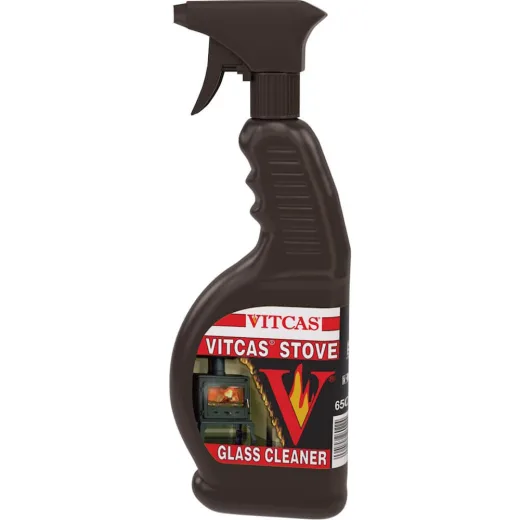
This Vitcas stove glass cleaner review comes down to one question: is the bigger bottle from a British refractory maker as good as the brands that cost more to fill a winter? On cold glass with ordinary brown tar, it does the job, and buyers on Amazon UK rate it highly. Two things are worth knowing before you buy. Its hazard panel on Amazon carries a DANGER warning for serious eye damage, which sits oddly beside Vitcas’s own website calling it “non-toxic”, so treat it like any other caustic cleaner and wear gloves and glasses. And on years-old, baked-on deposits, more buyers report needing a second round than with a foam.
What follows is drawn from Vitcas’s manufacturer page and its own shop listing, the Amazon UK product page and its safety panel, and UK buyer feedback, all read on 27 October 2026. We have not run a laboratory test, and we say where the sources disagree.
What it is
| Detail | From Vitcas and the Amazon UK listing |
|---|---|
| Format | Liquid from a trigger spray, ready to use |
| Bottle | 650ml (Vitcas calls it a “new larger” bottle) |
| Hazard shown on Amazon UK | DANGER: causes serious eye damage; causes skin irritation |
| Leave on for | “A few minutes” (Vitcas shop); about 10 minutes (Amazon listing) |
| Glass temperature | Cold |
| Also sold for | Oven doors, fireplace glass, BBQ grills |
| Made by | Vitcas, Broomhill Road, Bristol |
| Amazon UK rating at the time of writing | 4.6 out of 5 from over 1,000 ratings |
Vitcas is better known to stove fitters than to shoppers. It makes fire cement, stove rope, vermiculite board and heat-resistant paint, and the glass cleaner sits in the same range. Its heat-resistant spray paint is one of the picks in our heat-resistant stove paint round-up.
Does it shift tar?
On the brown, glossy film you get from a stove run low overnight, yes. Vitcas says it is made to remove “soot, grease, tar, and burnt-on residues” and its directions are simple: spray a small amount onto cold glass, leave it a few minutes to loosen the dirt, wipe with a damp cloth or kitchen roll, and repeat on stubborn stains.
Buyer feedback on Amazon UK follows a clear pattern. Most say the glass comes up gleaming and that it is good value. The mixed reports are about effort: some buyers say no scrubbing is needed, others say heavy deposits take a repeat application and more than a wipe. That is what you would expect from a liquid on vertical glass, which runs down before it has fully soaked in. A foam such as HG’s clings for longer.
The fix is the same trick that helps any liquid cleaner. Lift the door off if your stove allows it and lay it flat on an old towel, or spray, then press a sheet of damp kitchen roll over the glass so the liquid stays put while it works.
How long to leave it on
The two Vitcas listings disagree. The company’s own shop says to let it sit “for a few minutes”; the Amazon listing says to leave it for about 10 minutes before wiping. Start with a few minutes on light haze and go longer only on stubborn patches, checking that none has run onto the door frame or rope seal. If a patch is still brown after two rounds, the deposit is baked on, and a paste will do better than more liquid.
How to use it safely
- Let the stove go fully cold. On warm glass the cleaner dries before it works and leaves streaks.
- Put on gloves and eye protection. The hazard panel on Amazon UK lists serious eye damage. A splash from a trigger spray at eye height is exactly how that happens.
- Protect the stove. Keep the spray off the painted door frame, the rope seal and any stone hearth. Spray onto the glass from close range rather than misting the whole door.
- Spray, wait, wipe with a damp cloth or kitchen roll, rinsing the cloth often.
- Buff dry with a clean cloth.
If it gets in your eyes, rinse with water for several minutes and get medical advice. Keep it away from children and pets.
The “non-toxic” claim
Vitcas’s manufacturer page describes the cleaner as “Eco-Friendly & Non-Toxic, free from harsh chemicals”. The product safety panel on its Amazon UK listing says DANGER, causes serious eye damage, causes skin irritation. Those cannot both be the full picture. Most stove glass cleaners that genuinely dissolve tar do it with an alkali, and alkalis are hard on eyes and skin. We would go by the hazard label, not the marketing.
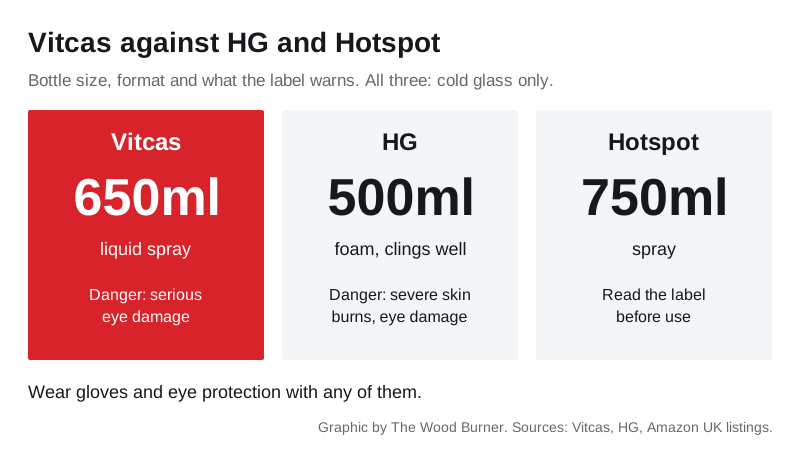
Vitcas against HG and Hotspot
| Vitcas | HG | Hotspot | |
|---|---|---|---|
| Bottle | 650ml | 500ml | 750ml |
| Format | Liquid spray | Foam | Spray |
| Clings to vertical glass | Less well | Well | Less well |
| Hazard on the label | Serious eye damage, skin irritation | Severe skin burns and eye damage | Check the label |
| Best for | Regular cleaning, value | Thick, brown tar | The biggest bottle |
If you burn every night and clean once or twice a week, Vitcas makes sense: a bigger bottle than HG, from a British maker, and buyers rate it well. If your glass has thick, baked-on tar that keeps sliding off, HG’s foam is the better tool; we cover it in our HG stove glass cleaner review. For the worst deposits, a paste beats both. All three are compared in our best stove glass cleaners round-up.
Where it falls short
- It does not fix the cause. Glass that blackens every night means wet wood or too little air. Burn logs below 20% moisture, as our guide to what moisture firewood should be explains, or switch to kiln-dried logs.
- Runs on vertical glass. It works best on a door laid flat, or held in place with damp kitchen roll.
- Mixed messages on safety. The label is what counts. Gloves and glasses, every time.
Who should buy it
Buy it if you clean regularly, want a bigger bottle than the best-known brands, and like the idea of buying from the firm that makes the fire cement and stove rope in your stove shop. Skip it for one-off rescue jobs on years of baked-on tar, where a foam or paste will save you rounds of spraying.
Vitcas Stove Glass Cleaner is sold on Amazon UK and direct from Vitcas. Check price on Amazon UK.
For the manufacturer’s description and directions, see Vitcas’s product page.
Frequently asked questions
Is Vitcas stove glass cleaner any good? On cold glass with ordinary brown tar, yes. It is rated 4.6 out of 5 by over 1,000 buyers on Amazon UK. Heavy, baked-on deposits may need a second application, and a foam clings better on vertical glass.
Is Vitcas stove glass cleaner safe? Treat it as hazardous. Its Amazon UK safety panel carries a DANGER warning for serious eye damage and skin irritation, so wear gloves and eye protection, use it on cold glass only and keep it away from children.
How long do you leave Vitcas stove glass cleaner on? Vitcas’s own shop says a few minutes; the Amazon listing says about 10 minutes. Start with a few minutes and leave it longer only on stubborn patches.
Can I use Vitcas glass cleaner on hot stove glass? No. Spray it onto cold glass only. On warm glass it dries too fast to work and can streak.
Is Vitcas better than HG stove glass cleaner? Vitcas gives you a bigger bottle, 650ml against 500ml, and suits regular cleaning. HG’s foam clings to vertical glass and is better on thick tar. Neither is gentle, and both labels say to protect your eyes.
Why does my stove glass go black so quickly? Usually damp logs or a fire starved of air. Burn wood under 20% moisture and run the stove hot enough, and the glass stays clearer for longer.
Want the seasoning calendar and our log-price watch in your inbox?
Join the Kindling List