Dirtbusters Stove Glass Cleaner Review: A Non-Caustic Paste
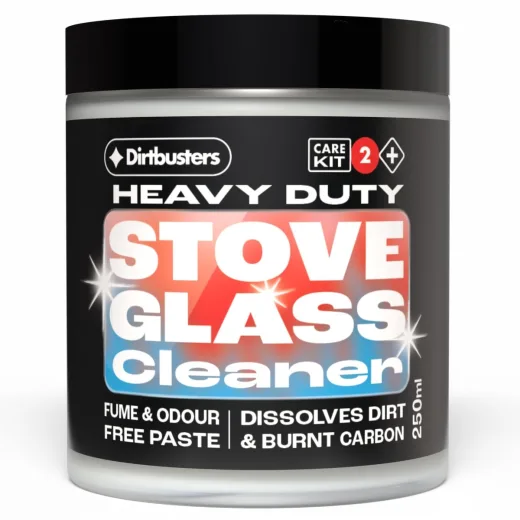
This Dirtbusters stove glass cleaner review is about a different kind of product from the sprays and foams most people reach for. Dirtbusters’ 250g tub is a cream paste with a fine polishing action, and it works more like a gentle scouring cream than a chemical stripper. That has two consequences. It is the better choice for thick, burnt-on soot that sprays slide straight off, because it stays where you put it. And its hazard label is milder than either of its best-known rivals: an irritant warning, where HG’s foam is labelled as causing severe skin burns. The trade-off is effort. Buyers who rate it highly still talk about elbow grease.
What follows is drawn from the Amazon UK product page, its ingredients and safety panel, and UK buyer feedback, all read on 28 October 2026. We have not run a laboratory test, and we say where the listing contradicts itself.
What it is
| Detail | From the Amazon UK listing |
|---|---|
| Format | Cream paste in a tub |
| Size | 250g (a 500g tub is also sold) |
| Scent | Citrus |
| Hazard statements | H315 causes skin irritation; H317 may cause an allergic skin reaction; H319 causes serious eye irritation |
| Contains | Under 5% non-ionic and anionic surfactants, methylparaben, bronopol, perfume, limonene |
| Leave on for | 5 minutes (product description); 5 to 10 minutes (bullet points) |
| Made in | The UK |
| Amazon UK rating at the time of writing | 4.3 out of 5 from 1,758 ratings, 65% of them five-star |
Dirtbusters is a UK cleaning brand that also makes an oven cleaning paste, a stove cleaning spray and a black stove polish. Dirtbusters says the glass paste is used by professional stove installers and cleaners.
Does it shift burnt-on tar?
This is where a paste earns its place. A spray or foam on a vertical door runs down before it has finished working, which is why heavy, baked-on deposits often need two or three rounds. The paste clings. You spread a thin layer, leave it, and it stays on the glass rather than dripping onto the rope seal or the hearth.
Buyer feedback on Amazon UK is consistent on three points. Most say it gets glass that other products could not shift back to clear, and that a tub lasts for years because only a small amount is needed. A minority say it is expensive for the size. And many, including happy buyers, say it takes some rubbing. That fits the formula: the declared ingredients are surfactants, preservatives and fragrance in a fine abrasive cream, with no strong alkali of the kind that does the dissolving in most sprays and foams. The paste loosens the tar and the polishing action takes it off, which means your arm does part of the work.
Around one in ten ratings are one or two stars. The criticisms that come up most are the effort on very heavy deposits and the price for the size.
How to use it
- Let the stove go completely cold. On warm glass the paste dries before it works.
- Put on gloves. The label warns of skin irritation and a possible allergic reaction, and you will be rubbing it in by hand.
- Apply a thin layer with a damp cloth or a non-scratch pad, working in small circles across the glass.
- Leave it 5 to 10 minutes. The listing gives both figures. Five is enough for a light haze; give heavy patches the full ten.
- Wipe off with a damp cloth, rinsing it often, then buff dry with kitchen roll or a dry cloth.
Use a soft cloth or a non-scratch pad, never a metal scourer: the paste is abrasive by design, and you do not want to add to it. If your stove glass has a special coating, check the stove manual first and try a small patch in a corner.
The safety label, read properly
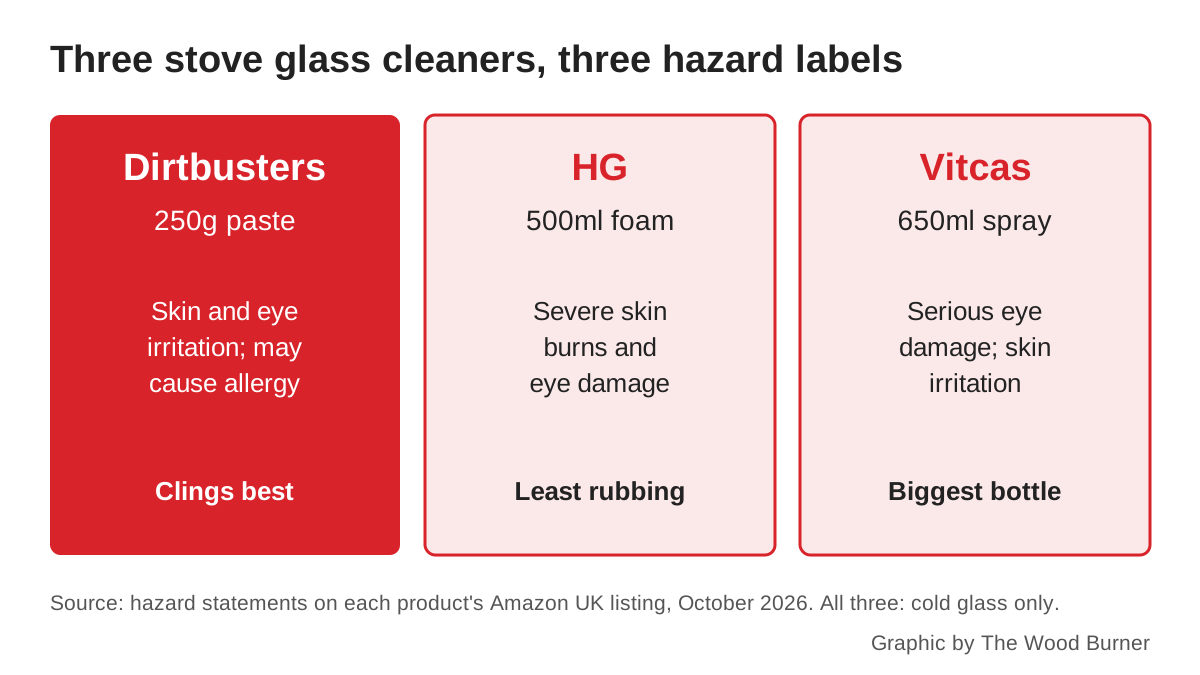
The Amazon listing calls the paste “non-caustic”, “fume free” and “non toxic”, while its safety panel lists three hazard statements. Both can be true in a limited way. The paste is not corrosive: its warnings are for irritation (H315, H319) and skin sensitisation (H317), which is a lower category than the “causes severe skin burns and eye damage” on HG’s foam or the “causes serious eye damage” on Vitcas. But “non toxic” is marketing, not a classification. It contains bronopol and methylparaben as preservatives and limonene as fragrance, and limonene is a well-known skin sensitiser. If you have reacted to citrus-scented cleaners before, wear gloves without fail.
“Fume free” is the useful claim. There is no solvent to evaporate, so you can light the stove as soon as the glass is wiped and dry.
Dirtbusters against HG and Vitcas
| Dirtbusters | HG | Vitcas | |
|---|---|---|---|
| Format | Paste | Foam | Liquid spray |
| Size | 250g | 500ml | 650ml |
| Clings to vertical glass | Best | Well | Least well |
| Hazard on the label | Skin and eye irritation, may cause allergy | Severe skin burns and eye damage | Serious eye damage, skin irritation |
| Effort needed | Most rubbing | Least | Moderate, with repeats |
| Best for | Thick, baked-on soot | Regular cleaning of brown tar | Regular cleaning, value |
If your glass is cleaned once or twice a week and has an ordinary brown film, a spray or foam is quicker. Our HG stove glass cleaner review and Vitcas stove glass cleaner review cover those. Choose Dirtbusters when the glass has gone black and crusty, when you are rescuing a second-hand stove, or when you would rather use something with a milder hazard label and accept a bit more work. All three are compared in our best stove glass cleaners round-up.
Where it falls short
- It takes effort. On the worst deposits you will be rubbing, not just wiping.
- The listing contradicts itself on dwell time and overstates the safety position. Go by the hazard panel.
- It does not fix the cause. Glass that blackens every night means damp wood or too little air. Burn logs under 20% moisture, as our guide to what moisture firewood should be explains, and run the stove hot enough to keep the airwash working.
Who should buy it
Buy it if your stove glass has thick, baked-on soot that sprays will not move, if you want one tub that lasts several seasons, or if you would rather avoid a corrosive cleaner in a house with children. Skip it if you want a quick weekly wipe with no scrubbing; a foam will be faster.
Dirtbusters Stove Glass Cleaner Paste is sold on Amazon UK. Check price on Amazon UK.
For why glass blackens in the first place, see the Stove Industry Association, the trade body for UK stove makers, and the Ready to Burn scheme for certified dry logs.
Frequently asked questions
Is Dirtbusters stove glass cleaner any good? On thick, burnt-on soot it is one of the most effective products because the paste clings to the glass. It is rated 4.3 out of 5 by 1,758 buyers on Amazon UK. Expect to rub on heavy deposits.
How long do you leave Dirtbusters paste on stove glass? The listing says 5 minutes in one place and 5 to 10 minutes in another. Use five for light haze and up to ten for heavy, baked-on soot, on cold glass.
Is Dirtbusters stove glass cleaner safe? It is not corrosive, but its label warns that it causes skin and serious eye irritation and may cause an allergic skin reaction. Wear gloves, avoid your eyes and keep the tub away from children.
Will Dirtbusters paste scratch stove glass? It is sold as non-scratch, with a fine polishing action. Use a soft cloth or non-scratch pad, never a metal scourer, and test a corner first if your glass has a coating.
Can I light the stove straight after using it? Yes. The paste is fume free, so once the glass is wiped off and dry you can light the fire.
Is Dirtbusters paste better than HG stove glass cleaner? For thick, baked-on soot, yes, because it clings and does not run. For regular cleaning of a brown film, HG’s foam is quicker and needs less rubbing, but its label carries a stronger corrosive warning.
Want the seasoning calendar and our log-price watch in your inbox?
Join the Kindling List