How to Store Firelighters Safely: Not in That Tin
The honest answer to how to store firelighters safely is on the box, and almost nobody reads it. The manufacturer’s own safety data sheet for a standard kerosene firelighter says: keep only in the original container, in a cool, well ventilated place, container tightly closed and dry, away from heat and direct sunlight, out of reach of children. The decorative cast-iron firelighter tin sitting on the hearth next to a lit stove breaks four of those five instructions at once.
This page covers what the classification actually means, where firelighters should live, and how to store kindling without turning the alcove beside your stove into a fuel store.
What a firelighter is classified as
A conventional white block firelighter is more than 75% kerosene, bound into a solid. Under CLP, the finished product carries a single hazard classification: Flam. Sol. 2, H228, flammable solid, with the signal word Warning.
The label precautions are short and specific:
- P102 Keep out of reach of children
- P101 If medical advice is needed, have product container or label at hand
- P210 Keep away from heat, hot surfaces, sparks, open flames and other ignition sources. No smoking
Two things follow from this that get misreported constantly.
It is not a liquid fuel and it does not evaporate into a fume hazard. The kerosene is bound into the block, and the safety data sheet notes that constituents are bonded by the polymerisation process, so ordinary handling exposure is unlikely. The product is stable under normal conditions.
It is still a flammable solid that ignites readily. That is the entire point of it. Anything that ignites readily deserves to be stored away from the thing you are about to light.
Natural firelighters are a different product with a different risk profile. Wood wool dipped in wax, the type used by Flamers, Zip natural cubes and Lekto, contains no kerosene. Their storage problems are wax softening in warmth and wood wool absorbing damp, not flammable vapour. They still burn very easily, so most of what follows applies anyway.
The five storage rules, and where they point
Taken straight from the manufacturer’s safety data sheet:
- Keep only in the original container. The original box is designed to hold the blocks separated and sealed. Decanting into an open tin is how you end up with crumbled firelighter dust and no label.
- Cool, well ventilated place. Ambient temperature. Not a warm airing cupboard, not a cupboard sharing a wall with the stove recess.
- Container tightly closed and dry. Damp firelighters light badly and natural ones light barely at all.
- Away from heat and direct sunlight. A windowsill in a south-facing room counts as a heat source in July.
- Out of reach of children. They look like sweets, they smell strong, and the label carries P102 for a reason.
Put those together and the answer is a closed original box in a cool, dry cupboard, at height, in a different part of the room from the appliance. Not the hearth. Not the log basket. Not the top of the stove alcove where the warmth is.
The firelighter tin problem
Lots of people buy an attractive metal firelighter tin and set it beside the stove. It fails the guidance three ways: the blocks are out of their original container, the position is the warmest spot in the room, and an open tin at floor level is exactly at toddler height.
If you want a tin, use it as an outer container for the sealed original box, and keep it somewhere cool. A tin that holds only a night’s worth, refilled each evening from a box stored elsewhere, is a reasonable compromise. A tin that holds the whole pack next to a lit fire is not.
Storing kindling
Greater Manchester Fire and Rescue Service puts the rule plainly: store fuel such as logs, kindling and briquettes away from heat and ignition sources, and if it is stored outdoors, store it away from your main property.
For kindling specifically:
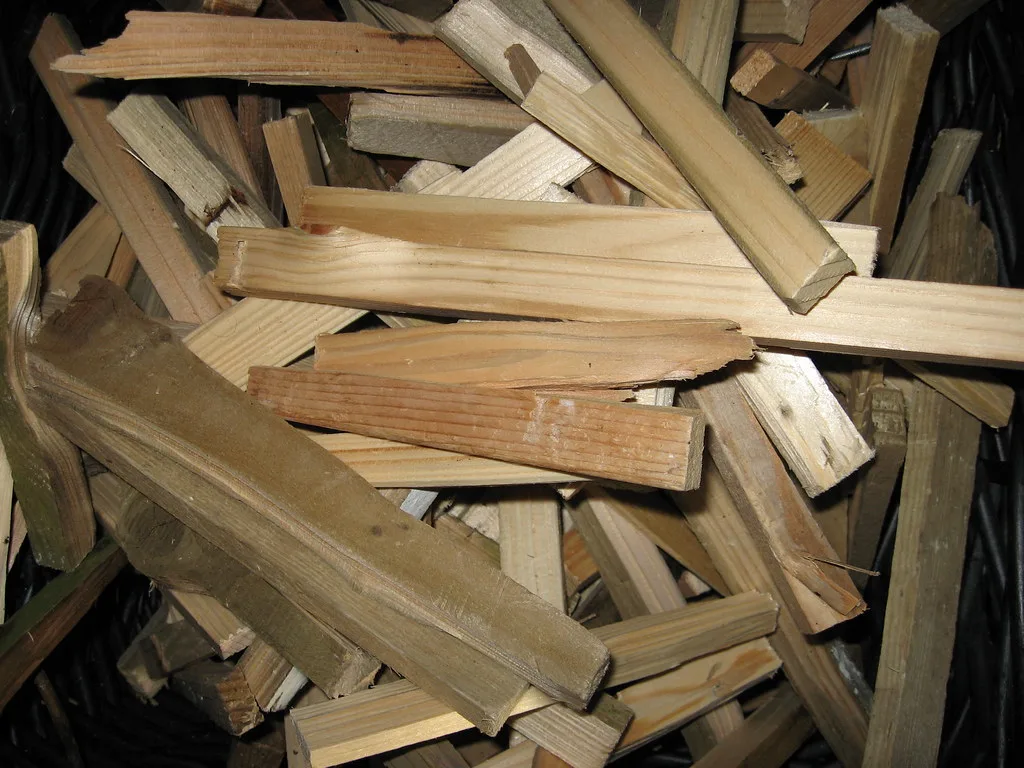
Keep it genuinely dry. Kindling that has taken up moisture does not catch, which is the commonest reason a top-down fire fails. Store it in a ventilated container rather than a sealed plastic box, because a sealed box traps whatever moisture came in with it. A slatted crate, a wicker basket or an open-topped bin all work.
Bring in a few days’ worth, no more. Kindling stored indoors in bulk is a fire load sitting in your living room, and wood brought straight in from outside carries insects and damp. Keep the bulk of it in the log store and bring in what you need.
Keep it clear of the appliance. Every stove has a minimum clearance to combustibles set by its manufacturer, typically several hundred millimetres, and flue pipes often need around three times the pipe diameter. Kindling and logs are combustibles. A basket tucked against the side of a hot stove is inside that clearance, whatever the installer left as a gap.
Off the floor, if the floor is cold. A stone or tiled floor will pull moisture into the bottom of a basket. A crate on feet, or a shelf, solves it. The same principle as keeping firewood dry applies at small scale.
If you make your own, our guide to making kindling covers splitting and drying it properly in the first place, and the best kindling page covers what to buy if you do not.
The rest of the hearth
Storage is only half of it. The fire service advice that goes with it:
- Do not use petrol or paraffin to light your fire. Ever. Solid firelighters exist precisely so that nobody needs to. Our guide to how many firelighters a wood burner needs covers doing it properly with the right quantity rather than an accelerant.
- Use a fireguard, particularly with children or pets in the house.
- Let ash cool completely before disposing of it. Ash stays hot far longer than it looks, and a metal ash can with a lid is the sensible container.
- Sweep the chimney to the right schedule. For wood, that is up to four times a year.
- Fit a carbon monoxide alarm. Separate risk, same room, no excuse.
A workable set-up
If you want the short version, this is what a sensible hearth looks like:
- Firelighters in their sealed original box, in a closed cupboard, at height, away from the stove.
- One evening’s kindling in an open basket, positioned outside the stove’s clearance to combustibles.
- The bulk of the kindling and logs outdoors in a ventilated store.
- A lidded metal ash can, a fireguard and a CO alarm.
- Long matches or a long-reach lighter kept with the firelighters, not loose on the hearth.
For what to buy in the first place, our firelighters and kindling buying guide compares the types, and the best natural firelighters page covers the wood-wool alternatives to kerosene blocks.
Frequently asked questions
Can I keep firelighters next to the wood burner? No. The label precaution is to keep them away from heat, hot surfaces, sparks, open flames and other ignition sources, and a lit stove is all four. Keep the box in a cool cupboard elsewhere in the room and carry across only what you are about to use.
Do firelighters go off or expire? The safety data sheet describes a conventional kerosene firelighter as stable under normal conditions, so an unopened box kept cool and dry lasts a long time. What degrades them in practice is damp, which stops them lighting cleanly, and heat, which softens wax-based natural firelighters. Natural wood-wool types are more sensitive to both.
Are firelighters dangerous if a child eats one? Treat it as a medical matter rather than panicking about the label. The finished block is classified as a flammable solid rather than a poison, and the manufacturer’s first aid advice for ingestion is to rinse the mouth, give plenty of water and get medical advice if the person feels unwell. Keep the packaging with you, since the label asks you to have it at hand if medical advice is needed. The simplest answer is to store the box out of reach in the first place.
Can I store firelighters in the shed or garage? Yes, if it is cool, dry and ventilated, and they stay in the original sealed box. Sheds can get very hot in summer and very damp in winter, so check both. A garage shelf out of direct sun is usually better than a shed roof space.
Is it safe to store kindling inside next to the fire? A basket for the evening is normal practice, provided it sits outside the clearance to combustibles your stove manufacturer specifies. Storing a week’s worth against the stove is not, because you have put a large fire load inside the zone the installer deliberately kept clear.
What should I never use to light a wood burner? Petrol, paraffin, meths, white spirit or any other liquid accelerant. Fire services are explicit about this and the risk is a flashback into the room. Damp wood and treated or painted timber are also out, for different reasons. Firelighters plus dry kindling plus dry logs is the whole method.
Does it matter if firelighters crumble in the box? Not for safety, but it makes them harder to place and easier to lose down the back of the hearth, where they are a fire load nobody remembers. Keeping them in the original packaging rather than loose in a tin is the main defence against this.
Sources
- Safety data sheet, Firelighter (Kerosene), Tiger Tim Products Ltd
- Greater Manchester Fire and Rescue Service, open fires, log burners and chimneys
Always follow the instructions on your own product’s packaging and your stove manufacturer’s clearance distances, which take precedence over any general guidance.
Want the seasoning calendar and our log-price watch in your inbox?
Join the Kindling List